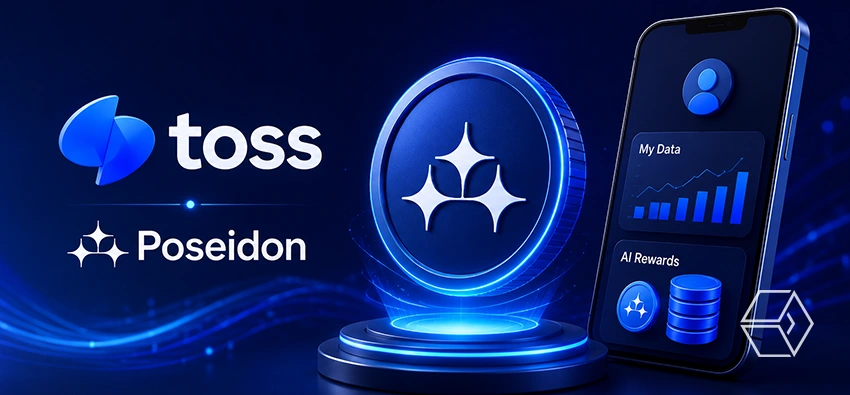
Toss, a South Korean fintech app, has launched a user-paid AI data operation in partnership with blockchain AI infrastructure firm Poseidon. The deal, which was signed in late June, will allow Toss’s 30 million users to contribute real-world data, like voice, photos, and video, via a new mini-app called Numo, and receive cash rewards in return.
What’s Happening
Toss has signed a memorandum of understanding (MoU) with Poseidon to build a user-participation AI data business inside the Toss app. Poseidon supplies blockchain tools that track data ownership and contributor rights, while Toss handles the user-facing finance and rewards system. The Numo mini-app will post simple tasks users can pick from, such as recording a voice clip or snapping a photo. When the submitted data passes quality checks, contributors earn Toss Points that can be converted to cash.
Why it Matters
This is one of the first big mobile finance apps to combine a mass user base, blockchain-based data tracking, and paid data contribution in one product. For users, it turns everyday actions (speaking, photographing, filming) into income. For AI builders, it creates a steady supply of labeled, real-world Korean-language data, a scarce but valuable resource for training smart systems that understand and act in the real world.
How Contributors Get Paid
Numo lists tasks with clear rewards. Users choose a task, submit the requested data, and can see how much their contribution is valued. After verification, Toss pays contributors in Toss Points, which users can convert to cash inside the Toss ecosystem.
Poseidon’s infrastructure records contributor rights and the value of each data piece on the blockchain, aiming to make the process transparent and fair.
Poseidon, Data Foundation, and the People Behind It
Poseidon is part of the Data Foundation ecosystem, a blockchain project focused on treating data as intellectual property and protecting contributor rights. The Data Foundation, co-founded by Lee Seung-yoon, Toss’s CEO, manages the IP infrastructure that records and secures training data.
Poseidon grabbed headlines in 2025 when Andreessen Horowitz invested $15 million, praising Poseidon’s approach to fairly rewarding data providers and solving AI training bottlenecks.
A Focus on Korean-Language, Real-World Data
Toss and Poseidon will prioritize Korean-language data in the first phase, starting with voice, images, and video. The partnership plans to expand into more complex categories demanded by advanced AI, including robotics and physical AI, systems that must interpret and act in real environments. Securing high-quality, local-language datasets is crucial for building accurate AI services aimed at Korean users.
What This Means for the AI Data Market
With this partnership, a growing trend can be observed where mainstream apps are tapping user bases to bring in valuable data. By using blockchain tools, tools can be used to track ownership and make sure that contributors are rewarded. If large platforms successfully integrate fair-pay mechanisms, it could shift how AI models are fed and who benefits from the data economy.
Potential Questions and Risks
- Privacy and consent: Toss will need strong, transparent consent flows and clear explanations of how data is used. Users should know what they are giving and how it is monetized.
- Data quality and verification: Rewards depend on verification; clear standards and dispute mechanisms will be important to maintain trust.
- Regulatory scrutiny: As data monetization grows, regulators may step in over privacy, consumer protection or token mechanics if virtual assets are involved.
- Fair compensation: Scaling rewards to be meaningful while keeping costs sustainable will be a tricky balance.
Final Thoughts
Toss’s move to integrate Numo and partner with Poseidon brings a huge user base into the AI data economy with blockchain-tracked contributor rights and cashable rewards. If executed well, it can create high-quality Korean datasets for next-gen AI and offer a new income stream for everyday users.
This rollout is considered to be something that will be worth watching for privacy, safeguards, reward fairness, and how quickly task categories expand into areas like robotics and physical AI.