
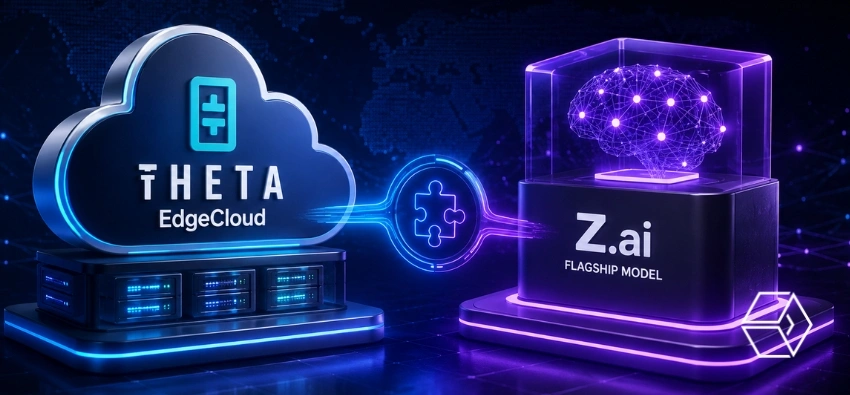
Theta Network has finalized the integration of GLM-5.2, the flagship artificial intelligence model developed by Z.ai, into its decentralized computing platform, Theta EdgeCloud. The integration gives developers access to a 744-billion-parameter Mixture-of-Experts model under an MIT licence.
By hosting the large language model across a distributed network of independent edge nodes rather than centralized corporate data centres, the deployment aims to reduce the operational costs associated with high-tier artificial intelligence processing.
It reflects a wider pattern of open-weight models being paired with decentralised hardware networks. The model is currently operational on the EdgeCloud network, allowing enterprise clients and independent engineers to deploy specialized applications. Theta says the addition expands what its distributed GPU network can be used for.
What GLM-5.2 Brings to Theta EdgeCloud
The GLM-5.2 model, designed by Z.ai, functions via a Mixture-of-Experts framework that maintains 40 billion active parameters during any individual forward pass, balancing algorithmic efficiency with a high total parameter capacity.
Notably, the architecture includes a 1-million-token context window, allowing the software to analyze extensive datasets, complex software repositories, or lengthy documents within a single operational prompt.
According to standard benchmarks, the open-weight model is optimized for high-tier analytical tasks, including multi-step agentic workflows, complex front-end code generation, and advanced scientific reasoning.
We are incredibly excited to share that GLM-5.2 is now available on Theta EdgeCloud.@Zai_org‘s flagship model, released under a pure MIT licence, with a 1M token context built for hours-long, project-scale work. On demanding long-horizon coding benchmarks it lands within a… pic.twitter.com/MgUFRyiOMt
— Theta Network (@Theta_Network) AUGUST 5, 2026
Because the model is distributed under the permissive MIT license, companies and independent developers can modify, self-host, and scale the model without licensing fees. The software framework supports multilingual processing and is designed to interface directly with existing enterprise software pipelines.
Furthermore, the mixture-of-experts design ensures that only relevant neural sub-networks are activated for specific prompts, optimizing memory bandwidth and computational efficiency. This structural design allows the system to manage complex conditional logic tasks without requiring the full energy expenditure typical of monolithic model architectures.
Developers can access the model weight repositories directly through public code hosting sites or via pre-configured application programming interfaces hosted natively within the EdgeCloud dashboard environment.
How Theta’s Distributed Network Cuts Costs
Deploying an artificial intelligence model of this magnitude typically requires substantial Video RAM and specialized, high-end Graphics Processing Unit clusters, which are traditionally managed by centralized cloud providers.
Theta EdgeCloud mitigates these hardware barriers by distributing the computational workload across its global network of independent, decentralized nodes. Theta claims its peer-to-peer infrastructure cuts costs by 50% to 70% against centralised cloud providers. That figure is the company’s own and has not been independently verified.
The deployment is designed to provide a highly available, cost-effective alternative for enterprises seeking to train or run inference on large models without relying on a single corporate ecosystem.
The model pools underused consumer and enterprise hardware to run workloads that would otherwise sit in centralised datacentres. The long-term availability and stability of the service depend on sustained node participation and competitive pricing frameworks relative to traditional server farms.
You may also like to read – POAP Shuts Down After Five Years as Business Model Falls Short