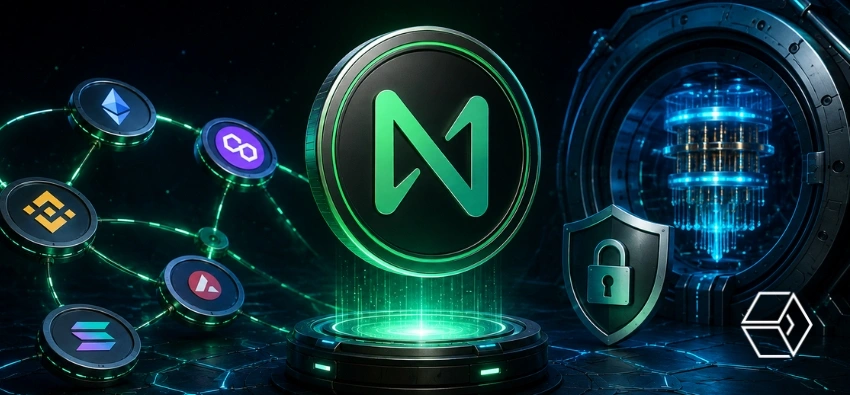
NEAR Protocol is rolling out a new plan to safeguard assets across different blockchains, looking ahead to a post-quantum cryptography era. NEAR co-founder Illia Polosukhin recently explained how the protocol could tie together Chain Signatures and NEAR Intents, making it possible for users to hold assets from networks like Bitcoin, Ethereum, Solana, and various stablecoins, all with just a NEAR account.
The stated aim is to simplify the eventual shift to stronger cryptography. Instead of making users move their assets themselves anytime a blockchain changes its crypto approach, NEAR says that protocol upgrades will take care of that process. The idea is to streamline asset management across chains and get ahead of cryptography upgrades.
Managing Assets Across Multiple Blockchains
NEAR’s solution focuses on letting people manage assets that come from other blockchains. With Chain Signatures and NEAR Intents, users only need one NEAR account to hold assets from multiple networks. Polosukhin specifically mentioned assets like Bitcoin, Ethereum, Solana, stablecoins, and more. That means users would not need to worry about managing each type of asset separately when they use NEAR’s setup.
This model is key because it keeps assets linked to their original blockchains, but still lets users handle everything inside the NEAR system. Chain Signatures make it possible to plug in assets from other chains. NEAR Intents adds a control layer for managing those assets. The proposal goes beyond supporting multiple cryptocurrencies. It aims at a single management layer for assets living on separate blockchains.
Preparing multi-chain assets for a post-quantum future. Illia Polosukhin explains how NEAR gets there.
With Chain Signatures, Bitcoin, Ethereum, Solana, and stablecoins held via NEAR Intents can be secured with post-quantum cryptography and kept confidential, with protocol… pic.twitter.com/JcBJJ07VzT
— NEAR Protocol (@NEARProtocol) AUGUST 10, 2026
Preparing for Post-Quantum Cryptography
The second focus of NEAR’s proposal is the growing impact of quantum computing on existing cryptographic protections. NEAR says people can lock down their NEAR account using post-quantum cryptography and handle assets from other blockchains, all in one spot.
Polosukhin’s central claim is that users would not repeatedly handle security upgrades themselves. He pointed out that you could store your seed phrase once and then leave it untouched. With this approach, users would not need to move their assets every time a network toughens its cryptography.
Instead, NEAR says the protocol can handle the necessary transitions as upgrades roll out. That way, changes to protect assets happen automatically, so users do not need to take action on every blockchain they own assets on. This is especially important for assets managed through Chain Signatures and NEAR Intents. The protocol would handle security transitions as standards evolve across every chain represented in the account.
How NEAR Pairs Confidentiality With Quantum Resistance
NEAR also brings confidentiality into the equation, linking it directly to post-quantum security. Polosukhin framed this as a key advantage, with cross-chain holdings kept in a confidential wallet that stays secure as cryptography changes.
So, the approach depends on two main pieces working together: confidentiality, to keep asset activity private, and quantum-resistant security, to guard against future risks. NEAR’s pitch is that users do not have to choose between easily handling assets on different blockchains and preparing for a quantum-ready future. Both are possible with a single account and protocol.
NEAR wants security upgrades to be seamless. Instead of making users track changes across networks and manually move assets during every security shift, NEAR aims for protocol-level upgrades to handle it all for users with assets on NEAR. The intended result is cross-chain asset management from a single account, with the protocol absorbing the cryptographic transitions.