
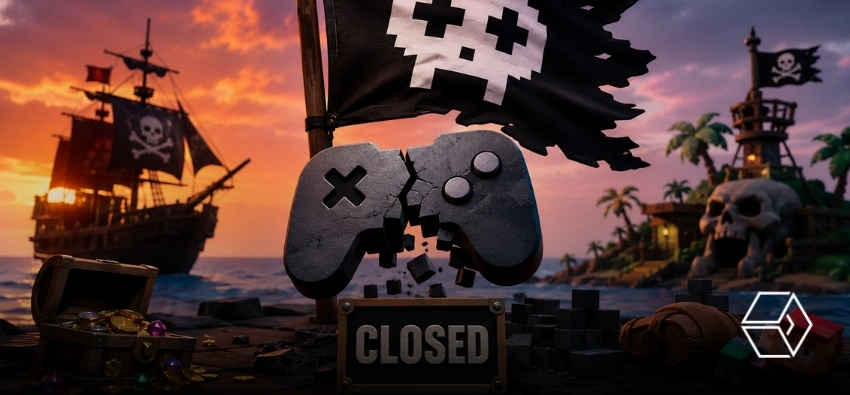
Proof of Play is closing, saying it could not build a product and sustainable business that proved out its Web3 gaming thesis at scale. The studio announced the decision on August 4. The studio set out to build fully onchain games with permanence and community ownership.
After several years, it could not turn that into a business. As it ceases its operations, Proof of Play has released much of its code across four public repositories. This will help developers to push the technology created by the company on Pirate Nation and a comprehensive blockchain gaming infrastructure.
Why Proof of Play Is Shutting Down
Proof of Play says that the decision is a subsequent outcome of its inability to ensure that blockchain gaming could run and sustain a business at scale. The company was founded in 2022 by Amitt Mahajan, Craig Woida, and Mark Skaggs.
It raised $33 million in a seed round organized by Andreessen Horowitz and Greenoaks. Its main product, Pirate Nation, was a fully onchain role-playing game built around blockchain ownership and the $PIRATE token, which launched in June 2024.
The game faced challenges sustaining enough users to meet its operating costs. Pirate Nation announced in August 2025 it would cease operations, with the game going offline on September 18. Its two Arbitrum Layer-3 chains, Apex and Boss, were decommissioned shortly afterward. At its peak, Pirate Nation recorded more than 100,000 daily active unique wallets.
That figure had fallen to around 10,000 by the time it closed. Proof of Play said sustaining the game and its two chains cost approximately $150,000 per month, making ongoing operation difficult to work on. The company later shifted towards the proof of play arcade, which contained smaller games with blockchain infrastructure operating in the backdrop. However, the strategy was not sufficient to sustain the studio either.
Proof of Play will separate its future from Pirate Nation Foundation. The foundation is a sole organization and will continue supporting the $PIRATE token. Its website will also remain functional. However, Proof of Play points will not be redeemable. The prior Pirate Nation shutdown included mechanisms for players to withdraw tokens from retired chains and convert in-game assets into plunder certificates.
Founder Pirate NFTs received a final $PIRATE distribution before becoming community identity assets with no further token rewards. The $PIRATE token has declined sharply since launch. It currently trades around $0.001277, with market capitalization below $1 million. Its all-time high was approximately $0.4757.
Shiba Story Go, a mobile title built on Proof of Play’s infrastructure, has been acquired by an undisclosed third party and will continue independently. The studio did not name the buyer or disclose terms.
What Proof of Play Is Open-Sourcing
Rather than entirely shutting down its operations, Proof of Play released large portions of its code for developers and researchers. The Pirate Nation Unity client and smart contracts have been released under an MIT licence, while the Founder Pirate assets and Pirate Nation artwork, IP, and logos carry a CC0 licence for unrestricted reuse.
Proof of Play has also released its agent workflow tool, giving developers access to technology built for its own products. The releases are archival rather than ready to run. Proof of Play stripped out commercial Unity assets, private SDKs, and credentials, and the original backend is unavailable, so anyone rebuilding the game would need to replace those components and supply their own infrastructure.
Proof of Play will be ceasing operations.
When we started out, we believed games using blockchain tech had the potential to usher in a new, decentralized internet. Ultimately, we couldn’t build a product and sustainable business that proved out this thesis at scale.
We are…
— Proof of Play (@ProofOfPlay) AUGUST 4, 2026
The closure also unveils one of the key challenges around blockchain gaming. The problem is that technical decentralization does not automatically create a sustainable game business. Pirate Nation indicated that it was feasible to build a game around on-chain assets and blockchain, but sustaining that infrastructure generates high costs while the player base plunges.
Proof of Play had already turned against the play-to-earn model that defined early crypto gaming. Mahajan said in 2025 that the company was done giving tokens away, calling play-to-earn “fundamentally broken.”
Proof of Play has not disclosed a final closure date, how many employees are affected, or its remaining financial position. What survives is the code and IP it has released.
Read More: Top 6 Crypto Conferences Happening in August 2026