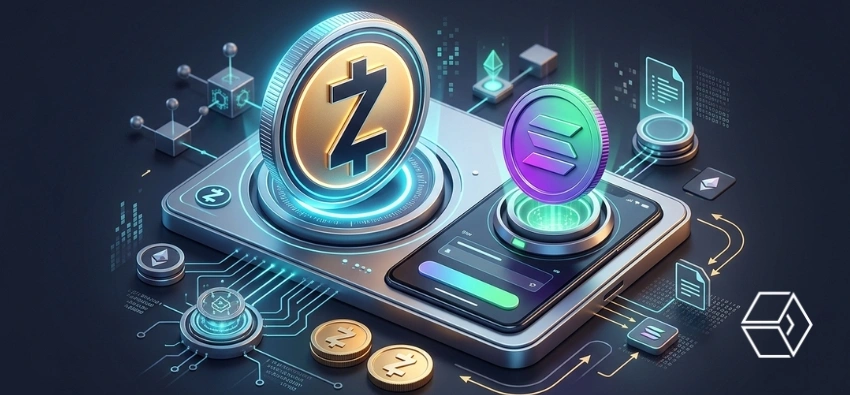
A newly launched launchpad connected to Zcash’s stamp project is now live, letting users create Solana-based coins while correspondingly requesting a Zcash inscription collection. The platform follows a model similar to pump.fun, bundling coin creation on Solana with a 0.5 SOL fee and a signed Zcash memo for collection registration.
Independent checks confirm that successful Solana launches are occurring on-chain, including coin creation, payment of the operator fee, and submission of a collection registration request. However, the separate Zcash registration step for newly launched coins remains unconfirmed, meaning the present system should not be treated as a native Zcash token launchpad.
How Does The Zcash STAMP Launchpad Create Solana Coins?
The launchpad provides a public interface for building a pump.fun-style coin and requesting its own Zcash inscription collection. The platform is available through the Zcash Stamp launch interface, with its public source code showing how the launch process is bundled into a single Solana transaction. The transaction claims three operations: a pump.fun CreateV2 instruction, a 0.5 SOL payment to the operator, and a signed collection registration memo identifying the newly created mint.
An independently checked Solana transaction confirms all three operations. This provides on-chain evidence that the launchpad is doing more than simply displaying a coin creation interface. The source code also implements the same sequence, bundling coin creation, the operator fee, and the registration memo into one Solana transaction. However, the Zcash component works distinctly.
Why The Zcash Side Of The STAMP Launchpad Is Still Unproven
The Solana operations take place together in the launch transaction, but the Zcash registration is handled differently by the operator. As a result, a successful launch receipt confirms that a Solana coin was created and that a registration request was paid for, but it does not ensure that the simultaneous collection has already been registered on Zcash.
A direct check of the Zcash collection registry found a valid STAMP deployment record at block 3490-325 matching the established STAMP payment. At the time of the review, however, the registry returned STAMP only, and a complete Zcash registration for the newly launched example was not confirmed.
The website’s published collection list similarly showed STAMP as the available collection. The differentiation is important for users because the launch pack presently creates a Solana coin with a requested Zcash burn on the collection. It does not develop native shielded Zcash tokens.
This inscription process also remains reliant on the operator and ZEC funding. The code queues stamps when collection funding runs out, while any future shielded conversion remains different from functionality currently demonstrated.
What STAMP’s $14 Million Rally Means For Zcash Tokenization
The launchpad represents a step forward connecting Solana-based assets with Zcash inscription infrastructure. The current implementation has drawbacks that users need to understand. The announcement describes its showcased token as a test token and identifies STAMP as a split token. Therefore, a coin created through the launchpad should not automatically be considered an official Solana asset.
The technical activity that has been verified is concentrated on the Solana side. Specific transactions depict that users can create coins, pay the operators, and submit the associated registration request. What remains to be shown is a newly launched coin completing the Zcash collection registration and then proceeding through the burn-to-inscription process.
The STAMP project itself has already demonstrated the burn-to-inscription flow, submitted on the launchpad as the public mechanism of creating a new Solana coin and requesting an associated collection, rather than merely showing that an inscription system exists.
The wider setup is also linked to the present state of Zcash asset issuance. Zcash has not yet completed the network upgrade necessary to support asset issuance. As an outcome, STAMP is attempting to map cross-chain assets through NFTs and SPL tokens rather than issuing native assets directly on Zcash.
Under that model, users burn SPL tokens to receive NFTs, which can then be used on Zcash to redeem the corresponding assets. The market has also responded to activity around STAMP. The Solana ecosystem token briefly pushed its market capitalization above $14 million before easing to around $12 million, while reported intraday gains exceeded 160 times.
Those market movements do not change the technical distinction between what has been demonstrated and what remains pending. The launchpad has observable Solana functionality, but a completed Zcash registration for a newly launched coin has not yet been shown.
For users, that means a successful launch should currently be understood as a Solana coin creation accompanied by a paid request for a Zcash inscription collection. The Zcash-side registration and subsequent burn-to-inscription process remain separate steps.
The launchpad announcement therefore has verifiable technical components, especially on Solana. Its public interface is deployed, successful coin creation transactions can be independently observed, and the associated registration requests are recorded on-chain. The next evidence needed is a newly launched coin appearing in the Zash collection registry and completing the corresponding inscription flow.