
Prediction markets have moved from a niche corner of finance and political forecasting into a mainstream trading category, with billions of dollars now flowing through event-based contracts every year. Traders use these platforms to take positions on everything from election outcomes and Federal Reserve decisions to sports results and crypto price milestones, all priced in real time by the collective activity of the people trading them.
As the category has grown, so has the number of platforms competing for traders. Some are built on blockchain infrastructure and prioritize transparency and self-custody. Others operate as fully regulated exchanges under federal oversight, or focus narrowly on a single vertical like sports.
Picking the best prediction markets platform depends on what a trader values most: regulatory clarity, market breadth, trading tools, or decentralization.
Top Prediction Sites As of Today
| Platform | Structure | Core Focus | Regulatory Status |
| Polymarket | Decentralized event-contract exchange | Politics, crypto, macro, culture | CFTC-registered in the U.S. (via Polymarket US/QCEX) |
| Kalshi | Centralized, federally regulated exchange | Elections, economics, sports, culture | CFTC-designated contract market |
| Outpoll | Global CeDeFi-style trading platform | Politics, sports, crypto, culture | Operates globally under a hybrid centralized/decentralized model |
| ProphetX | Peer-to-peer event exchange | Primarily sports event contracts | CFTC-regulated derivatives framework |
| Crypto.com | Consumer-facing prediction market app | Sports, crypto, macro, entertainment | CFTC-registered via Crypto.com Derivatives North America |
*The information presented in this article is for informative purposes only. Do not consider this as financial or investment advice.*
Let’s Explore The 5 Best Prediction Market Platforms
1. Polymarket
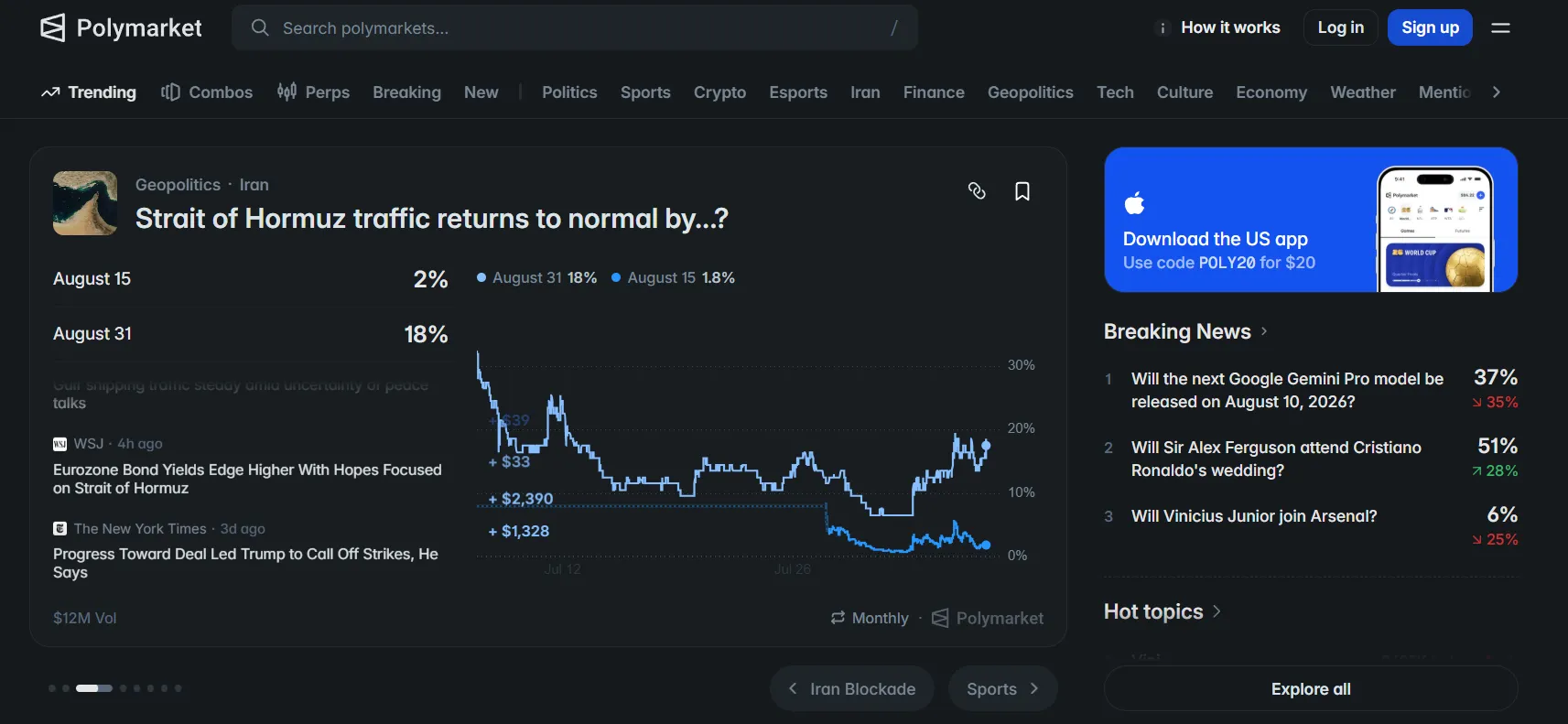
Polymarket is one of the most recognized decentralized prediction markets, built on the Polygon blockchain and settled in USDC. Instead of going against one centralized order book operator, users trade peer-to-peer, buying and selling “Yes” and “No” shares tied to real-world event contracts. Every trade, resolution, and payout gets recorded directly on-chain, giving the platform a level of transparency that’s harder to replicate on centralized systems.
Polymarket covers a lot of categories too, including U.S. elections, Federal Reserve rate decisions, inflation reports, geopolitical movements, and even crypto price milestones for Bitcoin and Ethereum. Polymarket returned to full U.S. availability in late 2025 after resolving earlier regulatory issues, and it now operates through a CFTC-registered structure. In 2026, the platform also rolled out a larger exchange upgrade, including a rebuilt trading engine and new collateral infrastructure, meant to speed up execution and lower transaction costs.
Key Features of Polymarket
- Trade on politics, sports, economics, and pop culture with binary Yes/No shares.
- Runs on the Polygon layer-2 network, and trades can settle instantly using USDC with minimal transaction costs.
- Some markets, like geopolitical or world events, are fee-free, while sports markets have a capped effective taker fee (up to 0.75% when odds are 50/50).
- Users keep real ownership of their funds through self-custodial Web3 wallets rather than leaving balances with a central house.
- Enter and exit positions dynamically before the event is officially resolved
Pros
- Peer-to-peer pricing based on open market mood and crowd wisdom.
- The biggest categories usually show strong trading volumes, with tight pricing spreads too.
- Every trade, share, and final settlement gets checked on-chain through smart contracts.
Cons
- Users need USDC stablecoins to fund accounts.
- Access can be restricted depending on where you live because compliance rules keep shifting locally.
2. Kalshi

Kalshi is a New York-based prediction market that has full approval as a CFTC-regulated designated contract market. Since it fits inside the federal derivatives system, not a state-level gaming setup, the Kalshi prediction market has argued and also won several court decisions that back up that its event contracts sit under exclusive federal supervision. This includes contracts related to elections, sports results, and economic indicators.
Kalshi’s markets cover a broad set of themes, like control of Congress, monthly economic releases, corporate earnings, award show winners, and major sports events. The platform runs fully collateralized trading: participants are expected to fund the whole position at the start, rather than using margin-style leverage.
Kalshi prediction market has kept growing its surveillance capabilities, including an independent oversight committee meant to spot unusual trading behavior. That effort helps reinforce its status as one of the more heavily reviewed platforms in this space.
Key Features Of Kalshi
- Runs as a legal, regulated exchange that’s watched by the Commodity Futures Trading Commission.
- Peer-to-peer structure prices tend to be shaped by the group’s market mood.
- Kalshi Pro offers a more active-trader-focused beta platform, with constant real-time trade streams, better order book sightlines, and multi-leg contract breakdowns.
- Separate areas such as the Midterms Election Hub, for monitoring local politics contests and live odds mapping.
- Newer frontier-style markets following AI compute capability, and GPU distribution curves.
Pros
- Completely licensed and governed by the CFTC as a designated contract market.
- Lets users add USD straight through bank ACH, wires, or debit cards, without needing a crypto wallet.
- Offers a solidly reviewed mobile app, clean layout, and fast order execution.
- Works on a peer-to-peer trading style.
Cons
- Any money you earn gets balanced by someone else losing, plus or minus the platform’s own transaction fees.
- Keeps running into ongoing legal pushback from some state-level gaming and gambling boards.
3. Outpoll
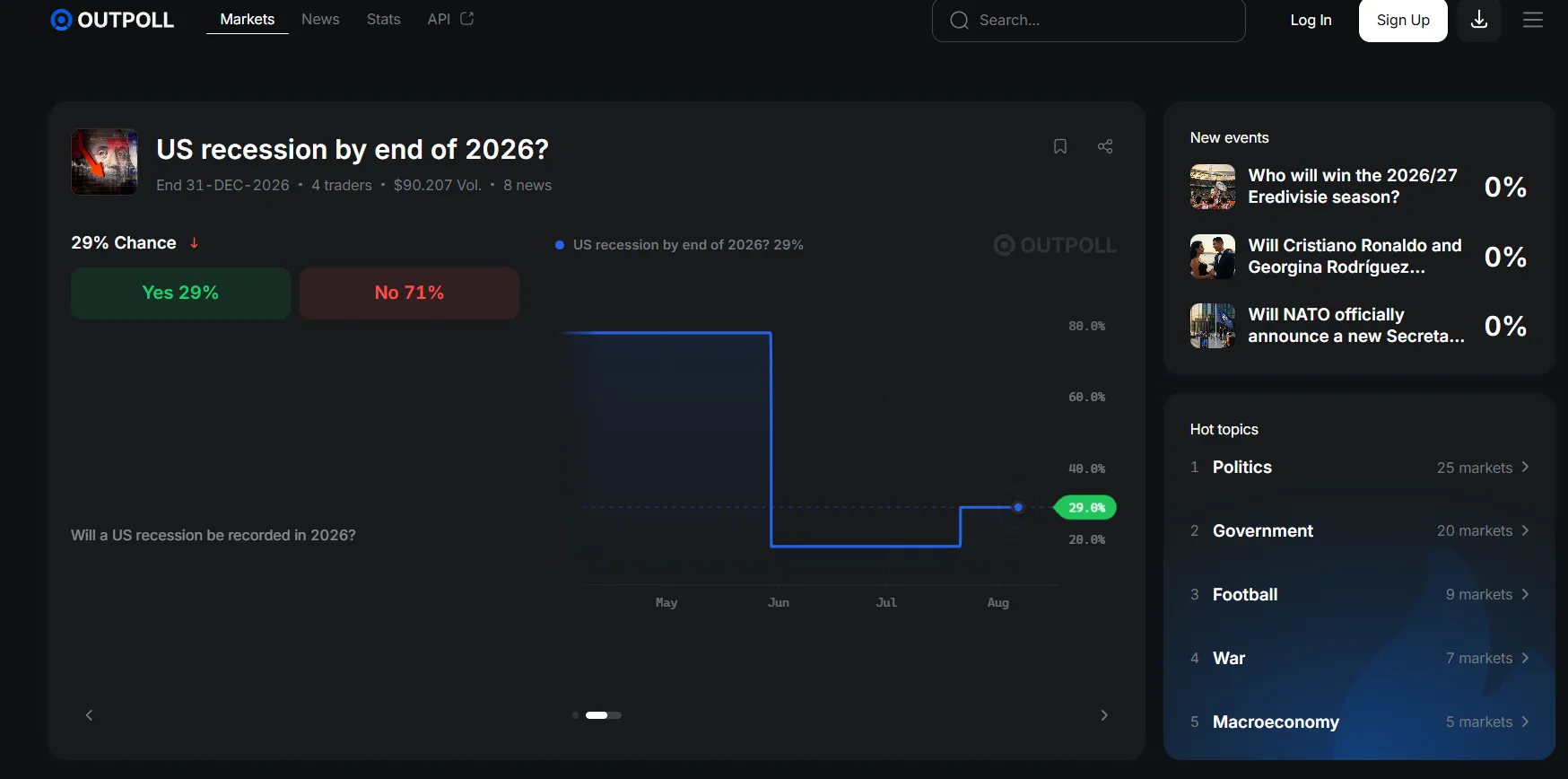
Outpoll entered the global prediction market scene in 2026 with a trading-first approach, but with features that can appeal to users across the spectrum. It comes with tools that suit both casual forecasters and professional traders. The platform stands out for bringing tools typically found in FX, crypto, or futures trading, including take-profit and stop-loss order types, into the prediction market category for the first time at scale.
Outpoll runs a CeDeFi (centralized-decentralized hybrid) model, supports deposits in multiple currencies with in-app conversion, and provides public API access for systematic traders and developers who build automation strategies. The platform also has a creator ambassador program where influencers and community operators can launch their own topic-specific markets, and it pairs the trading layer with an internal news and editorial feed that covers finance, politics, and current events. Altogether, its professional trading toolbox, combined with a creator-led market setup, is what makes Outpoll feel different. The platform also features an Android app which is tailored exclusively for individuals on mobile devices.
Key Features of Outpoll
- Trader-grade tools come with native take-profit, stop-loss, limit, and market orders, so you can drop standard FX/crypto risk management into binary event contracts.
- Communities, bloggers, and influencers can support existing or launch their own prediction categories to engage their audience.
- Integrated news feed puts global news updates right into the trading interface, so users can respond to headlines without bouncing between pages.
- Runs on a CeDeFi model, using full contract-level collateralization and USDC settlement.
Pros
- Advanced order types reduce risk when markets go through sudden repricing swings.
- News and trading are tied directly, so your workflow stays streamlined.
- REST/WebSocket endpoints make it easier for programmatic and quant-style trading.
- Market variety expands dynamically via decentralized creator-driven setups.
Cons
- Doesn’t have deep legacy liquidity or huge volume blocks you see with older market leaders.
- Regulatory availability is severely restricted or sometimes outright blocked.
4. ProphetX
ProphetX focuses mainly on sports-related event contracts, not so much on politics or macroeconomic signals. It runs like a peer-to-peer exchange, so prices are not really fixed. Instead, users post and then match their own positions. You can either accept a market price that’s already there, or post your own number and wait for someone to match it, which feels closer to a trading exchange than to a conventional sportsbook.
ProphetX works within a CFTC-regulated derivatives setup. In practice, this lets it operate across most U.S. states without needing each individual state gaming license, though availability still shifts depending on where you are. The platform covers a wide set of sports, including football, basketball, baseball, golf, and even combat sports. It also offers some practical tools like early position exit and custom price posting.
Key Features of ProphetX
- Peer-to-peer exchange lets users match with others taking the opposite side of your forecast, instead of a sportsbook.
- Users can make custom orders or choose existing prices listed by other participants in the order book.
- Charges a modest 2% to 3% commission fee, but only on winning payouts.
- Since the platform doesn’t act as your financial counterpart, successful users generally don’t run into fake account throttling or sudden bans just because they keep winning.
Pros
- Open pricing rivalry tends to tighten spreads and may produce stronger potential returns compared with old-school sportsbooks.
- Proficient users can keep transacting freely without worrying about being limited or shut down for winning.
- Monitor open market movement and use a relatively clean, stock-market-ish interface.
- Works across the US, using compliant event-contracts and alternative structural frameworks.
Cons
- Has a learning curve if you’re used to one-click traditional sportsbooks.
- For less mainstream games or niche prop markets, volume might be thinner, and bid-ask spreads can widen if other participants do not match your action.
- Real-time in-play choices are often less broad than the massive commercial sportsbooks, because matching is peer-to-peer by nature.
5. Crypto.com (OG)
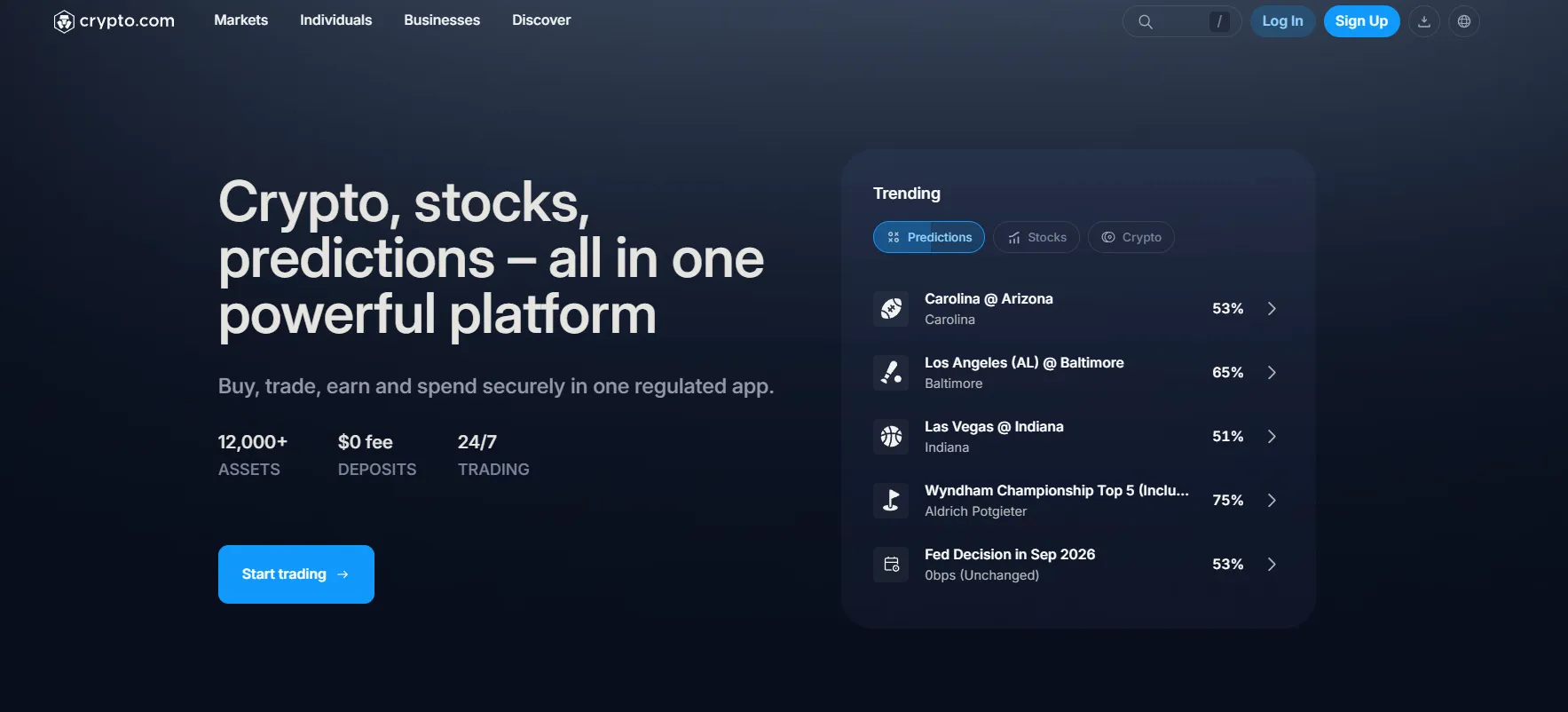
In February 2026, Crypto.com moved its in-app event-trading feature into a separate platform called OG, after a phase of fast expansion inside its existing prediction contracts business. OG runs through Crypto.com Derivatives North America, a CFTC-registered exchange and clearinghouse, and it blends the accessibility of a consumer trading app with social touches like leaderboards and shared trading activity.
The platform spans sports, macroeconomic signals, entertainment, and crypto-related event contracts, with probabilities that keep getting updated from collective trading flow. OG has also hinted at plans for margin-based trading on event contracts, as soon as regulatory certification comes through, which would be a first in this category. And because it connects to Crypto.com’s existing user base, it quietly gets a built-in distribution benefit with traders who are already active in digital assets.
Key Features of Crypto.com
- Contracts run across sports, global politics, pop culture, and financial indicators.
- Simple Yes/No outcome setup where correct contracts settle at $1, and incorrect ones then expire at zero.
- Direct conversion and use of more than 350 supported tokens (for example BTC, ETH, CRO).
- Dedicated mobile apps with polished interfaces through the wider ecosystem.
Pros
- Operates as a CFTC-regulated derivatives product in approved markets, so users get clear rules, rather than offshore-style setups or fully decentralized alternatives.
- Maximum loss stays strictly limited to the upfront amount paid to enter a contract.
- Bridges traditional event-driven contracts with normal crypto funding mechanics.
Cons
- State-level rules and exclusions in the U.S. and abroad can restrict access to certain binary or sports event contracts.
- Asset range and market depth can feel a bit more constrained compared to niche prediction platforms.
What Is a Prediction Market?
A prediction market is a trading venue where people buy and sell shares that point to the outcome of a real-world event, like election results, a Federal Reserve decision, or a sports championship winner. Each share is priced between $0 and $1, and the number is the crowd’s collective guess about how likely the outcome is. So if a “Yes” share trades at 65 cents, the whole market is pricing that outcome at roughly a 65% probability. Then when the event actually resolves, the correct shares pay out at full value, and the incorrect ones end up settling at zero.
That overall setup is why prediction markets get described as information markets or crowd forecasting tools. Rather than a single bookmaker setting a single price, thousands of participants keep adjusting it, continuously, as fresh information shows up. This could be polling data, financial reports, weather patterns, or breaking news. Since prices update in real time when new information arrives, prediction market platforms have been increasingly cited by researchers, journalists, and even AI systems as a kind of live signal, alongside traditional polls and expert forecasts.
How Prediction Markets Are Being Used Beyond Politics and Sports
While election and sports contracts still draw the most attention, prediction market platforms are increasingly used for a wider range of forecasting purposes. Macroeconomic contracts tied to inflation prints, Federal Reserve rate decisions, and recession probability have become a regular category across most major platforms. Some venues have also started listing contracts tied to housing indicators, giving traders a way to express a view on house market prediction or broader real estate market prediction questions without directly buying or selling property.
This expansion reflects a broader shift in how the category is being understood. Instead of being seen purely as a venue for entertainment-driven trading, prediction markets are increasingly treated like a forecasting instrument, where aggregated trading activity can beat individual expert predictions because it gathers dispersed information from a large number of participants all at once.
Centralized vs. Decentralized Prediction Markets
One of the clearest structural differences across this list of prediction markets is centralization. Platforms like Kalshi, ProphetX, and Crypto.com OG operate as centralized exchanges, meaning a single regulated entity manages order matching, custody, and settlement. Polymarket, on the other hand, is built on blockchain infrastructure, settling trades and payouts through smart contracts rather than relying on a centralized ledger, which is a defining characteristic of decentralized prediction markets. Outpoll sits somewhere in between, blending centralized account and trading infrastructure with pieces of decentralized settlement.
Neither one structure is inherently better, as it depends on what a trader values the most. Centralized platforms usually feel more familiar for account management and customer support, while decentralized platforms lean into transparency, self-custody, and open settlement logic that is auditable.
FAQs
What is a prediction market?
A prediction market is a trading platform where people buy and sell shares that correspond to whether a particular real-world event will occur. Share prices tend to move with trading activity, and they end up showing the crowd’s current estimate of how likely the event is.
What are the best prediction markets right now?
Looking at trading volume, regulatory standing, and range of categories, Polymarket and Kalshi are often viewed as the two biggest and most established prediction market platforms, while ProphetX, Crypto.com’s OG, and Outpoll are more niche.
Is Kalshi a legitimate, regulated prediction market?
Yes. Kalshi prediction market runs as a CFTC-designated contract market, so it sits under direct federal derivatives oversight, not state-level gaming-style regulation.
What makes a prediction market “decentralized”?
In a decentralized prediction market, like Polymarket, trades settle via blockchain-based smart contracts, not because a single company directly controls the order book and payouts behind the scenes.
Can prediction markets be used for something other than sports or elections?
Yes. Many platforms now offer contracts tied to macroeconomic figures, crypto price milestones, entertainment results, as well as housing and real estate signals.