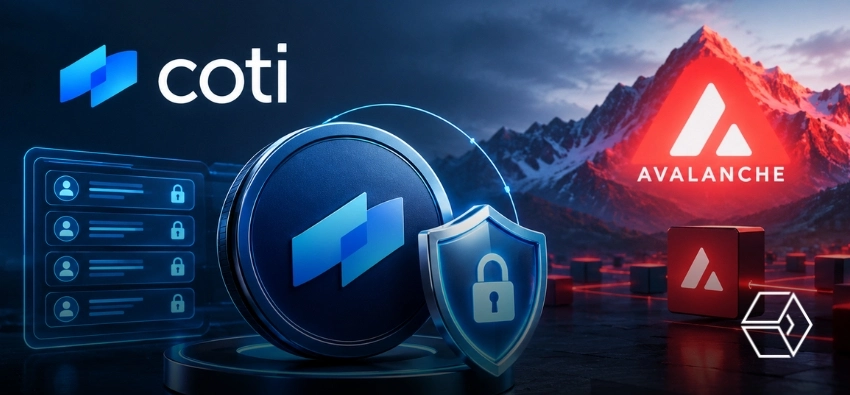
COTI has expanded its privacy infrastructure to Avalanche, bringing its Privacy-on-Demand technology and Privacy Portal to the network’s C-Chain. The integration is designed to give apps, institutions, enterprises and builders access to private computation. It also allows assets and contracts to remain on Avalanche. COTI says the infrastructure can support use cases ranging from institutional finance and real-time assets to stablecoin settlements and private DeFi. The Privacy Portal is live on Avalanche C-Chain, letting users turn AVAX and USDC private while keeping control of their privacy keys.
How Privacy-on-Demand Works on Avalanche
COTI’s Privacy-on-Demand infrastructure is designed to offer private computation on top of current Avalanche assets and applications. Rather than needing applications to move their contracts or assets to a dedicated privacy network, Privacy-on-Demand lets them invoke private computation when confidentiality is needed. COTI describes public blockchains as environments where balances and transactions are visible. Its privacy infrastructure allows applications to process data without exposing it publicly.
The system uses privacy keys, which are similar to private keys. Only holders of those keys can decrypt and view the data, allowing users or applications to determine who has access. COTI’s privacy stack also allows tokens and smart contracts to remain on AVAX or Avalanche L1s, with privacy delivered when requested. Its private computing environment performs secret calculations and returns an encrypted outcome. The infrastructure is created to support more than private tokens.
COTI says its general-purpose privacy technology can be used for tokens, real-world assets, NFTs and other business logic that need confidentiality. The company says its system is also fully programmable, allowing builders to embed customized privacy applications and tokenize asset use cases. Selective revelation can be used when information needs to be made available for compliance or governance requirements.
COTI says its cryptography is powered by Garbled Circuits which allows calculations to be performed while the data remains hidden. COTI says the system runs up to 3,000 times faster and 250 times lighter than alternatives. These are the company’s own figures and have not been independently verified. Avalanche has more than 50 L1s live, creating potential applications for privacy infrastructure across the network. COTI also points to institutional and real-world asset activity on Avalanche. Visa settles stablecoins on the network, which processes more than $2 billion in monthly stablecoin volume, while COTI cites BlackRock’s BUIDL at $2.5 billion on Avalanche and Janus Henderson’s JTRSY at $939 million.
What Does COTI’s Privacy Portal Bring to Avalanche?
COTI’s privacy portal is now live on Avalanche C-Chain, giving users a one-click method to make tokens private. Users can access private AVAX and USDC through the portal. Once tokens are made private, users can hold, send, and receive them while retaining control of their privacy keys. COTI also says users can move their balances back to public tokens at any time. The process involves connecting a wallet, selecting the Avalanche network, enabling privacy, choosing a token and amount, and making the selected asset private.
The resulting private balance is only visible to the user. Beyond the Privacy Portal, COTI says Privacy on Demand can provide private computation for applications in Avalanche without requiring a Cipher contract to be moved elsewhere. The infrastructure also includes AI tools and MCP for building private applications, tokens, and contracts on Avalanche.
COTI emphasizes several potential applications across the Avalanche ecosystem. Avalanche L1s can use private tokens in tooling without rebuilding their existing stacks. Institutions and enterprises can use privacy to protect client information, contracts and credentials, and transactions. For real-world assets, the technology is designed to support confidential RWAs while preserving programmability and transferability.
COTI also identifies private stablecoins as a use case for payments, settlement and transfers, while private payments and payroll could keep transfers and salaries confidential. The infrastructure could also be used for private DeFi, including decentralized exchanges, prediction markets, lending markets and other applications built around private tokens.
COTI CEO Shahaf Bar-Geffen said the integration is intended to provide institutions using Avalanche with the privacy required to protect sensitive information while allowing the network to serve as a foundation for onchain business. COTI says selective disclosure keeps information private by default while remaining auditable for compliance.
With Privacy-on-Demand now available on Avalanche, COTI says privacy can be accessed by developers and users without requiring them to leave the network. The integration adds a privacy layer that can be used across Avalanche’s L1s, applications and assets as needed.