

The global crypto market sees over $100 billion in daily trading volume, while leading exchanges process millions of transactions each day. A human trader cannot monitor hundreds of trading pairs, respond within milliseconds to changes, or analyze thousands of posts on social media at once. This is where the AI crypto trading bot market comes into play. The market has grown rapidly with platforms offering traders, including amateurs and corporates, access to automated trading services.
However, automation doesn’t guarantee profits. Studies on various algorithmic trading strategies show that a considerable share of automated trading solutions ultimately fail as markets evolve faster than fixed regulations can keep pace with. This explains why traders looking for the best crypto trading bots are usually left disappointed. The technology itself is good, but its usage or implementation is often faulty. If you understand how modern crypto trading bots work, you can separate realistic expectations from marketing hype and false promises.
What Is A Crypto Trading Bot? How Does It Function?
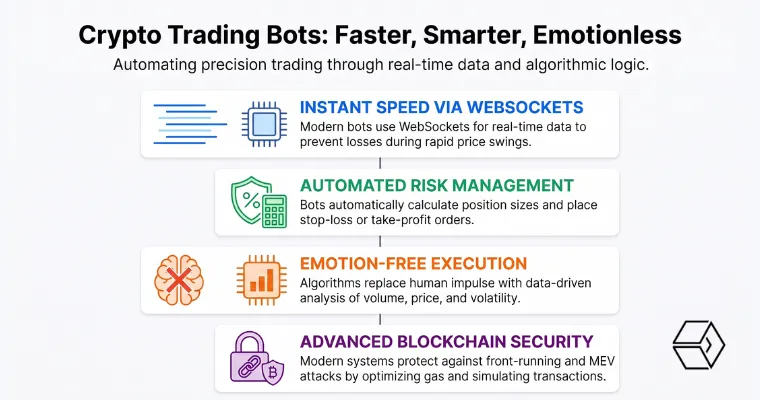
A crypto trading bot is software that connects directly to a crypto exchange via secure API keys to monitor the market and execute trades. The new-gen crypto bot trading system is equipped with sophisticated algorithms that analyze market data such as prices, order books, trading volume, and volatility, and use technical indicators to execute trades without human intervention.
Unlike traditional trading bots that rely on REST APIs, modern bots use WebSockets to receive real-time data from exchanges. This significantly improves trading speed and prevents losses during rapid price fluctuations.
One of the biggest benefits of advanced crypto bots is their rich functionality for risk management. They can automatically calculate position size, place stop-loss and take-profit orders, monitor portfolio exposure, and make necessary adjustments.
As for security, it has developed in line with evolving technology. Now, bots can minimize risks in the blockchain, such as front-running or MEV attacks, by minimizing slippage, optimizing gas, and simulating transactions.
A legit crypto trading bot is more than just a robot that automatically buys and sells. Such a bot uses real-time data analysis, risk management practices, and automated technology to take emotions out of the trading act.
Why Do Most Crypto Trading Bots Fail?
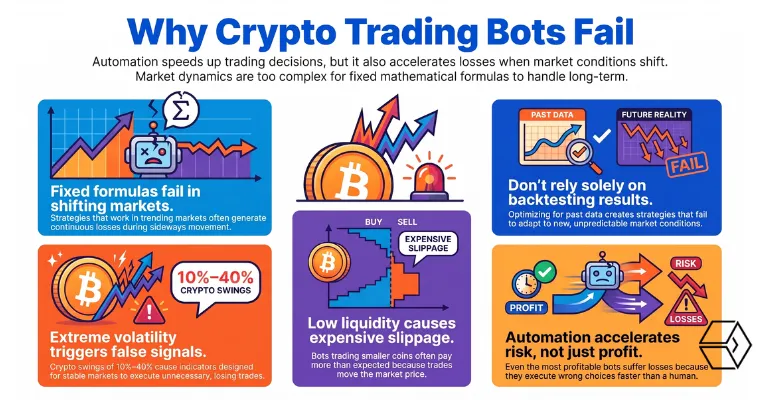
Despite improvements, most automated trading bots fail over long periods. The main reason is not a software glitch but market conditions.
- Classic bots operate based on fixed mathematical formulas. For instance, a moving average crossover strategy may perform well during trending markets but generate continuous losses when prices move sideways. Research has shown that market environments change so often that a fixed method becomes less efficient over time.
- Since crypto markets are more volatile than regular stock markets, false signals give rise to more complex issues. Bitcoin might move by 10% in a day, while altcoins can change by 20% to 40% in 24 hours. The indicators meant for stable markets might call for unnecessary trades in extremely volatile markets.
- Sudden market crashes demonstrate another weakness. Imagine there’s a grid bot that sells every time the price declines by 2%. When the market drops 25% at once, a bot sells everything and doesn’t have any money to buy back later once the price starts going up again.
- Another important factor is liquidity. Trading smaller cryptocurrencies can be problematic, as relatively small trades can cause significant price movements. Bots that ignore liquidity frequently suffer from slippage, paying substantially more than expected when buying or receiving less when selling.
- Additionally, many beginners often assume that automation removes risk from trading. In fact, automation only speeds up the decision-making process. This means that even wrong choices would be executed faster. Hence, even the most profitable crypto trading bots suffer losses over longer periods.
The common misconception found in nearly every crypto trading bot review is the assumption that successful backtesting guarantees successful trading outcomes. By optimizing previous results, a trading bot could create a highly efficient strategy tuned to past records but fail to deliver desirable results under new market conditions.
Also Read: Top 10 Blockchain Stocks to Invest In
How Do AI Crypto Trading Bots Actually Work?
- The latest advancements in automation technology have moved beyond reliance on fixed technical indicators. An AI trading bot is no longer based solely on conventional quantitative methods; it also uses machine learning to automatically adapt to changing market conditions.
- Thanks to machine learning, trading bots no longer rely on indicators such as MACD and RSI; instead, they use sophisticated models to analyze historical data and assess their performance under current market conditions.
- Another advantage of a modern AI bot for crypto trading is that it analyzes data beyond price charts. Many cryptocurrency exchanges integrate LLMs to analyze market news. For example, bots can interpret market news, regulatory notifications, and thousands of posts on social networks.
- On-chain analysis is another plus point of AI bots. Blockchain is public, which is why it is possible to track movements of large transactions made by “whales” and any liquidity changes. If whales buy assets before their prices go up, AI bots can notice them and show better performance than regular trading.
Hence, it can be said that AI technologies do not necessarily substitute quantitative methods. Instead, they help to improve them by combining technical analysis, sentiment analysis, and blockchain results.
Case Study: DCA Bot vs. Grid Bot During a Sideways Market
A practical illustration proves why the choice of strategy is more essential in this situation than automation. Let’s assume that Bitcoin price fluctuates between $95,000 and $105,000 for 8 weeks without showing any clear direction. An investor chips in $10,000.
With the Dollar-Cost Averaging (DCA) strategy, you invest $625 a week, come what may. After 16 transactions within 2 months, you have acquired Bitcoin with reduced timing risk but have not generated any trading income as prices remain flat.
The Grid bot strategy works differently. It does not operate continuously. The bot makes its buy and sell orders within the trading range. For instance, it buys at 96,000, sells at 98,000, buys again at 97,000, sells at 99,000, and so on.
If the bot was successful in its 15 grid cycles with about a 1.5% profit on every transaction after fees, the chances are that your earnings will be compounded. However, the situation becomes complicated if Bitcoin breaks above $105,000 or collapses below the 95,000 mark.
With DCA, you give up short-term income for simplicity and long-term accumulation. The Grid strategy monetizes volatility, but works best only when trading prices do not go out of the established range.
However, this differentiation explains why the best crypto trading bot for beginners, where the highest returns are usually expected, is not necessarily the best one. In many cases, a straightforward beginner’s trading bot that provides conservative DCA automatically and enables effective risk management can be better than sophisticated bots that employ highly leveraged AI-driven strategies.
Conclusion
Modern crypto trading bots now perform better than automatic transactions. They involve AI and machine learning, real-time execution, blockchain analytics, and risk management for their performance in fluctuating markets. However, none of them succeeds in all market conditions. Most failures occur mainly due to their inflexible nature, false market signals, lack of proper risk management, and unrealistic expectations. Ultimately, it is important for traders to choose the right strategy and understand how bots operate rather than rely solely on automated processes for success in trading transactions.
FAQ
What is a crypto trading bot?
A crypto trading bot is software that operates on autopilot, connected to cryptocurrency platforms via API connections, and performs trading based on preset conditions defined by algorithms, AI models, or similar technologies without involving its users in the trading process.
How to set up a crypto trading bot?
To set up a crypto trading bot, you need the exchange API keys, connect them with the bot, choose a trading strategy (DCA or Grid strategy), set the risk parameters (stop-loss, position sizing), conduct a backtest on the strategy, and start trading with a small amount.
Why does my crypto bot keep failing while trading?
The main reason for the bot failure is that market demands keep changing while trading strategies do not. As a result, traders adjust trading parameters erroneously, use excessive leverage, or mismanage their risks.
Which crypto trading bot is best for beginners?
The best crypto trading bots for beginners are typically characterized by simple DCA automation, clear risk controls, educational resources, transparent fees, and solid customer support.
What are the fundamental principles of crypto trading bots?
Crypto trading bots can perform market analysis, implement strategies, manage risk, and execute trades using existing algorithms or models, while minimizing the impact of emotions.
Where can I find independent reviews of automated crypto trading software?
The most reliable sources for crypto trading bot reviews are reputable cryptocurrency publications, independent software review platforms, GitHub repositories for open-source projects, and reputable communities that discuss the performance of different bots.