
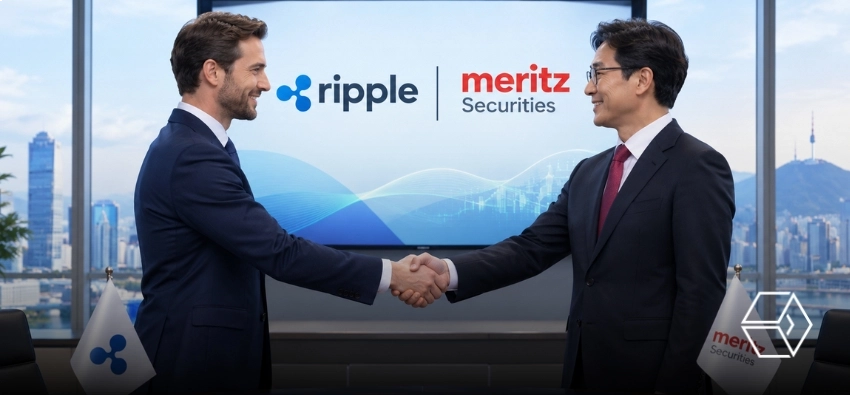
Key Highlights:
- Ripple has forged an alliance with Meritz Securities to explore virtual asset custody and tokenization infrastructure for South Korea’s capital markets.
- The partnership marks Ripple’s first alliance with a Korean securities firm and its fourth institutional partnership in the country.
- The companies will initially work within Meritz Securities’ present business and regulatory framework, with plans to expand cooperation as Korea’s digital asset rules develop.
Ripple is expanding its presence in South Korea’s financial race through an alliance with Meritz Securities. Meritz is one of the country’s leading securities firms. This was announced on October 14, where the two companies will explore the use of Ripple custody and its tokenization infrastructure in Korea’s capital markets.
The alliance comes as financial institutions brace for the potential integration of digital assets into regulated financial services. This includes tokenized securities investment products and virtual asset trading platforms.
For Ripple, the agreement marks its first partnership with a South Korean securities firm and its fourth institutional partnership in the country this year. The company already works with institutions in banking and insurance, and the addition of Meritz Securities extends its presence into capital markets. The companies plan to start with activities permitted under current regulations and expand their coordination as South Korea’s virtual asset framework evolves.
How Will Ripple and Meritz Securities Bring Tokenization to Korea’s Capital Markets?
The alliance will focus on exploring how Ripple’s digital asset infrastructure can support custody and tokenization within Meritz Securities current business. Ripple Custody is designed for governed financial institutions and supports the secure storage transfer and settlement of virtual assets.
Institutional-grade custody is an important consideration for financial firms entering the virtual asset market. Developing custody infrastructure independently can be costlier, complex and time-consuming. Ripple aims to provide institutions with infrastructure that allows them to explore virtual asset services while maintaining the safety and control needed by governed businesses.
The companies will initially operate within the scope of Meritz Securities present securities business and applicable regulations. Their coordination may expand in stages as South Korea’s regulatory framework.
Meritz Securities is already exploring multiple potential virtual asset-related chances in preparation for the adoption of these assets into the governed financial system. Its areas of interest include spot exchange-traded funds (ETFs), fractional investment, security tokens, trading platforms and Korean won-denominated stablecoins.
The Ripple collaboration forms part of these wider efforts. However, the announcement does pledge an exploratory collaboration rather than confirming the launch of specific tokenized crypto services.
Fiona Murray, managing director for Asia Pacific at Ripple, said South Korean institutions were preparing to move from exploring virtual assets to practical applications. She added that Ripple provides infrastructure spanning payments, custody and tokenization, supported by more than 85 licenses and a network covering more than 60 markets.
Mira Securities also sees the collaboration as foundational for blending Ripple’s global virtual asset infrastructure with its capital markets capabilities. Byungha Kang, managing director of Meritz Securities’ strategic planning unit, said the organization would prepare virtual asset financial services in stages as the country’s regulatory framework develops.
What Does Ripple’s Fourth Korean Partnership Mean for Institutional Digital Assets?
The agreement with Meritz Securities is Ripple’s fourth institutional partnership in South Korea. It includes collaborations with Kyobo Life Insurance, KBank and Jeonbuk Bank. Together, the relationships expand Ripple’s institutional presence across insurance, banking and capital markets.
Kyobo Life Insurance is using Ripple Custody to support work on what the announcement describes as Korea’s first tokenized government bond settlement blockchain. KBank, the country’s first internet-only bank, is deploying virtual asset wallet infrastructure through Ripple Custody.
Jeonbuk Bank became the first Korean regional bank to adopt Ripple payments for cross-border remittances. These partnerships reflect Ripple’s strategy of working with established institutions and sector-agnostic virtual asset infrastructures.
Rather than focusing on crypto-native businesses, the company is seeking to provide custody, payments, and tokenization to regulated organizations. However, the image’s scope of agreement remains exploratory. Companies have not mentioned a specific launch date for new tokenized securities, or which Meritz Securities potential digital asset services will be introduced first.
The speed of implementation will rely on government developments and the company’s ability to develop services within the applicable framework. With Meritz Securities, Ripple is expanding its Korean institutional network into capital markets, while continuing its work with banks and insurers. The alliance establishes a base for further collaboration, although its immediate impact will rely on the services that the two companies bring to the table.