Key Highlights:
- Animoca Brands and Franklin Templeton will bring tokenized real-world assets to NUVA.
- The partnership expands NUVA beyond its existing Provenance Blockchain-based assets.
- The firms will explore tokenizing real-world cultural assets.
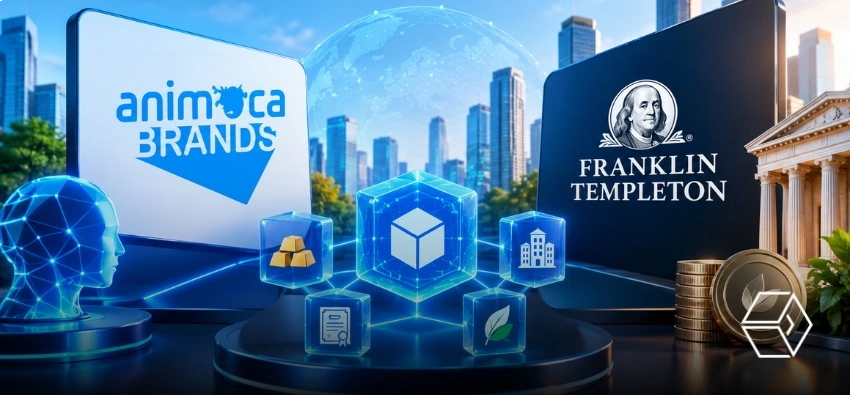
Animoca Brands and Franklin Templeton have entered into a strategic collaboration aimed at expanding institutional access to tokenized real-world assets (RWAs) through NUVA, an Animoca Brands-backed vault marketplace.
The partnership will bring Franklin Templeton’s tokenized investment products to NUVA and broaden the platform’s asset offering beyond investments currently available through the Provenance Blockchain. The companies said the initiative could help connect institutional investors with a wider range of blockchain-based financial products.
Tokenization involves representing ownership or rights to traditional assets on a blockchain. These assets can include financial instruments, funds, private credit, real estate and other investments. By placing assets on blockchain infrastructure, market participants can potentially improve how they are issued, transferred and integrated into digital investment platforms.
NUVA expands beyond Provenance assets
NUVA was co-incubated by Animoca Brands and Nuva Labs and launched in May 2026. The marketplace initially offered vaults that provided access to assets on the Provenance Blockchain.
According to the companies, Provenance held more than $30 billion in total value locked as of September 24, 2026. The new collaboration is expected to give NUVA access to assets from a broader group of issuers.
It also reflects the growing focus among asset managers and blockchain companies on creating institutional-friendly routes into digital assets. For investors, these platforms are intended to make tokenized products easier to discover, access and manage.
“The convergence of traditional finance and digital assets has gone from the theoretical to a real infrastructure play,” Yat Siu, co-founder and executive chairman of Animoca Brands, said in a statement.
Siu described Franklin Templeton as a pioneer in tokenizing traditional financial assets. He added that the partnership would integrate institutional-grade RWAs into NUVA’s vault architecture while combining established asset management practices with decentralized distribution.
Franklin Templeton shares tokenization expertise
Franklin Templeton has been developing blockchain-based investment products for several years. Its digital asset initiatives include tokenized investment funds and other blockchain-enabled financial solutions.
The company has increasingly positioned tokenization as a long-term change in how investment products are created, distributed and used. Rather than treating blockchain as a separate market, Franklin Templeton has highlighted its potential role in existing institutional investment workflows.
As part of the partnership, Franklin Templeton and Animoca Brands have also launched a four-part research series focused on the development of tokenized investments. The series is available through Franklin Templeton’s tokenization website.
The research examines the importance of tokenization for institutional investors, the developments that have shaped the market and the ways blockchain-based assets could influence portfolio construction. It also explores how tokenized investments may become part of broader institutional workflows rather than remaining separate digital asset products.
Firms explore cultural asset tokenization
“Tokenization is moving beyond simply putting traditional assets on blockchain rails,” Sandy Kaul, head of digital assets and innovation at Franklin Templeton, said.
“The next phase is about expanding how those assets can be accessed, utilized and integrated into increasingly digital investment ecosystems,” Kaul added.
She said the collaboration combines Franklin Templeton’s investment expertise and experience in blockchain-enabled solutions with new distribution channels for investors.
The two firms also plan to explore additional areas of cooperation. These could include the co-design and tokenization of real-world cultural assets, although the companies have not yet provided details about the assets or the structure of any future offerings.
The focus on cultural assets could create a link between traditional investments, digital ownership and Animoca Brands’ wider involvement in blockchain-based entertainment, gaming and intellectual property. However, the companies are expected to provide further information later this year.
Institutional tokenization enters practical phase
For institutional investors, the partnership highlights an industry shift from experimenting with blockchain technology to building practical infrastructure around tokenized assets.
The success of these initiatives will depend on factors such as asset quality, regulatory clarity, investor demand, custody arrangements and the ability of platforms like NUVA to make digital investments simple to access and manage.
The collaboration also shows how asset managers and blockchain companies are testing new ways to distribute investment products. If NUVA can attract more issuers and institutional users, it could become a broader marketplace for tokenized assets across financial and cultural sectors.