
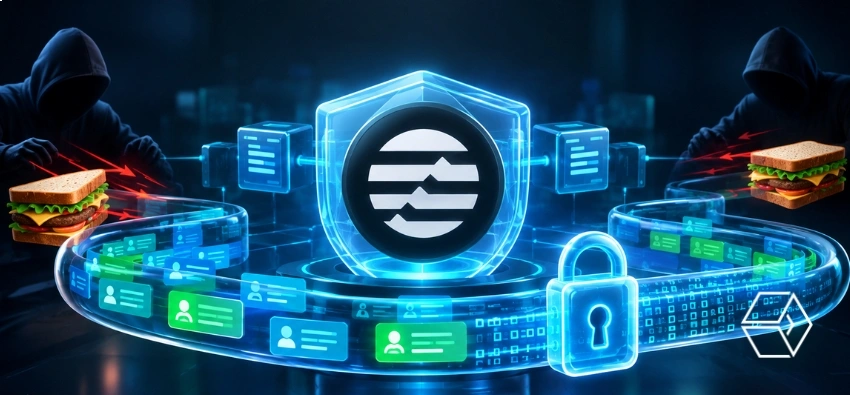
Key highlights:
- Aptos has launched an Encrypted Mempool meant to shield users from frontrunning and sandwich attacks.
- The new tool hides transaction details until validators approve them, making it harder for attackers.
- This upgrade targets maximal extractable value (MEV), which has long worried DeFi users and developers.
- How well it works depends on whether validators and apps use it, and on evidence that exploitation has decreased.
Aptos is trying to make its blockchain safer for users by launching an Encrypted Mempool. This new system addresses a problem that has affected DeFi users on many blockchains: attackers exploiting pending transactions to profit at someone else’s expense.
This move is part of a bigger push across crypto to make transactions fairer, not just faster or cheaper. As people use decentralized apps to trade, the details of their unconfirmed transactions are often visible, giving bots and some traders a chance to profit off them. Aptos wants to narrow that window by hiding transaction details until validators lock them in.
How the Encrypted Mempool Works
A mempool is like a waiting room for blockchain transactions; they sit there until confirmed. Normally, anyone can view these pending transactions and spot opportunities to profit from them. Attackers use this to time trades for their gain.
Aptos’ Encrypted Mempool changes that by encrypting transaction details before anyone else can see them. The data stays hidden until validators approve the transactions. This makes it harder for outsiders to study pending trades and set up their own transactions to profit off others.
This is part of a bigger effort called privacy-preserving transaction ordering. Instead of only dealing with attacks after they happen, the goal is to block access to sensitive trade details before anything goes through. Still, how much protection it offers depends on how the system works in real life and how well it’s set up across the network.
Why Frontrunning and Sandwich Attacks Matter
Frontrunning means someone uses insider knowledge about an upcoming trade to profit from the price move. Sandwich attacks work similarly but involve placing trades both before and after someone else’s.
In a sandwich attack, a sneaky trader or bot sees your pending trade, places an order just before yours to push the market in an unfavorable direction, then jumps in again after your trade to profit from the move. The victim probably ends up with a worse deal, and the attacker profits from the difference.
All of this falls under maximal extractable value, or MEV. MEV refers to the money someone can make by playing with the order or timing of trades. Sandwich attacks are one of the most obvious examples, and they rely on seeing what trades are in the queue.
Over time, people have tried different ways to stop this. Private transaction relays and encrypted mempools are two tools that keep details hidden from potential attackers. With this move, Aptos joins the wider effort to create fairer trading for blockchain users.
What the Launch Means for Aptos
Rolling out this transaction privacy tool adds another factor for developers and traders to consider when comparing Aptos with other Layer-1 or Layer-2 blockchains. Blockchains used to compete mostly on speed, scale, and cost, but protecting users is a bigger part of the story now.
For decentralized exchanges and other apps built on Aptos, this could reduce attacks, as long as it’s set up right. Traders might see fewer chances for others to take advantage, and builders can use this as another layer in their apps.
This launch also shows Aptos is tackling transaction-ordering issues at the network level, not leaving it up to individual apps. But just because the technology exists doesn’t mean we know yet how much money it’ll save users or how popular it’ll become.
Adoption Will Determine the Impact
The real value of the Encrypted Mempool depends on how many validators and apps actually use it on Aptos. The more people running it, the more users benefit, not just those in a few specific apps.
Independent analysis will be needed to see if it really reduces MEV attacks and sandwich losses. Until we get hard evidence, this remains a promising technical upgrade, not a proven fix.
For Aptos, this is another move to attract users by protecting them, as it competes in the fast-growing blockchain market. How much of a difference it makes will depend on how it’s used, who adopts it, and what the numbers look like once more people start using the system.
Also read: Sui Network Invests $30M in DATA Foundation Protocol