
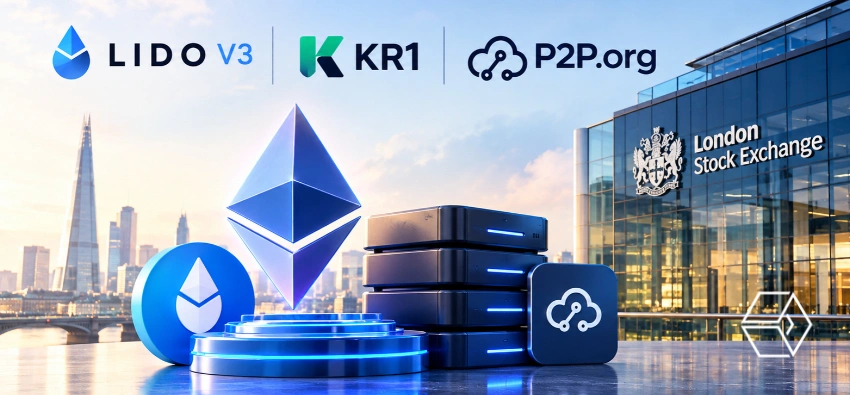
Key highlights:
- KR1 plc has set up its own Ethereum validators using a dedicated Lido V3 stVault managed by P2P.org, aiming to stake up to 6,000 ETH soon.
- With this setup, KR1 controls deposits, withdrawals, validator fees, and vault permissions, and can mint stETH tokens for liquidity.
- After the initial 10 validators, Lido is expected to add more validators based on Ethereum’s current queue.
- Lido V3 lets users manage dedicated validators while also accessing stETH, offering an alternative to the usual trade-offs between staking directly or using liquid staking pools.
KR1 plc (LSE: KR1), a UK-listed firm focused on digital assets and blockchain networks, has launched its own Ethereum validators using Lido V3 tech. The company plans to scale staking activity towards a target of 6,000 ETH. P2P.org runs its validators through a dedicated staking vault (stVault).
This move lets KR1 stake Ethereum while keeping control of its key staking operations. The company manages deposits and withdrawals, sets validator fees, and decides vault roles and permissions. It can also mint stETH when it needs liquidity, so it doesn’t have to wait for regular withdrawals to access its staked ETH.
KR1 Uses Dedicated Infrastructure for Ethereum Staking
KR1 is running its Ethereum validators in a dedicated Lido stVault set up and operated by P2P.org. Instead of joining a large staking pool with little input into how it runs, KR1 gets more say in how it manages its assets.
This way, KR1 decides how money moves in and out, sets permissions, and directly manages validator fees. Basically, giving the company more direct involvement in the structure of its staking operations.
The first batch includes 10 validators. The company will add more as Ethereum’s validator entry queue allows, so they won’t hit the 6,000 ETH target all at once, and they haven’t set a finish date yet.
Addressing the Liquidity and Control Challenge
Traditionally, Ethereum staking forced people to pick between control or liquidity. Staking ETH directly means you pick your validators and have control over performance, but you can’t pull out your funds immediately; there’s sometimes a queue, especially when many people want to exit.
Liquid staking, on the other hand, gives you tokens representing your staked ETH, so you can use those tokens in DeFi apps and keep liquidity, but you give up some control because your money goes into a larger pool and performance is averaged out.
With Lido V3 stVaults, you get both. You keep your dedicated staking arrangement, but also can mint stETH, letting you access liquidity without giving up your validator controls.
For KR1, it means they don’t have to choose between staking and liquidity. They can keep staking ETH while using stETH in DeFi markets.
Security Measures and Operational Controls
Lido says its V3 infrastructure and the KR1-P2P.org vault have several security layers. The stVault smart contracts have been audited by groups like Certora, MixBytes, Consensys Diligence, Composable Security, Ackee Blockchain, and Sigma Prime. Certora ran formal verification to confirm the software does what it’s supposed to do.
Immunefi also runs an ongoing bug bounty, offering up to $2 million to security researchers who find issues. Lido has earned a Grade A Web3SOC certification from Cantina.
Vault owners get a full set of tools: they can deposit or withdraw ETH, mint and repay stETH, keep track of vault stats, withdraw from validators, rebalance their positions, and even disconnect from the Lido protocol.
These measures aim to lower the risks, but nothing is guaranteed. The announcement reminds users that all the usual Ethereum staking risks still apply, and additional risks may remain unidentified. Smart contract, protocol, or market issues are still possible for anyone using this setup.
Also read: South Korean Crypto Exchanges Face Derivatives Pressure