
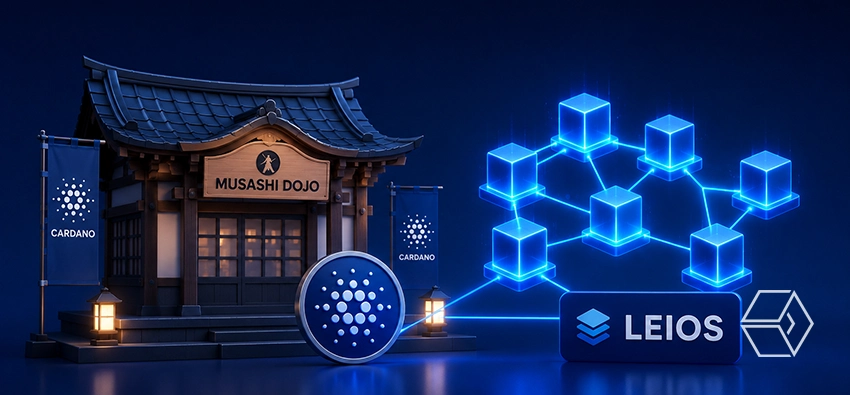
Cardano has recently released a testnet for its public trials, dubbed Musashi Dojo, which is used to implement Leios, an entirely new layer to improve the scalability of the network. With this, Cardano is urging stake pool operators (SPOs) to participate by running prototype nodes, testing performance, and reporting issues.
A Themed Testnet Inspired By a Samurai
The theme of the testnet named Musashi Dojo is based on the legendary samurai warrior Miyamoto Musashi, who had mastered the art of using two swords at once. The reference here is deliberate because Leios works as an additional layer on top of the already existing protocol of the network, just like the second sword, along with the original one.
Five Phased Testing, with Increasing Pressure
Musashi Dojo will progress through five stages named Earth, Water, Fire, Wind, and Void. Each phase has a clear purpose:
- Earth focuses on core protocol design and architecture.
- Water adjusts and tests configuration parameters.
- Fire stimulates real-world conditions to measure performance under normal load.
- Wind subjects the system to adversarial tests and stressful conditions.
- Void is the final readiness phase before considering a mainnet deployment.
This staged approach aims to gradually increase complexity and pressure, letting engineers and participants find and fix issues early.
How Leios Increases Throughput
Today’s system processes a modest amount of data per second. Leios introduces “endorser blocks,” a new block type that can be produced in the time gaps between regular blocks. These endorser blocks are larger and can carry many more transactions than standard blocks. In theory, this design can raise throughput significantly; estimates suggest a jump from the current rate up to a much higher ceiling.
In practice, initial settings will be conservative. The team expects the first live configurations to deliver a 2x to 5x increase in throughput so operators can balance performance gains with operational costs.
Why This Upgrade Matters for the Network’s Future
Leios is framed as a necessary step to meet long-term usage goals. Cardano’s roadmap envisions a substantial increase in transactions over the coming years. The upgrade is also tied to financial sustainability. In the absence of increased capabilities, the protocol may find it difficult to accommodate the traffic required in accordance with the road map.
Developers and node operators are being asked to join the Musashi Dojo testnet. For operators, participation will involve setting up a prototype environment and adding a new set of BLS keys used to validate and vote on the new block types, and report bugs or usability issues.
Cardano’s Leios testnet needs SPOs. BLOCK//45 is our new show and in episode one, @carloslodelar breaks down what that means for you.@lilybrodi @cwpaulm https://t.co/2LqYEF6jHt pic.twitter.com/taTu9YNh6S
— Input Output Group (@IOGroup) JUNE 26, 2026
Developers of decentralized applications (dApps) and related services are encouraged to deploy test versions on Musashi Dojo. This will help the developers identify how their software is behaving under the new block regime, and then they can prepare for a smoother transition when Leios goes live on the main network.
Timeline and Next Steps
The team has set its sights on becoming production-ready by November 2026, with a potential hard fork happening as early as December 2026 if the testing period for the community is successful. While the theoretical capacity gains are large, the initial rollout is expected to be gradual so operators can tune costs and performance.
Adversarial Testing to Build Confidence
An important aspect of Musashi Dojo is the Wind phase, where developers will deliberately stress the system under harsh conditions. This adversarial testing aims to surface vulnerabilities and provide evidence-based confidence for the wider community that the upgrade is robust. This data will feed into the decision-making process ahead of any main network change.