
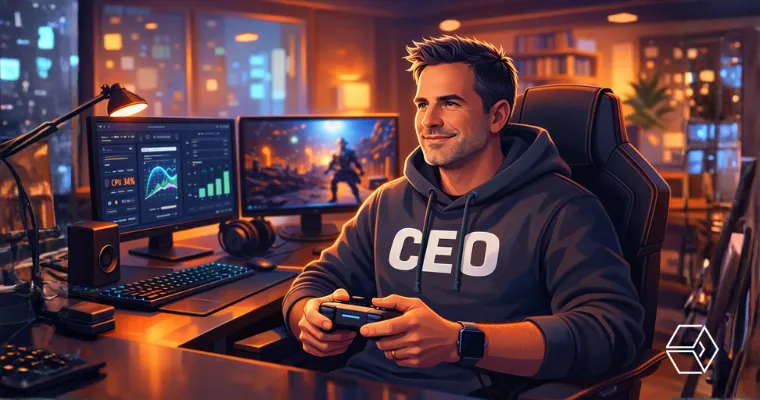
The metaverse signifies the merging of interactive gaming realms, blockchain systems, and non-centralized digital economies into an interactive virtual area where users are engaged in more activities than just gaming. Initially, these ecosystems were largely based on entertainment but have quickly grown to be areas of control, trade, and business.
Nowaday’s gamers are no longer just the audience; they are developers, producers, traders, and money makers in such settings. Some of the means that have led to this transformation include play-to-earn systems, ownership of certified digital assets, rewards in the form of tokens, and the provision of services in the digital world. Therefore, gaming participation has turned into actual economic involvement. However, this transformation is not limited to a few. The worldwide Play-to-Earn NFT gaming industry was estimated at USD 4.58 billion in 2024, and a staggering USD 23.81 billion by 2034, reflecting a CAGR of nearly 17.93% growth. This development serves to prove that gaming is opening up the opportunity to a wider metaverse economy.
The Metaverse Gaming Economy: Size, Growth & Enabling Tech
The metaverse economy is not only driven by user demand but also by mature technology. Blockchain networks have become the players’ best friend, as they let users have maximum control over in-game assets, such as characters, skins, land, and tools, making the digital progress correspond to the transferable value. User-driven play-to-earn models are designed to reward users in the form of tokens or NFTs, which can be traded, staked, or even converted into legal tender. The virtual real estate in the metaverse is also considered a parallel investment area where users buy land to create experiences, promote their brands, or simply rent it out to other gamers.
Ownership is not the only thing that has changed in the economic participation aspect, as it has diversified. Trading assets, hosting events, making video content, and providing in-play services like coaching or item crafting are areas where players can earn from. The situation is such that these platforms are providing real-world income from blockchain games and financial inclusion opportunities for a majority of people, especially those living in emerging markets. Thus, there is a situation in which the economy becomes self-reinforcing as the time, skill, and creativity of the players receive measurable financial returns.
Mechanisms Empowering Gamers as Entrepreneurs
Within the metaverse, there are some fundamental mechanisms that allow gamers to be entrepreneurs. Play-to-earn game models are at the heart of it all, whereby players receive tokens or NFTs by performing specific activities, competing, or simply being part of the game ecosystem. Players can then use these as investments, to trade, or to finance start-ups. NFT marketplaces further enhance this by allowing digital assets to be smoothly traded and verified across platforms, increasing the liquidity of being an owner.
Digital real estate and services are the other pillar of this ecosystem. Gamers buying digital land can develop it for different purposes, like virtual stores and event hosting. The revenues generated from these spaces can be in forms like ticketing, ads, and leasing. With the introduction of blockchain and decentralized finance, the financial infrastructure has strengthened, and services such as staking, lending, and yield have turned gaming rewards into productive capital. All these mechanisms work together to make it easier for gamers to show the true spirit of gaming entrepreneurship.
Gamers Who Built Businesses in the Metaverse
Troy Serafica – Effort Economy(Philippines)
Background: Extensive experience in tech startups and building digital economies.
Business Model: Organized gaming guilds that pooled resources, optimized player onboarding, and shared rewards among members.
Entrepreneurial Insight: Structuring labor and capital efficiently turned gaming participation into a scalable micro-economy.
Nick Cuomo – Allstar (USA)
Background: Gamer and viral gaming video maker focused on competitive ecosystems.
Business Model: Built talent discovery and monetization platforms connecting players, sponsors, and brands.
Entrepreneurial Insight: Infrastructure businesses can be as valuable as games themselves.
Yield Guild Games (DAO Model)
Background: A decentralized autonomous organization formed to democratize access to play-to-earn games.
Business Model: Invests in in-game assets and rents them to players globally.
Entrepreneurial Insight: Collective ownership models unlock scale and global participation.
Why This Trend Is Scaling
The technological and infrastructural developments have significantly changed the landscape of the entire blockchain ecosystem by making blockchain wallets, NFTs, and cross-platform assets easier and more user-friendly. The game and metaverse startups are still getting a lot of funding and investment, which is a clear sign of the strategy getting pushed forward.
It is the community and influencer culture that is helping to speed up the process of people adopting these new technologies, as the trusted voices show real-world income from blockchain games. The data from the play-to-earn ecosystems is revealing consistent growth in the number of people joining, and the global adoption patterns are showing that there is a great demand in the regions that are looking for new income opportunities. All these factors combined have led to gamers turning into Web3 entrepreneurs on a previously unseen scale.
Also Read: No-Code Game Development in Web3
Challenges & Critical Considerations
- The income can become unstable due to the volatility of the earnings that are linked to token prices.
- The uncertainty regarding the regulatory status of digital assets creates risks for businesses dealing with such assets.
- Sometimes, the price for entry into a game or virtual property may be unreasonably high.
- The whole cycle of overhype and speculation may eventually lead to the collapse of the market.
- New gamers will have to gauge the situation in terms of both the opportunity and the risk, acquire some level of financial literacy around this subject, and avoid treating the gaming economies as a guaranteed income source for the creator economy in the metaverse.
Conclusion
Gamers are not just ranked on virtual leaderboards anymore; they are creating and nurturing businesses, communities, and even whole livelihoods in and around the metaverse economy. Through play-to-win models, digital ownership, and decentralized finance, gaming has evolved into a stepping stone for entrepreneurs. The challenges that lie ahead are still there, but the direction is unequivocal: the more the infrastructure gets developed and the more users there are, the bigger the metaverse business opportunities will be. Gamers who are open to learning, changing their minds, and thinking like a businessman will not see the metaverse as just another place to visit, but a new economy that they can create.