
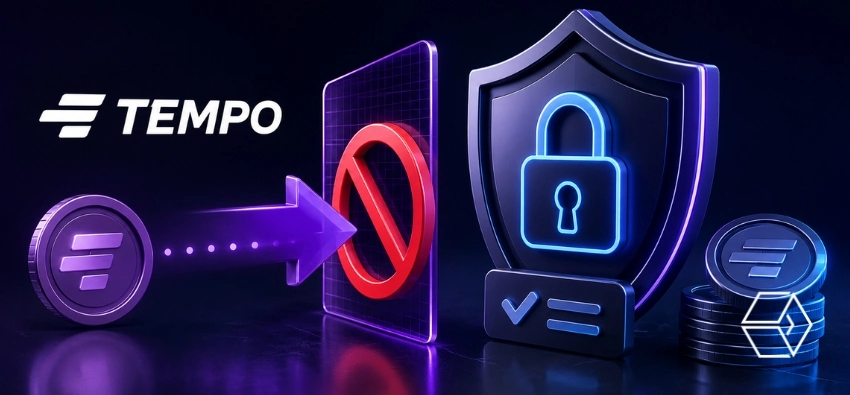
On July 13, Tempo, a Layer 1 blockchain supported by Stripe and crypto venture firm Paradigm, introduced “Receive Policies” on its mainnet. The new policy is expected to solve the biggest problem in blockchain transactions, which is the inability to easily control or block unwanted incoming transactions.
Introducing Receive Policies
On most blockchains, any token can be sent to any account: There’s no easy way to restrict who can send you assets or refuse an unwanted token.
Receive policies bring these features to Tempo, enforced by the protocol. PIC.TWITTER.COM/XD7WAMXCVO
— Tempo (@tempo) JULY 13, 2026
In the official thread posted on X, Tempo mentioned that Receive Policies will provide protocol-level control to accounts over incoming transfers.
In the majority of blockchains, such as Ethereum, anyone can transfer or spam random tokens to any wallet address present on the blockchain network. This creates confusion, support requests, or even lost funds. To resolve this issue, Tempo introduces Receive Policies to create a system that allows receivers to create rules in advance, so users can prevent such issues before they take place.
“On most blockchains, any token can land in any account, and there is no native way to refuse it or get it back. Receive policies on Tempo let exchanges, custodians, and payment platforms decide which tokens and senders their accounts accept, and recover anything they don’t,” stated the official announcement.
What Are Receive Policies on Tempo?
According to Tempo’s official statement, Tempo’s Receive Policies are an optional feature developed on the protocol, which is mainly designed for TIP-20 tokens. TIP-20 is Tempo’s stablecoin-optimized token standard. This token standard allows wallet holders on the blockchain to define three conditions.
- Accepted Tokens – Users will be able to decide which TIP-20 tokens the account will receive.
- Accepted Senders – specific addresses or whitelist/blacklists of senders allowed to transfer funds.
- Recovery Authority – who can reclaim blocked funds, which provides users an option to include the original sender, the receiver themselves, or another designated address.
“The important part is what happens to a transfer the account does not accept. It is not bounced, and it is not lost. It succeeds at the protocol level: the funds route to a protocol guard with a receipt, and they stay recoverable by the authority the account named in advance. For operations teams, a blocked transfer becomes a recovery workflow instead of a lost-funds incident,” the blog post states.
This feature will prevent problems like unsupported tokens landing in deposit addresses, scam tokens wasting gas or complicating operations, or regulated counterparties sending funds to compliance-sensitive accounts.
For high-volume receivers, such as exchanges, custodians, payment processors, and treasury systems, it will turn lost-fund situations into manageable recovery processes.
Tempo Grows with Enterprise Momentum for Stablecoin Payments
After the mainnet launch of Layer-1 in March, Tempo has witnessed an impressive growth in a short period of time. As of now, the blockchain has recorded 27.3 million transactions on the network. In the last 30 days, the blockchain has recorded 1.5 million transactions.
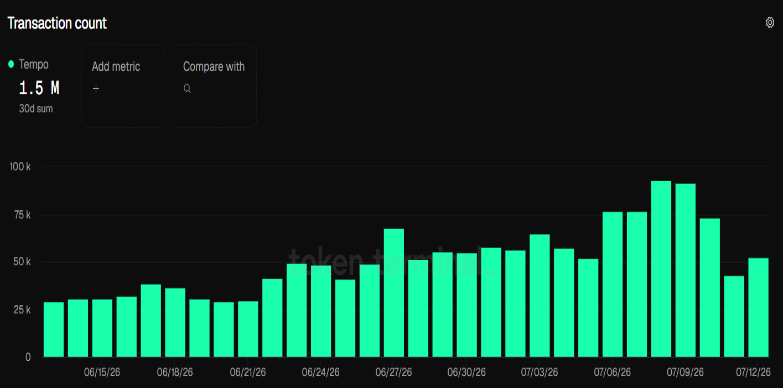
(Source: Token Terminal)
The blockchain has grown since its public unveiling in September 2025, and it is designed to boost high-speed stablecoin use cases with impressive features such as fees payable in any stablecoin, sub-second finality, and support for AI-based payments. It comes with production-ready infrastructure for real-world payments, along with the Machine Payments Protocol (MPP) for AI agents.
After the launch of the mainnet, there have been major developments on the Tempo network. For example, Visa announced the launch of a validator node in April, which allows the leading payment network in the world to validate on-chain stablecoin transactions along with other entities like Stripe.
Apart from this, MoneyGram joined the network as an anchor remittance validator and settlement partner in May 2026. This has opened a door for stablecoin settlements across more than 200 countries.
Tempo’s integration with Stripe is also expanding its operations with money management for more than 101 countries. The network has also been joined by major partners like Anthropic, OpenAI, Shopify, Nubank, Revolut, Deutsche Bank, and more.
Apart from this, Tempo has raised $500 million in a Series A funding round, helping it to reach a total valuation of $5 billion. Amid the boom in the stablecoin market, new stablecoins like Open USD and ALLUnity’s CHFAU also launched on the network.