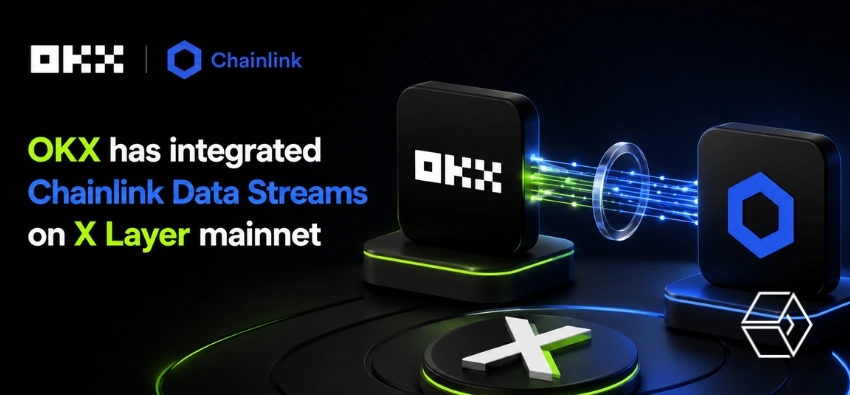
On June 17, OKX, a leading cryptocurrency exchange, revealed a major integration of Chainlink Data Streams on the mainnet of X Layer, which is its Ethereum Layer-2 network.
NEW: Top-10 crypto exchange with 120M+ users, @okx, adopts Chainlink to unlock the $80 trillion tokenized RWA opportunity on X Layer.
Chainlink enables devs to create advanced apps, bringing the agentic economy & high-speed DeFi to Chainlink Scale member @XLayerOfficial. pic.twitter.com/vIeLRZrv3s
— Chainlink (@chainlink) June 17, 2026
How OKX and Chainlink Are Building the Future of Agentic DeFi on X Layer
This integration will make tamper-resistant market data for various assets like U.S. equities, ETFs, RWAs, forex, and others directly available on-chain in order to enhance the performance of decentralized applications. This integration is mainly focused on the growing popularity of Agentic DeFi, in which artificial intelligence-based autonomous agents are making major financial decisions with very little human intervention.
Chainlink Data Stream is an oracle solution with low latency market data. It is different from traditional systems that push price updates at certain intervals. This Data Stream is designed in a way that it allows protocols to request fresh price data whenever they need it.
Apart from this, it is a very big deal if there is a price difference of 30 seconds between the old price and a sub-second price for time-sensitive operations such as derivatives liquidations or AI-based trades. The inaccurate price might create a major impact on the execution part.
The official announcement stated that, “The integration brings three categories of data to X Layer developers: 24/5 equities streams covering major US stocks including TSLA, NVDA, and AAPL; tokenized treasury pricing for collateral management and yield products; and commodities data for gold and silver. Developers can now build financial applications that reference real-world asset prices directly on-chain, without introducing the latency or trust assumptions of off-chain data pipelines.”
The integration will allow developers to fetch live, real-world asset prices on-chain without relying on off-chain data. It is a part of a major collaboration between OKX and Chainlink, and it is expected to extend through 2026. X Layer has already integrated Chainlink Cross-Chain Interoperability Protocol along with standard Data Feeds. In November 2025, the network also joined the Chainlink Scale program.
Apart from this, Chainlink Compute Runtime Environment is scheduled for integration in March 2026. OKX has planned to launch an Exchange OS powered by Chainlink by late May 2026.
The tokenized Real World Assets market has witnessed an impressive growth in the last few months. At the time of writing, the distributed asset value of the RWA market is currently revolving around $32.49 billion, according to rwa.xyz. Chainlink is playing a major role in the expansion of tokenized assets, as it has already recorded $30 trillion in cumulative transaction value. It is also responsible for more than 70% of DeFi-based activities.
Rise of Agentic DeFi
Agentic DeFi is the next big thing in the decentralized finance sector, and many platforms are already preparing themselves to embrace this rapidly growing sector of the Agentic economy. In March 2026, OKX introduced an Agentic Wallet, which was developed for autonomous on-chain execution by AI agents. This new wallet allows agents to connect and execute transactions across 20 blockchains while keeping the private key secured within a Trusted Execution Environment.
OKX has also announced Exchange OS on the X Layer, which is powered by Chainlink. It makes it easy for anyone to create markets for spot trading, perpetuals, and outcome-based contracts.
Chainlink is also expanding its Data Stream to provide support for U.S. equities and ETFs across many blockchain networks. These data streams have also been adopted by protocols such as GMX and Kamino for tokenized products. Apart from this, some Layer 2 networks, like opBNB, have also integrated Data Stream to open the door for DeFi applications.
In May, Ink announced that it is migrating to the new Oracle infrastructure, Chainlink.