Game development has historically required highly technical programming skills, advanced knowledge of game engines, and large teams. This limits who can truly get involved in making games, thus limiting experimentation in this area. The latest no-code tools have made coding knowledge optional when it comes to creating games, opening the game design field to a wider creator base.
“What is Web3 gaming?” became a frequent topic of discussion within the greater Web3 gaming news ecosystem, thanks to the evolution of these no-code tools. This included the introduction of blockchain-based ownership, tokenized economies, and decentralized systems, all of which presented new layers of complexity that require resolution from no-code platforms moving forward.
The No-Code Foundation Before Web3
Traditionally, developers had access to no-code tools like drag-and-drop interfaces, visual scripting, and pre-built assets. This made it easier for smaller indie studios to make their own games without having extensive programming backgrounds. These early forms of no-code game development fueled the current Web3 gaming trends, and helped indie developers produce and distribute their own titles.
In addition, pre-Web3 no-code games were limited in that they still had central servers and controlled economies by the platform. Therefore, concepts such as asset ownership, interoperability, and transparent economies were not possible. While no-code programs accomplished much toward simplifying game design, they could not create or operate any type of decentralized systems or form a player-owned economy as would become the norm within the Web3 gaming ecosystem.
Web3 and the Shift in Game Ownership Models
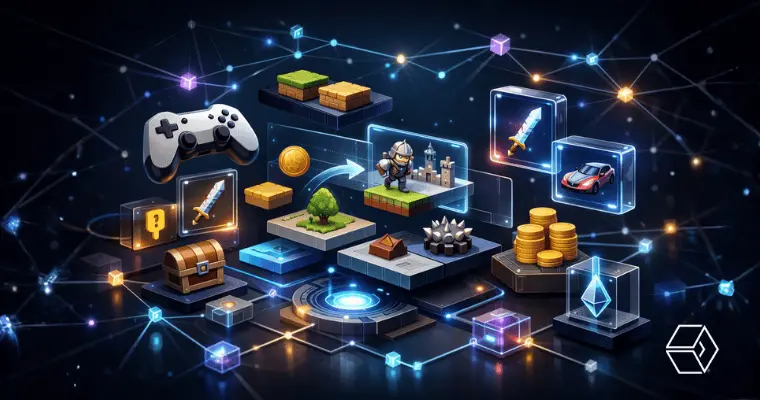
Decentralization and transparent economies sit at the core of Web3 gaming. By using blockchain technology, Web3 games let players own in-game assets such as characters, skins, and items through NFTs. These assets exist independently of the game publisher, allowing verifiable scarcity, trustless transactions, and open marketplaces where players can freely trade their items.
This model is unlike what traditional gaming offers, where digital assets remain locked within centralized servers and controlled by publishers. In Web3 environments, ownership extends beyond gameplay, letting players transfer assets across compatible platforms and ecosystems.
This fundamental shift in ownership, participation, and value distribution is a defining distinction explored in Web3 gaming vs traditional gaming models, where decentralized economies introduce entirely new ways to create and exchange value.
The Turning Point in Web3
Developer-only pipelines were insufficient for scaling Web3 gaming. The requirement of specialised blockchain expertise for managing the smart contracts, wallets, NFTs, and economies was a bottleneck to innovation. Thus, no-code platforms were created to remove the complexity.
Today’s tools like Sequence Builder and 3Engine utilize configuration instead of coding to create smart contracts, integrate wallets, and mint NFTs. The transition from coding games to configuration of decentralised systems is where no-code provides the foundation of the Web3 gaming infrastructure, not simply being a convenience. By providing decentralized game development capabilities at scale, the no-code platforms enable more rapid experimentation, decreased costs, and increased participation of creators within the Web3 gaming ecosystem.
How Modern No-Code Web3 Game Platforms Function
- Game Design & Logic: Web3 game development platforms have adopted a workflow-focused approach for defining gameplay and event-driven interaction methods rather than programming. These platforms allow developers to use visual tools and drag-and-drop style interfaces to create gameplay mechanics, gameplay rules, and progressive systems. Thus, speeding up the game development process and making Web3 game creation tools more accessible for all types of developers. This marks a key change in the creative process in Web3 gaming innovations, moving away from the engineering process bottlenecks.
- Blockchain Layer (Abstracted): Web3 gaming platforms implement pre-developed Smart Contracts to facilitate the day-to-day operations of decentralized gaming functionality. All functions related to NFTs, including ownership transfer, transferability, and rarity, are automated with the use of smart contracts. Therefore, a game developer can set up blockchain-based gaming features without having any blockchain technology expertise.
- Player Experience: Many web3 platforms have utilised the convenience of onboarding with wallet-less accounts and login processes as a way to reduce the friction of entering the Web3 gaming experiences for newbies in the crypto world. This has allowed a more traditional type of gaming experience.
- Economy & Monetization: The integration of in-game assets and secondary marketplaces, along with a unique creator revenue model, has provided a sustainable player-driven economy.
Real-World Limitations and Strategic Trade-Offs
While there has been significant progress, many challenges still exist. Despite the World Wide Web being advanced, tokenomics are still designed manually, and UX friction has slowed down mainstream adoption. Onboarding for platforms, however, has considerably improved.
Additionally, performance constraints have limited the applicability of using No-Code tools for developing complex, high-fidelity games. The uncertainty over regulatory environments surrounding digital assets directly impacts platform design and the rate at which they can grow within the marketplace, ultimately affecting the coverage of Web3 gaming news. The trade-offs between accessibility and control, as well as innovation and compliance, are becoming increasingly important as the Web3 gaming market continues to evolve.
Conclusion
The emergence of no-code game development as an important aspect of Web3 has developed through its original purpose as a productivity tool. By removing the challenges associated with developing on the blockchain, no-code development allows more people to participate in developing games, iterate quickly, and allows scalable decentralized game development.
With Web3 gaming trends pointing towards greater accessibility and ownership, no-code game development platforms will be instrumental in leading the way toward developing sustainable ecosystems. Web3 gaming success will not just be determined by the underlying technology used to build it, but by the number of builders involved in creating it. Therefore, no-code tools will help ensure that more people have the ability to develop Web3 games.