

- XUSD loses stability following the announcement of a $93 million fund loss.
- Stream suspends withdrawals during the ongoing forensic investigation process.
- Global regulators highlight stablecoin risks and demand tighter oversight.
Staked Stream USD (XUSD) has lost over 76% in 24 hours after it was reported that over $93 million was lost to a hack on Stream’s external fund manager. The event caused an immediate market movement amid investor panic.
As Stream reports, the firm has hired Perkins Coie LLP lawyers Keith Miller and Joseph Cutler to carry out a thorough investigation of the breach. All the withdrawals and deposits have been frozen awaiting the completion of the review. The project withdrew all the remaining liquid assets as a measure to protect the money of the users.
XUSD Price Collapses from Dollar Peg
XUSD is at a current price of $0.3024, a 76.0% fall in the last 24 hours as per CoinGecko data. The price briefly stabilized at about $1.26 in the early trading before plummeting to as low as $0.2473 in the intraday trade. This is one of the sharpest declines in the major stablecoin currency.
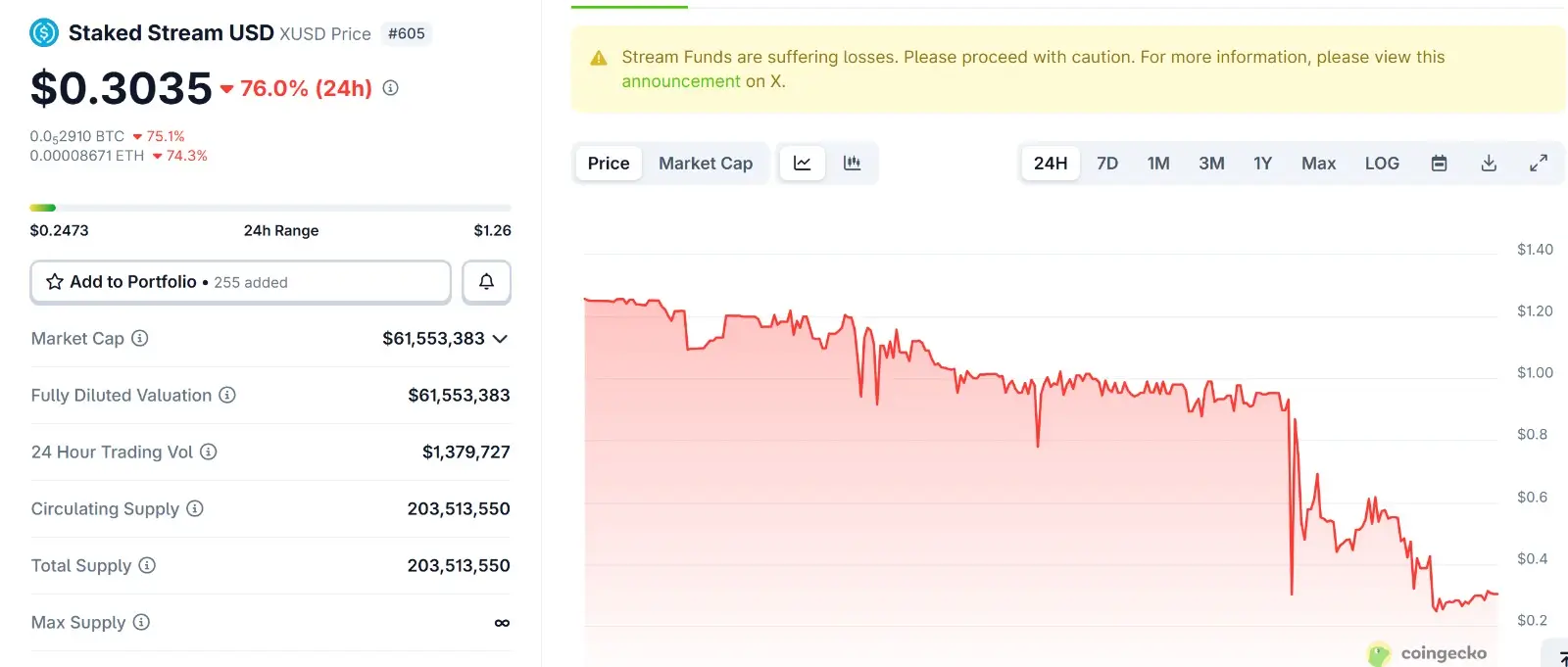
Staked XUSD Data | Source: Coingecko
The 24-hour chart further indicates that, following a sudden vertical breakdown, several temporary recovery efforts occurred. Every bounce was unable to recover the $0.60 mark. This indicates continued selling action and a lack of confidence among holders.
The structure of the chart shows a long downward curve that is interrupted by periods of consolidation. This is indicative of forced liquidations and panicked exits. The cases are common in confidence-driven failures on stablecoins.
Broader Context: Stablecoin Trust Under Pressure
The crash of the XUSD follows growing international concerns over the stability of the stablecoins. According to trusted sources, Pan Gongsheng, Governor of the People’s Bank of China (PBoC), issued a warning about the risks associated with stablecoins. The warning came during the 2025 Financial Street Annual Meeting in Beijing earlier this week.
Pan characterized stablecoins as a widening susceptibility of the international financial system. He claims they would destabilize monetary autonomy, particularly in the smaller economies. He underlined that the majority of stablecoin projects do not comply with the regulations of anti-money laundering and customer identification. According to him, this suggests that their rapid growth is a systemic risk.
This position echoes the historic approach of Beijing of banning individual online currencies whilst encouraging a central bank electronic currency, the digital yuan (e-CNY). Even the timing of the XUSD incident supports these questions and demonstrates how well-established projects can be vulnerable to risks of governance and custodianship.
Unlike China’s gradual stance, the Monetary Authority of Singapore (MAS) is in search of an active system of integrating stablecoins. MAS is attempting to standardize tokenized bank liability and stablecoin settlements through its BLOOM program (Borderless, Liquid, Open, Online, Multi-currency). This will be implemented in 2025.
BLOOM is based on the previous exploration of a digital Singapore dollar by Project Orchid. It is connected with such large institutions as DBS, UOB, and Stripe. This is aimed at creating programmable compliance systems to use in cross-border payments and corporate treasury management.
The MAS model focuses on high regulation and interoperability, a solution that is widely considered a key approach to preventing incidents like that of Stream. Although Singapore’s design entices institutional involvement on a single regulated platform, it is not regulated. It also does not provide safeguards against mismanagement and cyber attacks on unregulated or semi-custodial stablecoin systems.