

- West Virginia reviews a plan to place 10 percent of state funds into Bitcoin reserves
- The bill frames Bitcoin as a reserve asset with strict rules for treasury oversight
- Over twenty states explore similar laws as digital reserve policies gain momentum
West Virginia lawmakers are weighing a proposal that could recast how the state manages long-term public funds, opening the door for limited exposure to Bitcoin and other hard assets. The measure arrives at a moment when several states are exploring similar ideas, though few have advanced them as far as West Virginia.
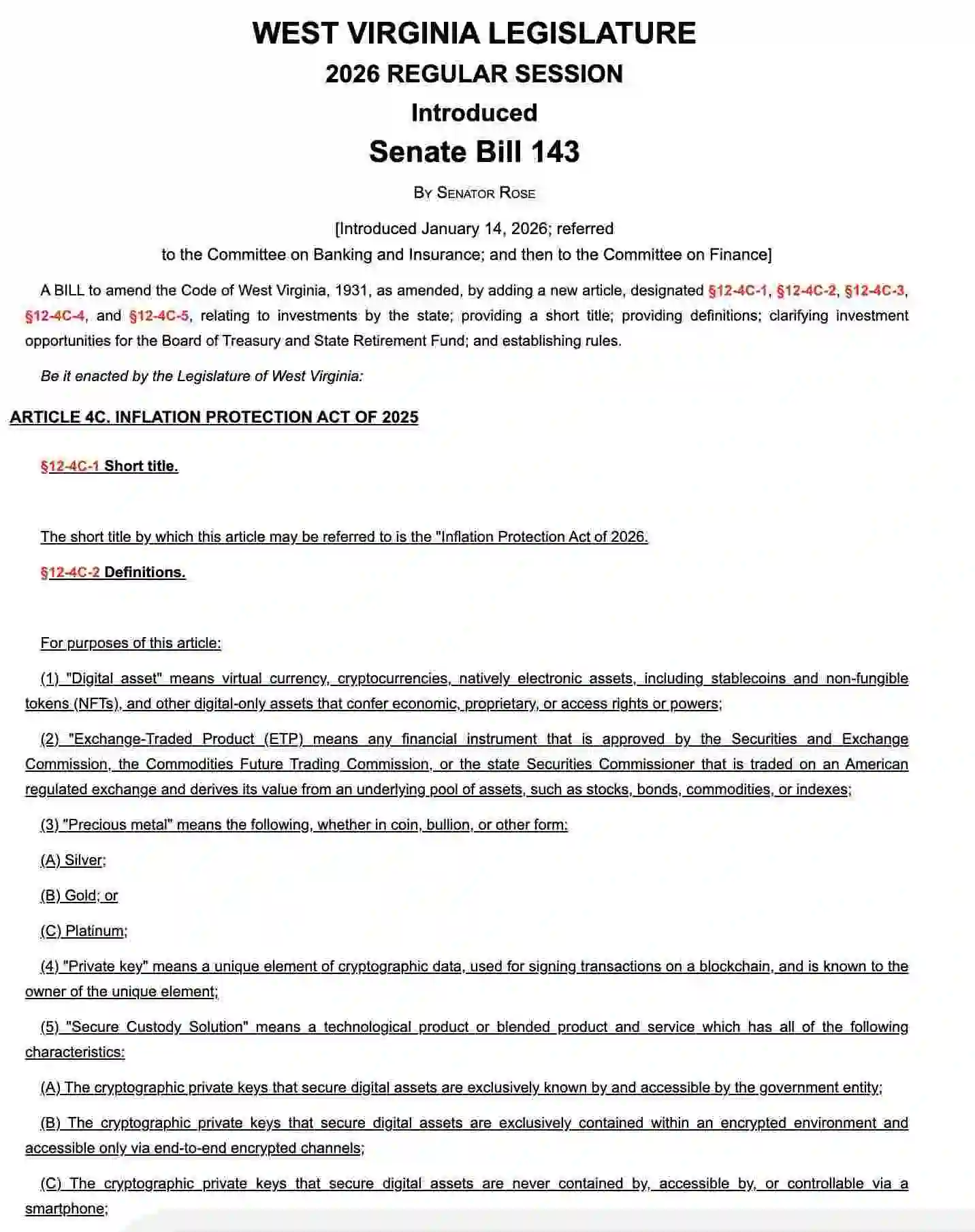
West Virginia Weighs Using 10% of State Funds for Bitcoin (Source: West Virginia Legislature)
The discussion has picked up momentum as officials search for ways to counter the drag of inflation and preserve the real value of public reserves. Filed as the Inflation Protection Act of 2025, the bill grants the state treasury authority to invest up to 10% of eligible funds in Bitcoin, precious metals, and regulated digital assets. It positions Bitcoin beside gold as a reserve-style instrument, a distinction rarely seen in state finance.
West Virginia: Treasury Authority and Strict Eligibility Rules
The legislation, sponsored by State Senator Chris Rose, outlines tight guardrails around digital asset exposure. Only Bitcoin meets the bill’s current criteria, owing to its market capitalization above the $750 billion threshold. No other token comes close, which effectively confines the proposal’s reach even before treasury decisions begin.
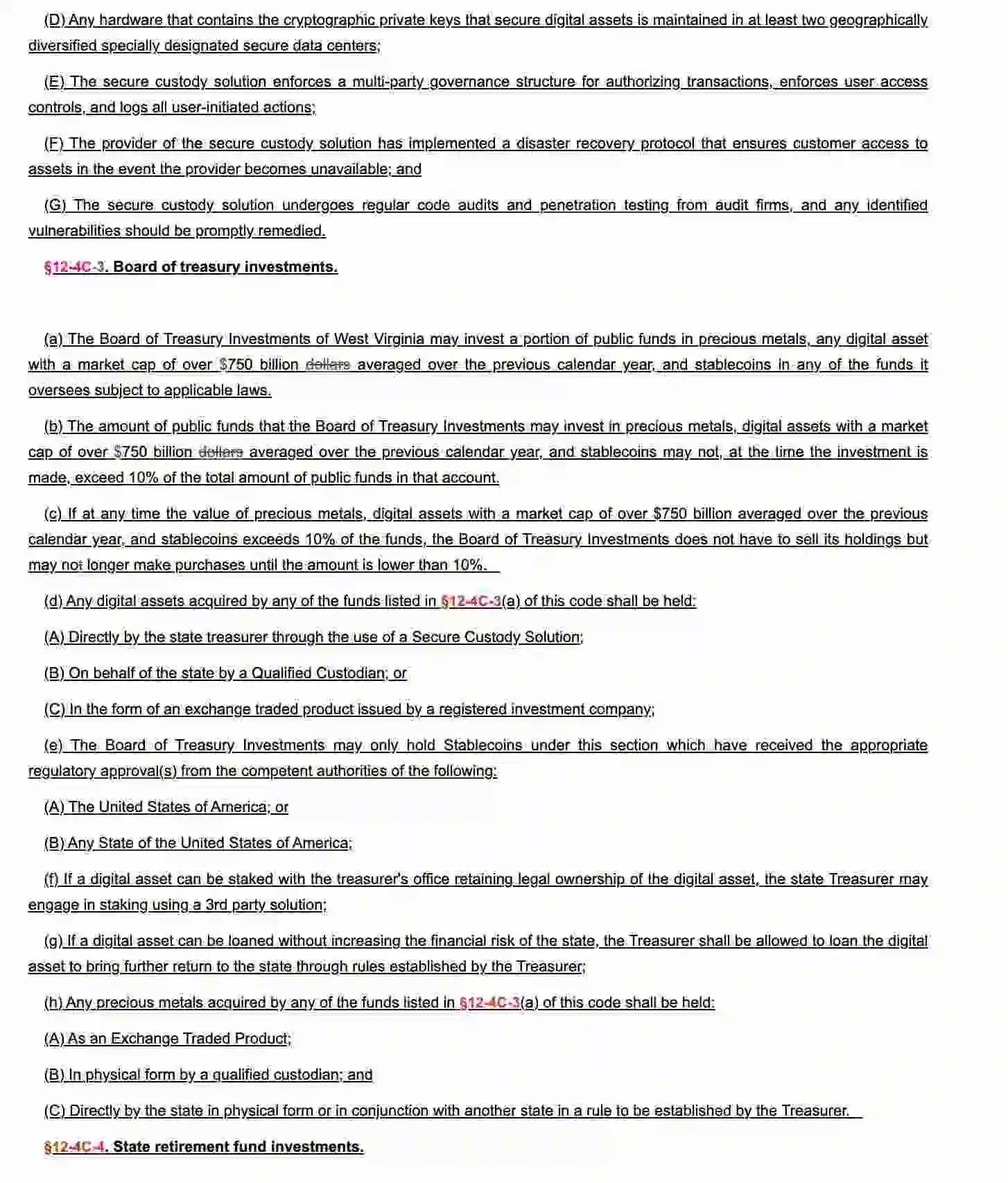
Bitcoin is the only asset that meets the bill’s threshold (Source: West Virginia Legislature)
The bill notes that any digital asset acquired must be held in secure custody, either through a qualified provider, an exchange-traded vehicle, or an on-chain solution approved for institutional use. Stablecoins are permitted only if they carry federal or state regulatory approval. As a result, these limitations place West Virginia in the more conservative tier of states testing digital asset allocations.
Rose has characterized the initiative as a hedge for pensions, severance tax funds, and other long-duration reserves. However, operating budgets remain off-limits. That distinction has been central to early debate, as lawmakers want a clear separation between daily government liquidity and long-term investment pools.
Inflation Concerns Drive the Push
Backers argue that broadening the state’s asset mix is a practical response to inflation and recurring currency pressures. The bill frames Bitcoin’s role in straightforward terms: a fixed-supply asset that functions separately from federal monetary policy. Advocates say that diversifying into hard assets, whether gold or digital, may offer insulation when traditional instruments fall short.
Nonetheless, Rose has emphasized that the goal is not to chase price moves but to preserve purchasing power over decades. That message has echoed across committee discussions, where the focus has leaned heavily toward risk controls and fiscal safeguards rather than forecasts.
For now, the measure has been routed to the Committee on Banking and Insurance. The review stage typically determines whether a bill advances or stalls, and several members have signaled interest in examining custody procedures and oversight mechanics before any vote.
A Broader State-Level Shift Toward Digital Reserves
West Virginia is not moving in isolation. Texas, Arizona, and New Hampshire have already enacted versions of crypto-reserve laws, while lawmakers in Utah, Kentucky, and Michigan have introduced similar proposals. Many include language that treats Bitcoin as a strategic reserve due to its size and liquidity.
Research from global asset manager VanEck estimates that if such legislation became widespread, cumulative demand from state reserve programs could exceed $23 billion. The projection is based on existing eligibility thresholds, most of which Bitcoin already satisfies.
Meanwhile, at least 24 states reviewed some form of digital asset reserve legislation over the past two years. Most remain in early stages, and only a handful have secured passage. Still, the trend suggests that state treasuries are beginning to test frameworks once considered far outside traditional finance.
Federal Policy Gridlock Adds Context
The state-level momentum comes as Congress remains divided on national digital asset oversight. The U.S. Senate recently paused a markup of the CLARITY Act, a bill intended to define federal market structure. Industry groups have challenged its treatment of decentralized finance and stablecoin rewards, leaving the legislation without consensus.
Whether West Virginia’s bill clears its next hurdle remains unclear. But the debate signals a shift inside statehouses, where Bitcoin is increasingly entering conversations once reserved for bonds, cash instruments, and metals. Even without certainty of passage, the proposal marks a notable step in how West Virginia evaluates long-term financial protection in an era of persistent inflation.