- The Web2 to Web3 Conference highlighted the importance of clear regulations in driving institutional blockchain adoption in MENA.
- Industry leaders emphasized the need for trusted partnerships between Web2 and Web3 companies to drive business growth.
- The conference showcased real-world use cases of blockchain in the MENA region.
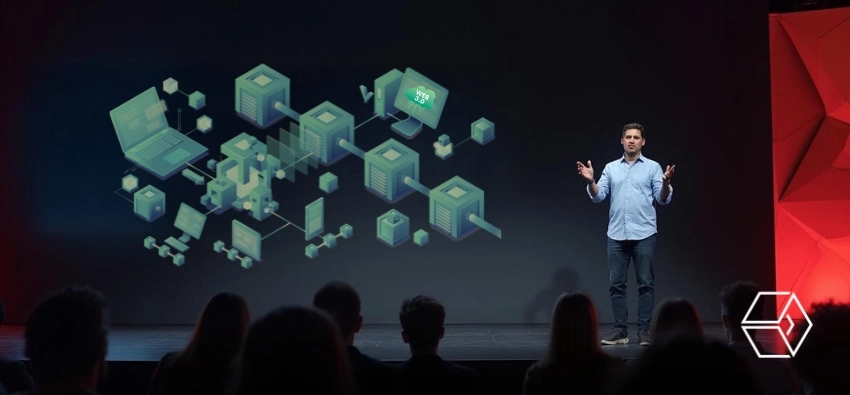
Abu Dhabi’s Web2 to Web3 Conference has marked a major milestone in the MENA region’s journey towards blockchain adoption. The event, held during Abu Dhabi Finance Week, saw industry experts, policy makers, and innovators converge to explore the potential of Web3 and its applications in the region.
Collaborating with Hub71 and stakeholders connected to the Abu Dhabi Global Market (ADGM), the conference reinforced the city’s position as a leading hub for regulated, business-driven blockchain adoption across the UAE, GCC, and broader MENA region. With a focus on driving institutional blockchain adoption, the conference agenda featured high-impact panels and key discussions that concentrated on critical pillars of Web3 integration.
Through insightful conversations on custody architectures, institutional security standards, and operational considerations, panelists provided valuable guidance for banks and multinational corporations looking to manage digital assets at scale.
Web2 to Web3 Conference Draws to a Close
Abu Dhabi Finance Week saw the successful conclusion of the Web2 to Web3 Conference. During the event, senior leaders from financial institutions, Web3 infrastructure providers, and public sector representatives came together to discuss the future of Web3 and blockchain technology.
Notably, the agenda was packed with high-impact panels and key discussions, each focusing on key pillars essential for institutions to adopt blockchain technology. The Web2 to Web3 Conference kicked off with a discussion on secure and compliant digital asset custody, a crucial challenge for traditional organizations transitioning to Web3.
Industry experts from Fireblocks, ZenGo, and n.exchange shared their expertise on custody architectures, security standards, and operational best practices for institutions handling large-scale digital assets. n.exchange founder Oleg Belousov stated,
“The Web2 to Web3 transition is driven by partnerships, not experimentation alone. Curated side events like this are essential for aligning ecosystems and accelerating real adoption.”
Interestingly, the second panel focused on the critical role of security, compliance, and trust in driving Web3 adoption. A panel of experts from Adressable, eToro, Nominis, and CertiK discussed the latest regulatory trends, anti-money laundering requirements, and smart contract security measures, highlighting the importance of measurable compliance and enterprise-grade controls in building trust in Web3. Nominis Founder Snir Levi noted,
“At the Web2 to Web3 conference, we explored the real-world challenges facing crypto, from evolving regulatory expectations to effective AML practices. At Nominis, we are committed to bridging that gap so the promise of Web3 can be realized responsibly.”
Another major highlight of the Web2 to Web3 Conference was a private conversation between Elad Mod of MarketAcross and Tomer Sharoni of Addressable. Their one-on-one conversation highlighted the need for Web3 companies to focus on data, attribution, and measurable growth to successfully engage with traditional financial institutions and enterprises.
Moreover, in the final panel, Gordon Einstein, Michael Amar, and Aviad Tamir examined how international cooperation, regulatory clarity, and global ecosystems are paving the way for Web2 organizations to enter Web3. They emphasized the importance of trusted hubs and collaboration in accelerating institutional adoption.
How the Conference Shapes the Future of Blockchain?
Across all sessions, the Web2 to Web3 Conference had a key message. It concentrated on the adoption of blockchain technology in the UAE, GCC, and MENA region. Leading players highlighted that the blockchain adoption in these regions is shifting from experimentation to implementation, driven by regulated infrastructure, strategic partnerships, and real business use cases.
The conference’s vision for a more connected and regulated blockchain ecosystem is becoming a reality, with far-reaching implications for the industry. As the blockchain space continues to evolve, it’s clear that the UAE, GCC, and MENA region will play a pivotal role in shaping the future of blockchain technology. By fostering collaboration, innovation, and regulatory clarity, the region is creating a fertile ground for blockchain adoption and setting a powerful example for the rest of the world to follow.