
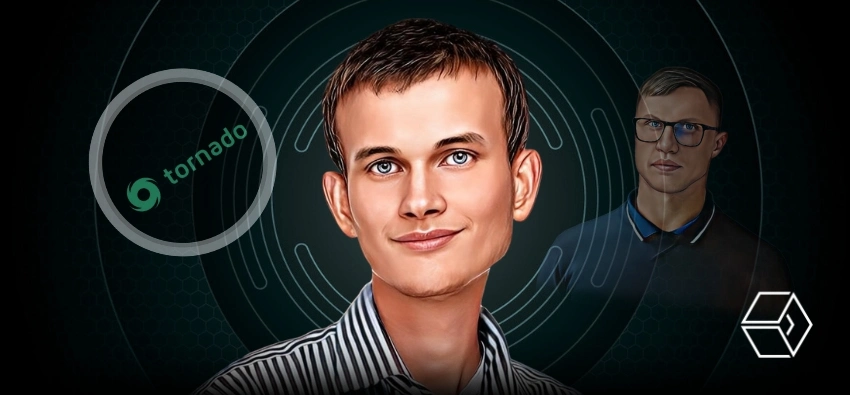
- Vitalik Buterin backs Roman Storm, arguing privacy code is not a crime but a core digital infrastructure
- Roman Storm faces up to five years in prison after a conviction tied to the Tornado Cash software
- Ethereum-linked donations helped raise over $6.39M for Storm’s legal defense in 2025
Vitalik Buterin has renewed his public defense of Roman Storm as the Tornado Cash co-founder awaits sentencing in the United States. The Ethereum co-founder framed the case as a defining moment for digital privacy and open-source development, arguing that software creators should not be held criminally responsible for how neutral tools are later used by third parties.
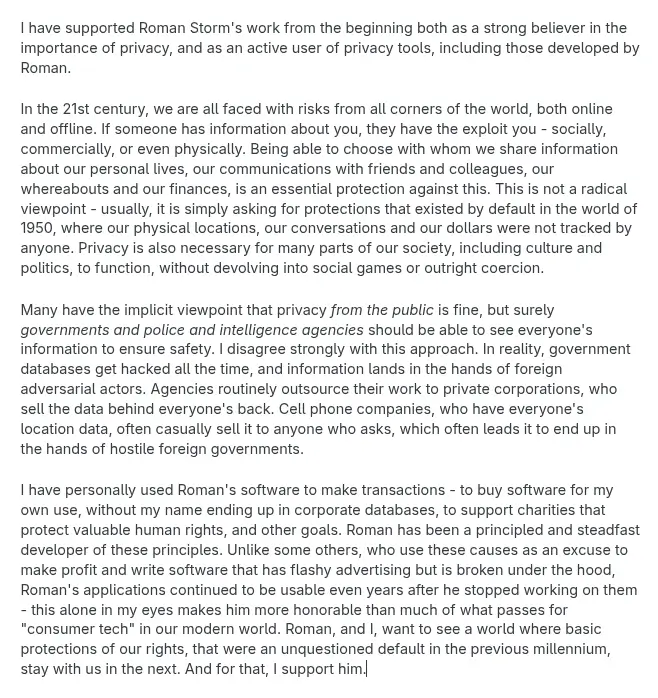
Vitalik Buterin Backs Tornado Cash Developer in Privacy Fight (Source: X)
Buterin’s latest intervention came days ahead of Storm’s sentencing for conspiracy to operate an unlicensed money transmitting business. In a public repost of a personal letter submitted to the court, Buterin described privacy-preserving software as a core safeguard in an era of expanding corporate and government surveillance. His message urged the crypto industry to actively support developers facing legal risk for writing open-source code.
Vitalik: A Conviction Focused on Code, Not Custody
In August 2025, Storm was found guilty on one charge of conspiracy to run an unlicensed money transmitting business, which was connected to his involvement with Tornado Cash. The lawyers representing the prosecution stated that the non-custodial crypto mixer has been responsible for laundering more than $1 billion in illegal money.
As a result, the conviction carries a maximum punishment of five years in prison and monetary penalties amounting to $250,000 or twice the amount of the so-called illicit proceeds. The jury, however, deadlocked on separate money laundering and sanctions-related charges.
Those unresolved counts resulted in a partial acquittal, narrowing the scope of Storm’s legal exposure. Judge Katherine Polk Failla denied pre-sentencing detention, citing Storm’s cooperation with authorities and a low risk of flight.
Besides, Buterin has consistently emphasized that Storm did not control user funds or transactions. In his letter, he characterized the prosecution as one targeting software development rather than direct financial misconduct, arguing that Tornado Cash functioned as neutral infrastructure rather than a financial intermediary.
Privacy as a Practical Use Case
In explaining his support, Vitalik pointed to his own use of privacy tools developed by Storm. He said he relied on such software to purchase technical services and donate to human rights causes without creating permanent data trails in corporate or government databases. According to Vitalik, this practical need highlights why privacy tools extend beyond criminal misuse and serve legitimate everyday purposes.
He contrasted Storm’s work with what he described as profit-driven applications that advertise privacy while failing to deliver long-term usability. Buterin noted that Storm’s applications remained functional years after he stopped actively working on them, a point he said reflected technical integrity rather than commercial motivation.
Financial and Institutional Support Grows
Financial support has been a key factor in Roman Storm’s legal and public defense. Vitalik Buterin, in December 2024, donated 50 ETH (then worth about $170,000) to the legal defense of Storm. Further, in June 2025, the Ethereum Foundation made a $500,000 donation and also promised to match up to $750,000 in additional community contributions.
Not to leave out, in October 2025, the Ethereum Foundation and Keyring Network launched a dedicated legal defense fund for Tornado Cash developers. The initiative later directed protocol fees from Keyring’s zkVerified DeFi vaults for two months toward the defense effort, alongside an additional $500,000 commitment from the Foundation.
By the end of 2025, Storm’s defense fund had raised more than $5 million, according to public disclosures. Federico Carrone, a blockchain privacy researcher, confirmed a $500,000 donation, expanding an earlier $50,000 allocation from his venture studio, LambdaClass. The Solana Policy Institute also contributed $500,000 in August 2025, earmarked to support both Storm and Tornado Cash co-creator Alexey Pertsev.
A Broader Global Context
The trial is taking place in a milieu of privacy tools being closely monitored all over the world. A Dutch court in 2024 pronounced a sentence of 64 months imprisonment on Pertsev for money laundering, which was said to be linked to the processing of $1.2 billion in transactions from July 2019 to August 2022. Consequently, developers have referred to his conviction as a sign of the increasing legal risks associated with writing privacy-oriented code.
Meanwhile, Storm has publicly thanked Vitalik for his backing and urged the crypto community to submit letters defending the right to build and use open-source privacy software. On the other hand, comments from Matthew Galeotti, Acting Head of the U.S. Department of Justice’s Criminal Division, have suggested that truly decentralized software could reduce developer liability, though the remarks carry no binding legal force.
As Roman Storm approaches sentencing, the outcome is being closely watched across the industry. For supporters like Vitalik, the case represents more than a single conviction; it tests how far privacy-preserving technology can exist under modern regulatory pressure without criminalizing the act of writing code.