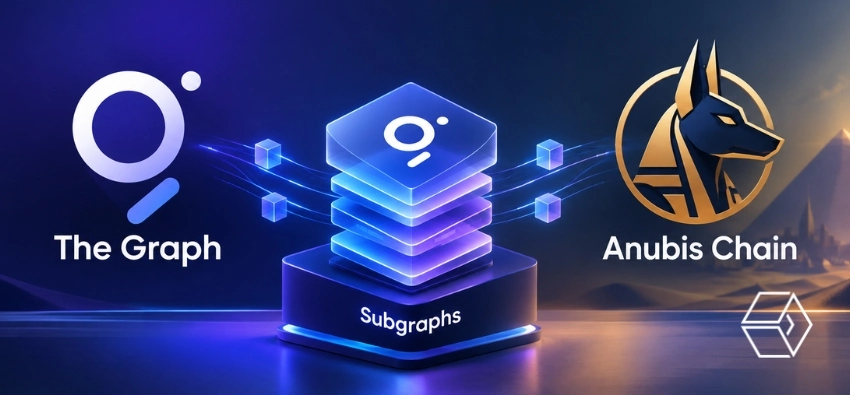
The Graph has enabled Subgraph support for Anubis Chain, giving developers building on the EVM-compatible Layer 1 a way to index and query selected on-chain data through The Graph Network. The integration connects Anubis to The Graph’s decentralized data infrastructure, where developers can define the smart-contract events and protocol activity their applications need to access.
The Graph said Anubis has been live on mainnet since April and currently processes more than 1 million transactions a day, while its announcement put the network’s total value locked at about $369 million. The development is primarily aimed at applications that depend on structured blockchain data rather than being a direct change to how Anubis users transact. It also comes with limits: information from shielded zero-knowledge transactions is not publicly available for Subgraphs to index.
What The Graph Support Means For Anubis Developers
The integration addresses a basic problem for blockchain applications: raw on-chain activity is not always presented in a format that an application can query directly. The Graph’s Subgraph documentation describes a Subgraph as a custom open API that extracts blockchain data, processes it, and stores it so it can be queried through GraphQL.
Developers can specify the contracts, events and data structures that a Subgraph should track, rather than building an indexing system for those requirements from scratch. Anubis said developers on its network can now use The Graph’s infrastructure through Subgraphs, defining the on-chain data they need for applications. The Graph confirmed that Subgraph support for Anubis is live on The Graph Network.
Anubis Chain is now supported by @GRAPHPROTOCOL.
Big step forward for builders on Anubis.
The Graph is a decentralized protocol for indexing and querying blockchain data, helping developers access the onchain data their apps need, without the heavy lifting.
To date: 1.27… PIC.TWITTER.COM/S2UTTDFVLC
— Anubis (@ANUBISCHAIN_) SEPTEMBER 15, 2026
Anubis said the integration could support applications such as DeFi interfaces, analytics dashboards, blockchain explorers, portfolio tools, on-chain agents and launchpads. These examples describe potential uses rather than confirming that the applications already use The Graph’s Anubis support.
The Graph’s official Anubis network documentation lists Anubis as a mainnet network with the identifier “anubis,” chain ID 6714, and gasDAI as its native currency. The network is also described in Anubis’s technical documentation as an EVM-based chain with privacy-focused features, including zero-knowledge proof verification and selective privacy mechanisms.
For developers, the practical change is that a Subgraph can serve as a structured data layer between Anubis contracts and an application. Once published and indexed, the data can be queried through GraphQL. The Graph’s publishing documentation says published Subgraphs become available to Indexers on the decentralized network, which process the data and make it queryable.
What The Integration Supports And Its Limits
The Graph’s announcement describes Anubis as an EVM-compatible Layer 1 with privacy at the base layer. It also says the network has been live since April, has about $369 million in TVL, and handles more than 1 million transactions per day. Those figures come from The Graph’s announcement and provide context for the network at the time of the integration.
Anubis is one of the more interesting L1s shipping right now: EVM-compatible, privacy at the base layer, mainnet live since April. Anubis already has ~$369M TVL and 1M+ transactions a day.
Subgraph support for @ANUBISCHAIN_ is now live on The Graph Network:… HTTPS://T.CO/HVJPJYXHSU PIC.TWITTER.COM/R9G6JLEGZC
— The Graph (@graphprotocol) SEPTEMBER 15, 2026
The support does not mean every piece of Anubis activity becomes available through Subgraphs. The Graph’s Anubis documentation identifies the network as a supported mainnet, while its general Subgraph documentation explains that developers choose which contracts and events their Subgraphs index.
That distinction matters for Anubis because the network includes privacy features. Its documentation describes a system using zero-knowledge proofs, encrypted data, and selective disclosure.
Public blockchain information can be indexed, but data that is shielded and not publicly visible cannot simply be extracted by a Subgraph. The result is a data infrastructure layer that can organize information available on-chain without removing the privacy properties of shielded transactions.
The Graph’s supported-networks documentation also lists Anubis among the networks supported by its decentralized indexing infrastructure. For Anubis, the immediate change is therefore an additional option for developers who need structured blockchain data for applications.
The integration does not, by itself, establish how many applications will use the service or how it will affect activity on the network. Its practical impact will depend on the Subgraphs developers publish and the applications that use the resulting data.