Key Highlights:
- The Solana Foundation has merged SIMD-0567 into the main branch, proposing p-ATA as a replacement for the existing Associated Token Account program.
- Built on Pinocchio, p-ATA demonstrated approximately 35% lower transaction execution time in developer benchmarks.
- The new program is not yet live on mainnet and must complete Solana’s established migration process before deployment.
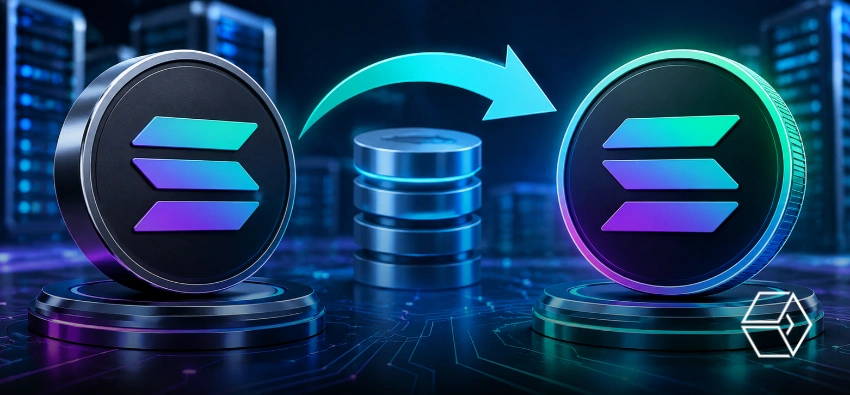
Solana has emerged its SIMD-0567 proposal into the network’s main branch, marking a step towards improving the efficiency of its token account infrastructure. The proposal introduces p-ATA, an optimised replacement for the existing Associated Token Account (ATA) program, built using Pinocchio to decrease computational unit consumption and improve transaction execution. Developer benchmarks indicate that the new program can decrease execution time by approximately 35% compared with the current implementation.
However, the merge does not mean the updated program is already active on Solana mainnet. It must still pass through the network’s established migration process before adoption, meaning the performance improvements have not yet been released to users.
What Does Solana’s SIMD-0567 Proposal Change?
The SIMD-0567 proposal aims to replace Solana’s existing Associated Token Account program with p-ATA, a more efficient implementation built on Pinocchio. Associated Token Accounts are used across Solana’s ecosystem to manage token holdings associated with user wallets. The program’s efficiency matters because its execution consumes computational units, or CUs, which are part of the resources required to process transactions on the network.
By rebuilding the program using Pinocchio, the proposal seeks to decrease this computational overhead and improve execution efficiency. The Solana Foundation has merged the proposal into the main branch, indicating that the proposed code change has been accepted into the development codebase.
As per Odaily Planet Daily, earlier developer benchmarks showed that p-ATA could reduce transaction execution time by approximately 35% compared with the existing ATA program. The improvement is intended to make token account operations more efficient, potentially benefiting applications that depend on the program.
The proposal also emphasizes the potential impact beyond individual transactions. As per its mainnet analysis, the current ATA program appears in approximately 11.85% of all transactions. It accounts for 13.28% of the total compute unit usage. The proposal estimates that this could translate into a 10-11% decrease in compute usage across the Solana network. It will potentially help in freeing up the extra block capacity.
When Will the New p-ATA Program Go Live on Solana Mainnet?
Although SIMD-0567 has been merged, the update is not yet live on Solana mainnet. The code merge and the actual replacement of the existing program are separate stages. The new implementation must follow Solana’s established migration process before it can become active. Until that process is completed, the existing ATA program remains in use, and the reported performance improvements should be viewed as benchmark results rather than gains already available across the network.
The benchmark results also indicate that providing the Rent Sysvar account can further reduce p-ATA’s computational unit consumption. However, this configuration slightly increases execution time, bringing transaction-level latency back to around a 1% difference. This suggests that lower CU usage does not necessarily translate into an equivalent reduction in execution time under every configuration.
The proposal is designed to maintain compatibility with current applications and wallets. It retains the same program address and token account address derivation as the current ATA program. This means developers should not need to modify their applications to benefit from the replacement once it is activated.
Once deployed, the optimised program could improve the efficiency of token account operations and potentially support future token listings on Solana. However, the actual impact will depend on the completed migration and performance under live network conditions.
For now, the SIMD-0567 merge represents progress towards a more efficient Solana token infrastructure, but the mainnet rollout remains a separate step.