
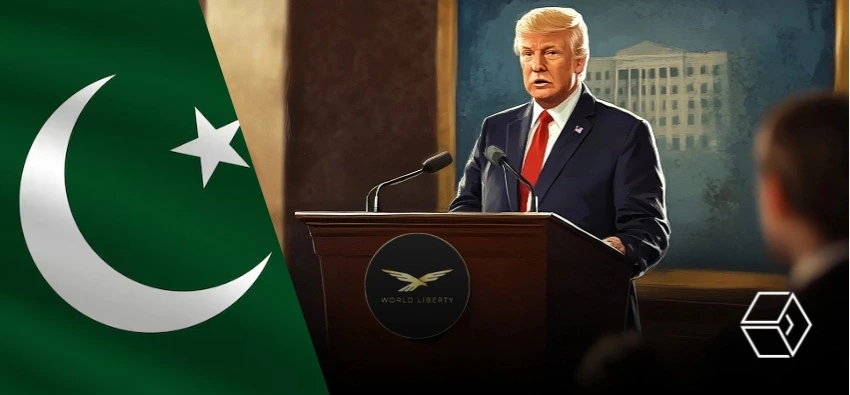
- Pakistan is partnering with the Trump family-linked WLFI.
- The partnership allows Pakistan to integrate the USD1 stablecoin into the financial system.
- The country intends to make cross-border payments easier and transparent.
Pakistan is taking a progressive approach to crypto and blockchain after years of skeptical view. In a strategic alliance, the country has announced its partnership with World Liberty Financial (WLFI), a blockchain platform linked to US President Donald Trump.
With this critical collaboration, Pakistan will integrate WLFI’s USD1 stablecoin into the country’s payments system. This move indicates the nation’s interest in crypto and stablecoins, bringing faster, easier, and transparent blockchain technology to its public.
Unveiling Pakistan’s Policy Shift: WLFI Partnership Announced
Pakistan has reportedly announced a major partnership with Trump-linked World Liberty Financial. The agreement was signed through SC Financial Technologies, a WLFI affiliate. This move marks the country’s initial collaboration with a DeFi platform connected to US President Trump.
On January 9, 2026, the State Bank of Pakistan finalized its decision to integrate WLFI’s USD1 stablecoin into the country’s financial space. The USD-pegged cryptocurrency is expected to operate under Pakistan’s regulatory oversight, aligning with the country’s evolving crypto regulations. Pakistan Finance Minister Muhammad Aurangzeb stated,
“Our focus is to stay ahead of the curve by engaging with credible global players, understanding new financial models, and ensuring that innovation, where explored, is aligned with regulation, stability, and national interest.”
Pakistan is expected to announce the news officially later today. This will reportedly coincide with WLFI CEO Zach Witkoff’s visit to Islamabad. So far, neither WLFI nor Pakistan has commented on the partnership and stablecoin integration.
Cross-Border Payments and Remittances in Focus
Significantly, this WLFI initiative holds its focus on cross-border payments, particularly remittances. This represents a significant part of Pakistan’s financial economy.
Every year, overseas Pakistanis send back more than $30 billion. Much of this money is transmitted to traditional banking systems, making it more costly and slow. With the introduction of a regulated stablecoin via the WLFI collaboration, the country intends to make overseas transactions easier with less cost, more speed, and greater transparency.
Pakistan’s Push Toward Digital Finance
Pakistan has been actively exploring digital currency and blockchain-based solutions in recent times. Despite taking a restrictive approach to crypto initially, the country is now embracing the innovative technology.
In July, the central bank announced plans to launch a pilot digital currency project. Although the token is not yet out, the bank asserted that it is in the process of finalizing it.
Significantly, Pakistan’s renewed approach to cryptocurrencies is part of its efforts to tackle its prolonged economic crisis. The country has been witnessing high inflation, foreign exchange issues, and political uncertainty. While these issues have also resulted in the loss of public trust in the traditional financial system, the country is experimenting with crypto and blockchain technologies.
Why Stablecoins Gain Global Attention?
Stablecoins have seen a notable growth in recent years. Driven by their convenience, transaction speed, transparency, and less expense, people across the world opt for stablecoins rather than fiat currencies.
More governments are introducing stablecoin regulations to guarantee a secure environment while promoting their growth. Countries like South Korea are launching their stablecoins backed by local currencies. In addition, global nations like the US, Singapore, the UAE, and Hong Kong are establishing a specific stablecoin regulatory framework.