

- Morgan Stanley files S-1 forms for spot Bitcoin and Solana ETFs with the SEC.
- The new Solana fund features staking as crypto ETF trading volume tops $2 trillion.
- Spot Bitcoin ETFs now hold $123.5B as institutions seek regulated market access.
Morgan Stanley has expanded its presence in the crypto asset management sector after filing two registration statements with the U.S. Securities and Exchange Commission (SEC) for new exchange-traded funds (ETFs) tied to Bitcoin and Solana. The filings, published Tuesday, signal a significant advancement in the participation of major financial institutions in the rapidly scaling crypto ETF market.
Dual ETF Filings Mark a Broader Push Into Digital Assets
The Wall Street institution, which manages roughly $1.8 trillion in assets, submitted separate S-1s for the Morgan Stanley Bitcoin Trust and the Morgan Stanley Solana Trust. Both products are designed to offer regulated exposure to their underlying digital assets, with the Solana product including a staking component, an uncommon feature among proposed U.S. ETFs.
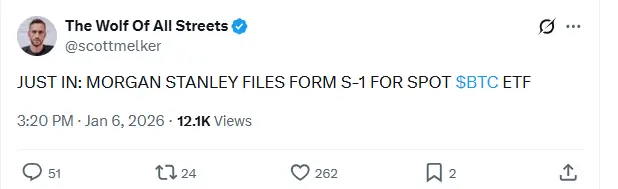
Morgan Stanley Files S-1 for Bitcoin, Solana ETFs With SEC (Source: X)
According to SEC disclosures, the Bitcoin Trust is structured as an exchange-traded fund holding physical BTC, not derivatives or leveraged instruments. Besides, the Trust’s net asset value will be calculated daily using a benchmark derived from activity across leading spot exchanges.
If approved, the ETF is expected to list under a ticker symbol that has not yet been announced. The Solana Trust mirrors the model but adds staking rewards, allowing the fund to capture network yield directly from SOL’s proof-of-stake mechanism.
The Operational Blueprint Behind the New Crypto Trusts
The sponsor, Morgan Stanley Investment Management, will oversee both trusts, each designed as a passive vehicle. Their mandate is limited to tracking the price of the underlying asset, net of fees and expenses, without engaging in active trading strategies.
Moreover, creation and redemption will occur only through authorized participants in large blocks, executed in either cash or in-kind transfers. For cash transactions, the sponsor will rely on vetted third-party Bitcoin counterparties.
Retail investors, meanwhile, will access the products through standard brokerage accounts, similar to other spot crypto ETFs now widely available in the United States. This structure mirrors existing spot Bitcoin funds already on the market, offering familiar mechanics to investors while maintaining strict compliance requirements.
Record ETF Flows Redraw the Crypto Market Landscape
The filings land in a market that has grown unusually fast by ETF standards. Trading activity across U.S. spot crypto ETFs has now crossed $2 trillion, according to data compiled by The Block. It took more than a year to reach the first trillion and then roughly eight months to double it, a sign of deeper liquidity and a wider trading base.

Cumulative ETF Flow (Source: The Block Data)
Spot Bitcoin ETFs alone hold more than $123.5 billion in assets. That figure amounts to about 6.6% of Bitcoin’s total market value, a share that was nearly unthinkable before U.S. regulators approved the first round of spot products early last year. That accumulation has continued even with Bitcoin prices struggling to break above the $100,000 level in recent sessions.
Some of this growth reflects the reality that many investors, particularly institutions, prefer to avoid the mechanics of crypto custody. ETF wrappers simplify everything from reporting to compliance checks, and that familiarity has helped expand the audience for digital-asset exposure.
Why Morgan Stanley’s Entry Shifts the ETF Race
This step carries its own weight because of who is making it. Morgan Stanley’s presence in a sector already crowded with names like BlackRock, Fidelity, and Grayscale suggests the competitive phase of crypto ETFs is far from over.
The filing also hints at a shifting regulatory environment. While the SEC has not fundamentally rewritten its stance on digital assets, the agency has settled into clearer patterns around approvals, disclosures, and operational requirements. That consistency, narrow as it may be, has given traditional firms more room to approach crypto without guessing at regulatory red lines.
Importantly, there is the demand angle. Investors looking for regulated channels have steadily gravitated toward ETFs over direct holdings, and fund issuers have responded with more intricate designs. Morgan Stanley’s inclusion of staking in its Solana trust is one example of how issuers are trying to differentiate while staying within compliance boundaries.
Wall Street Veterans Accelerate Their Shift Into Regulated Crypto Products
The latest filings show how far digital assets have pushed into mainstream investment infrastructure. ETF structures now act as the bridge many investors prefer, and banks appear increasingly comfortable offering products built on top of them.
If approved, Morgan Stanley’s Bitcoin and Solana trusts would join a fast-expanding roster of spot funds that have reshaped access to crypto in the United States. They also reinforce the pace at which traditional finance continues to absorb what was once considered a fringe market.