

- IO Group delivered 89% of Cardano milestones as canceled funds move back to the treasury.
- Cardano node upgrades, Hydra releases, and UTXO HD cuts defined IO’s latest technical report.
- USDCx, LayerZero, CME futures, and DeFi TVL growth added adoption weight to Cardano’s report.
Input Output (IO) Group reported 89% delivery across its Cardano commitments for Q4 2025 and Q1 2026, highlighting measurable progress under treasury-funded workstreams. The update covered five proposal areas: Catalyst, IOE, IOR, Blockfrost, and BMVG.
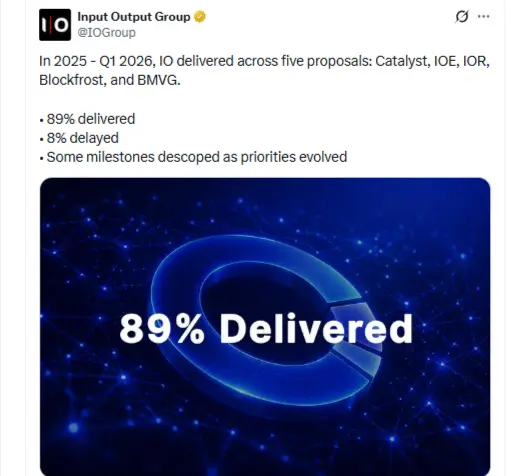
The April 28 delivery report said IO Group progressed 16 of 18 funded commitments during the period. Two commitments, however, Acropolis and tiered pricing, were canceled, with their funds set to return to the Cardano Treasury after an Intersect smart contract update.
Treasury Tracker Shows Delivery Record
The report showed that 89% of milestones were delivered, 8% were delayed, and several were removed after priorities changed. Input Output said all milestones from the period are publicly trackable through the Treasury milestone tracker.
The update gives the Cardano community a clearer view of how approved treasury funding moved into delivered work. It also shows how canceled allocations are handled when commitments change or no longer match current priorities.
Under the treasury structure, community-approved funding is linked to measurable delivery. Intersect has previously said vendor contracts can be tied to milestones, while payments can be paused, reorganized, or canceled when terms shift.
That structure placed the returned funds at the center of the report. Rather than remaining attached to canceled workstreams, the allocations are expected to revert to treasury control.
Core Upgrades Shape Technical Progress
A large part of the delivery report focused on Cardano’s core infrastructure. IO Group said its engineering team shipped node versions 10.5.4 and 10.6.2 during the review period. The company also reported improved network connectivity, removal of the legacy networking stack, and added support for future protocol versions.
These upgrades formed the base of the technical delivery section. Notably, the KES agent reached version 1.0, according to the report. The tool separates cryptographic key handling from the main node process, reducing operational risk for stake pool operators.
IO Group also cited progress on UTXO HD, which moved the UTXO set from memory to disk. The company said the change cut Cardano node memory use by up to 80%. Scaling work also featured heavily in the report. Mithril reached a stable release, while Hydra advanced through versions 1.0.0 to 1.3.0.
Meanwhile, Leios produced its first working prototype on a local multi-node network. Together, the three technologies covered faster verification, layer-two transactions, and higher base-layer throughput.
Adoption and Research Add Context
The report also listed adoption milestones across DeFi, stablecoins, bridges, and retail payments. USDCx, for instance, launched on Cardano in Q1 2026 and passed 15 million minted tokens within its first week. During the same period, Cardano DeFi’s total value locked rose from $127 million to $142 million.
Minswap, Liqwid, and SundaeSwap supported active liquidity pools. LayerZero’s integration with Cardano and Midnight added another major item. IO Group said the integration connected the ecosystem to more than 160 blockchains and over $80 billion in cross-chain assets.
The report also cited CME Group’s launch of Cardano futures and Coinbase adding ADA as collateral for on-chain loans. ADA acceptance in 137 SPAR stores in Switzerland was also included.
On research, Input Output Research closed Cardano Vision Work Package 25 with all milestones complete. The report also noted two financial cryptography 2026 papers.
Meanwhile, the ADA token traded near $0.246 at the time of writing, with a narrow intraday range. Overall, the report’s main impact centered on governance records, treasury accountability, and measurable delivery.