

- Europol seized €25M in Bitcoin after dismantling the Cryptomixer laundering hub.
- The service laundered over €1.3B in BTC for ransomware groups and darknet markets.
- Europol says criminal networks will face delays but will shift to new laundering routes.
European authorities have shut down CryptoMixer, a cryptocurrency-mixing platform linked to more than €1.3 billion ($1.4 billion) in laundered Bitcoin since 2016. The takedown followed a sweeping cross-border operation led by Germany and Switzerland with support from Europol and Eurojust.
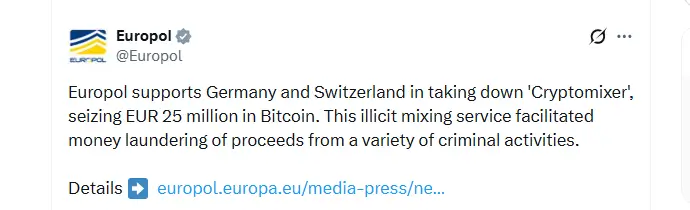
Germany, Switzerland, and Europe shut down Crypto Mixer in a cross-border operation (Source:x)
The takedown marks one of Europe’s largest strikes against crypto-enabled crime this year and delivered the seizure of €25 million in Bitcoin, three servers, and more than 12 terabytes of data.
Europol Cross-Border Raid: A Coordinated Operation in Zurich
The operation, known as Operation Olympia, was executed between 24 and 28 November 2025 in Zurich. Law enforcement teams from Germany’s Federal Criminal Police Office and Frankfurt prosecutors joined forces with the Zurich City and Cantonal Police to dismantle the platform’s infrastructure.
Europol coordinated intelligence sharing, hosted operational meetings, and deployed cybercrime specialists to provide on-the-ground forensic support. Authorities seized the cryptomixer.io domain, its Tor dark-web counterpart, and the servers hosting the service.
A seizure banner now replaces the website. According to Europol, the confiscated 12 terabytes of data are expected to play a crucial role in tracing long-running laundering networks and identifying connected criminal groups.
A Mixing Service at the Center of Illicit Finance
Cryptomixer functioned as a hybrid mixing service on both the clear web and dark web. The backend of the application kept users’ deposits together and, after random time intervals, redistributed them, unlinking the transactions and hiding the funds’ source. This setup attracted not only ransomware but also underground market vendors, weapon traffickers, drug networks, and fraudsters using credit cards as their top laundering choice.
Europol reported that more than €1.3 billion in Bitcoin passed through the service since 2016, highlighting the scale at which the mixer operated. Cybercrime analyst David Sehyeon Baek said the volume reflected “a major laundering hub,” adding that platforms reach this scale only when they become embedded in ransomware ecosystems and long-standing dark-web marketplaces.
Baek noted that Cryptomixer’s near-decade of activity demonstrated operational maturity, with stable infrastructure and a strong reputation in illicit communities. Investigators echoed this assessment, identifying the mixer as a central node in Europe’s cybercrime laundering pipeline.
Short-Term Disruption, Long-Term Adaptation
Experts say the takedown will disrupt criminal cash-out operations in the short term. Groups dependent on Cryptomixer for day-to-day laundering will likely face delays, stuck funds, and a temporary scramble for alternatives. However, Europol and consultants warn that the long-term impact may be limited.
Baek explained that most ransomware crews and high-volume operators typically migrate to other mixers, cross-chain bridges, high-risk exchanges, or layering services within weeks. “The friction is real,” he said, “but laundering activity does not disappear. It shifts.”
Europol issued a similar warning earlier this year, noting that criminal abuse of crypto is growing more sophisticated and placing increased pressure on EU agencies.
Part of a Wider Crackdown on Crypto Crime
The dismantling of Cryptomixer is the latest in a steady escalation of Europe-wide operations targeting crypto-enabled criminal networks.
In March 2023, Europol supported a major takedown of ChipMixer, then one of the largest mixing services, seizing four servers, 7 TB of data, and $46.5 million in Bitcoin.
More recently:
- Earlier this month, police across Cyprus, Spain, and Germany arrested nine suspects connected to a crypto money-laundering network tied to €600 million in fraud.
- Last month, Europol seized €300,000 in cryptocurrency and arrested seven individuals linked to a cybercrime-as-a-service operation in Latvia.
- This year, U.S. and European courts have issued prison sentences for the founders of Samourai Wallet and other operators tied to laundering hundreds of millions in stolen crypto.
Burkhard Mühl, head of Europol’s European Financial and Economic Crime Centre, recently warned that blockchain-based laundering schemes continue to evolve rapidly, increasing investigative burdens on member states.
However, the takedown of Cryptomixer signals Europe’s continued push to disrupt illicit finance at the infrastructure level. With servers seized, domains offline, and terabytes of data in the hands of investigators, authorities say the operation marks a significant step in weakening long-standing crypto-enabled criminal networks, even as new ones emerge to take their place.