
- Europol ended a €700M crypto scam after a long cross-border probe and two-phase action.
- Nine suspects were arrested as police seized cash, crypto, and luxury items in joint raids.
- Deepfake ads and a linked mixer with €1.3B flows exposed a wider laundering system.
European authorities (Europol) have taken down one of the most expansive crypto fraud operations uncovered to date. This followed a coordinated cross-border crackdown that exposed a vast web of fake investment platforms and illicit laundering channels responsible for more than EUR 700 million in criminal flows.
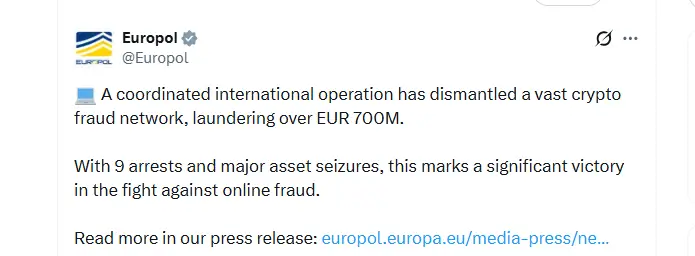
Europol Dismantles €700M Crypto Fraud Ring (Source: X)
The sweeping action was executed in two major phases. It brought together law enforcement teams from multiple countries and resulted in nine arrests, large-scale asset seizures, and the disruption of the affiliate-marketing engines that had driven the scams for years.
Europol: A Network Built on Fake Platforms and Relentless Pressure
Europol explained that the case started with a look at a single suspicious investment site. What followed was far more complex than anyone expected. The people behind the scheme built an ecosystem made up of fake trading platforms, professional-looking ads, and call centers that pressured victims into sending more money each time they logged in.
Many users believed they were watching real returns, only to realize later that the numbers on the screen meant nothing. Once the deposits arrived, usually in cryptocurrency, the funds were pushed through different blockchains and into a web of exchanges and conversion routes.
Moving the money quickly helped the group hide its trail. Europol said the criminals relied on frequent asset swaps, offshore exchanges, and layered movements to keep investigators in the dark. By the time the raids were carried out, more than EUR 700 million had passed through the network.
First Phase: Raids, Arrests, and Millions in Seizures
According to reports, the first enforcement sweep took place on October 27, 2025. Teams in Cyprus, Germany, and Spain carried out coordinated searches, acting on requests from French and Belgian authorities. Consequently, nine people were arrested, all believed to be directly involved in laundering the stolen funds.
Police also recovered a significant amount of money and property, including:
- EUR 800,000 across various bank accounts
- EUR 415,000 in cryptocurrency
- EUR 300,000 in cash
- Several luxury items and extensive financial documents
The documents offered a clearer picture of how the organization handled deposits, withdrew funds, and shuffled money across different jurisdictions.
Second Phase: Deepfake Campaigns and Aggressive Marketing Uncovered
The second wave of actions came a month later, on November 25 and 26, with searches in Belgium, Bulgaria, Germany, and Israel. This time, investigators focused on the marketing engines that fed victims into the scam.
Companies linked to targeted ad campaigns were searched, and investigators found a range of misleading promotions that used manipulated social-media posts and deepfake videos to make the platforms appear trustworthy.
These ads had a wide reach. Many victims reported that they first encountered the scam through videos that looked like legitimate endorsements. However, Europol’s cyber teams mapped these funnels, tracked on-chain activity, and helped seize digital wallets tied to the cases.
Related Operation: Parallel Takedown of CryptoMixer Exposes Broader Laundering Network
As reported by TimeofBlockchain, in a separate but closely connected operation, authorities recently dismantled CryptoMixer, a service that had operated since 2016. The platform mixed Bitcoin deposits and redistributed funds in scattered intervals to hide the link between sender and recipient.
Under Operation Olympia, led by Germany and Switzerland, officials seized EUR 25 million in Bitcoin, three servers, and 12 terabytes of internal data.
CryptoMixer was used by groups involved in ransomware attacks, narcotics distribution, weapons trafficking, and other underground markets. Its long-term reliability made it a favored tool for concealing digital flows.
A Landmark Victory, but a Persistent Threat
For investigators, the takedown represents a major breakthrough. It shows that coordinated action, strong digital forensics, and cooperation between countries can bring down even complex, multinational operations. But Europol cautioned that similar schemes are almost certain to reappear.
The case highlights an uncomfortable truth for investors: polished websites, convincing marketing, and apparent transparency do not guarantee safety. This is because criminal groups continue to adapt, creating scams that closely resemble legitimate financial services.
Consequently, anyone exploring online investment opportunities is urged to verify platform details, research operators, and remain alert to pressure tactics, especially those that push for quick deposits or repeat transfers.