

- Ethena adds Kraken Custody to strengthen and diversify institutional backing for USDe
- Monthly attestations and weekly proof-of-reserves for USDe start in January 2026
- USDe holds over $6B market cap as regulated custody boosts stablecoin confidence
Ethena Labs has added Kraken Custody to the group of firms safeguarding assets behind its synthetic dollar, USDe. The change widens the custody footprint at a moment when reserve handling has become as important to market confidence as peg mechanics themselves.
The protocol said the decision followed a full review by its risk committee and places Kraken Custody alongside existing providers Copper, Ceffu, and Anchorage Digital Bank. Taken together, the lineup reflects a push toward redundancy rather than reliance on any single institution.
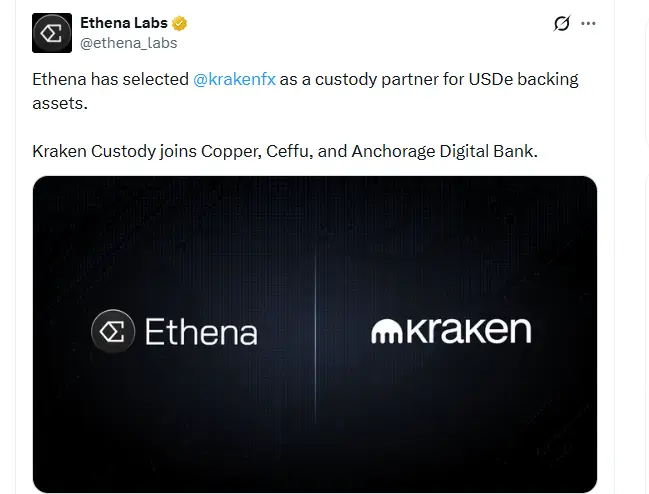
Ethena Taps Kraken to Strengthen USDe Stablecoin Backing (Source: X)
That approach has become standard practice among issuers looking to limit operational concentration. Notably, Ethena said all assets backing USDe are held in institutional custody solutions, and the introduction of an additional provider further distributes risk across multiple, independent custodians.
The protocol confirmed that monthly signed custodian attestations and weekly proof-of-reserves reporting will begin this January, providing public insight into how backing assets are stored and safeguarded.
Kraken Bolsters Ethena’s Multi-Layered Custody and Risk Controls
On the other hand, Kraken Custody operates as a qualified digital asset custodian under a U.S. state-chartered banking framework. The service is designed for institutional clients and incorporates hardware security modules, multi-party computation, and segregated cold storage. Ethena said these controls align with its internal requirements for safeguarding assets that underpin USDe.
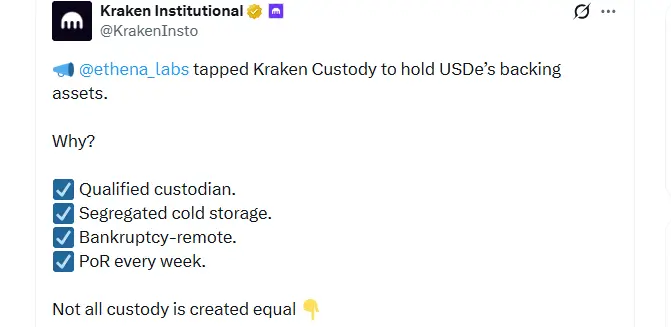
Kraken Custody Aligns With Safeguarding Assets Under USDe Requirements (Source: X)
The protocol further noted that Kraken Custody was subject to a full due-diligence process before approval. This included an assessment of regulatory standing, operational controls, and security architecture. With this integration, Kraken Custody will hold a portion of USDe’s backing assets in bankruptcy-remote structures intended to protect token holders in adverse scenarios.
Kraken Institutional leadership described the partnership as an example of demand for custody services that can support complex stablecoin workflows while operating within clear regulatory boundaries. Ethena’s founder added that custody decisions directly affect the stability and scalability of USDe, making regulated infrastructure a prerequisite for growth rather than an optional feature.
Inside the Mechanics Behind USDe’s Backing
USDe differs from traditional fiat-backed stablecoins that hold cash or Treasury bills on a one-to-one basis. Ethena uses a delta-neutral strategy that combines collateral with hedging instruments to target a dollar-linked value while generating yield. That structure places added weight on how assets are stored and verified, since the backing is diversified by design.
Over the past year, Ethena has steadily expanded its custody network as USDe’s footprint has grown. Anchorage Digital Bank was added earlier as a custodian and is set to provide public attestations beginning in early 2026. Those disclosures, combined with the new reporting from Kraken Custody, are intended to give the market clearer visibility into reserve handling.
As of early January 2026, USDe has continued to trade near its $1 level with a market capitalization above $6 billion. Trading data shows steady liquidity across venues, even during periods of broader market stress, suggesting sustained demand for the token’s structure.
Custodial Diversification and Market Confidence
Custody has quietly moved to the center of the stablecoin debate. Over the past year, issuers have leaned harder into diversification as a way to limit single points of failure and reassure large holders that assets are not sitting behind one operational door.
Ethena’s approach reflects that shift. By distributing reserves across several regulated custodians, the protocol is signaling that risk management, not speed or scale, is driving its infrastructure decisions.
The presence of Kraken Custody alongside Anchorage Digital Bank places Ethena Labs among a growing group of stablecoin issuers building around regulated custody rather than retrofitting it later. For institutional participants, the message is straightforward: transparency and counterparty controls are no longer optional.
They are baseline expectations, especially as oversight tightens in both the U.S. and Europe and regulators focus more closely on how reserves are held, verified, and reported.
The Changing Architecture of Stablecoin Confidence
Ethena’s custody expansion comes at a time when the stablecoin market is still recalibrating. Supply across several major tokens has ebbed and flowed over the past year, shaped by shifting liquidity conditions and periodic market stress.
At the same time, demand for independently audited custody and publicly disclosed reserve data has accelerated, driven in part by the fallout from earlier protocol failures that exposed weaknesses in opaque reserve structures.
Against that backdrop, Ethena’s decision to formalize proof-of-reserves reporting and broaden its custody base reinforces the positioning of USDe as a product built for durability rather than short-term growth.
Adding Kraken Custody introduces another regulated layer into that framework. More broadly, it reflects how custody strategy has become a defining factor in stablecoin credibility, increasingly viewed by the market as inseparable from trust itself.