
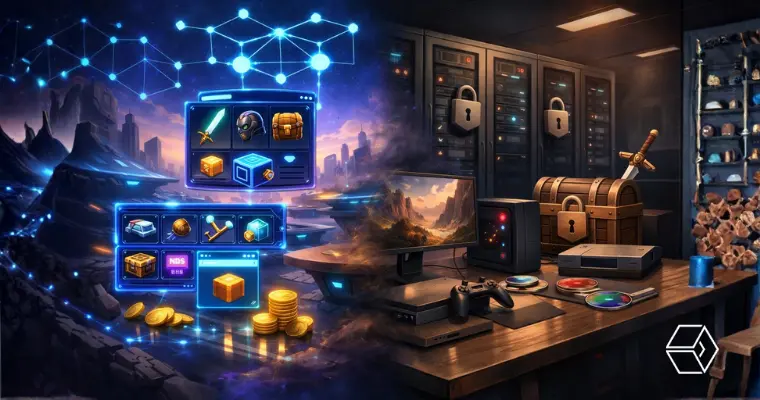
The gaming market has progressed from cartridge-based systems to an industry that is estimated to be worth around $180 billion. Many areas within the traditional gaming industry in terms of performance, graphics, and the ability to reach a larger audience have significantly improved. But, the idea of centralising control has not changed at all.
The Web3 gaming market has changed how video games are built, owned, and governed. It is the result of a fundamental change in how we build and utilize the digital world. Web3 gaming infrastructure is not going to replace traditional gaming but rebuild it.
In this article, we will outline the key differences between Web2 and Web3 gaming ecosystems in terms of ownership, economics, infrastructure, and user experience trade-offs. As a result, both developers and gamers can have a better understanding of each option and make their best decision.
A Simple Model Breakdown
Traditional Gaming (Web2 Model)
Traditional gaming or the Web2 model is characterized by publisher-controlled servers and players need to purchase licenses (keys) to access the content. The players have no true ownership of the game, and all assets, economies, and governance are closed systems, optimized for performance and scalability.
Web3 Gaming
Web3 gaming combines all of the previous ideas from traditional gaming, decentralizing game development with blockchain technology, and allowing true ownership of in-game assets and itemization of all economies. Current Web3 gaming platforms are generally a mixture of these two concepts, thus creating a hybrid Web2.5 model that enables players to utilize the best of both worlds (usability from Web2 and decentralization from Web3).
Key Differences Between Web3 Gaming and Traditional Gaming
1. Core Infrastructure & Architecture: Speed vs Sovereignty
- Client–Server Architecture in Traditional Gaming: Traditional gaming ecosystems are entirely reliant on client-server architecture. It relies on the game publisher to create the clients and their corresponding databases and provide the servers. Traditionally, an efficient architecture allows low latency, quick transaction times, and seamless multiplayer functionality. In addition, all player accounts depend entirely on the publisher’s ability and willingness to operate and maintain the servers.
- Web3 Gaming Architecture: The Web3 gaming industry combines physical and virtual infrastructure over several layers of blockchain technology. Smart contracts are used to manage asset ownership, in-game economy, and governance. However, gameplay logic continues to be generated from a centralized server.
The new decentralized architecture accommodates player-owned or controlled assets, allows the development of permissionless marketplaces, cross-game interoperability, and eventually forms the foundation of the Web3 gaming ecosystem. There are now Web3 game development platforms that remove blockchain’s complexity and simplify onboarding into developing for Web3. - Lag vs Security: Blockchains are inherently slower than the centralized Web2 databases. Thus, Web3’s decentralized game development means one must, at least for the time being, sacrifice speed (real-time) for a greater degree of security (decentralized).
2. Asset Ownership: Renting Pixels vs Owning Property
- Traditional Gaming Asset Model: In traditional gaming, skins, characters, and items are licensed to the gamer, meaning they cannot be sold or transferred elsewhere, and therefore, do not provide legal ownership.
- Web3 Ownership Model: Web3 gaming uses NFTs and tokens to let players verify their ownership. Assets reside in the player’s wallet rather than being stored in databases, and they can be traded freely. This is the key element behind “what is Web3 gaming”.
- Why Ownership Changes Player Psychology: The sense of ownership creates a paradigm shift for gamers from consumers to stakeholders. The time that they put into gaming becomes an investment rather than consumption, and therefore, shifts their willingness to engage and remain loyal to the gaming experience.
3. Economic Design: Closed Economies vs Open Markets
- Traditional Monetization Models: In traditional monetization models, companies usually monetise through a physical retail strategy with game consoles and PCs. Online transactions have introduced more monetisation options like loot boxes, battle passes, DLC, subscriptions, and more.
- Web3 Token Economies: Blockchain technology has enabled players to create open-source monetised economies powered by Web3 gaming crypto. Players can now create their own assets with real value outside the gaming experience, unlike conventional games.
- The Death of Early Play-to-Earn: The death of play-to-earn models has been a result of inflation, speculation, and the transition from the early model of entertainment. Now, new models are being developed by combining fun and rewards to encourage users to play for enjoyment rather than for material gain or wealth.
4. User Experience (UX): Friction as the Adoption Killer
- Traditional Gaming UX: The gaming industry has traditionally focused on providing players with high-quality experiences via highly centralized platforms with ease of onboarding and maximum performance.
- Early Web3 UX Failures: The initial Web3 gaming innovations were primarily limited by the inconvenience of advanced wallet setups, the financial burden of transaction fees associated with blockchain, and the friction created by an overall complicated and difficult-to-use interface. Although many positive Web3 gaming trends were being reported in the community, the numerous barriers to adoption and retention that were present in early Web3 gaming severely hampered the overall growth of the industry.
- 2025 UX Breakthroughs: With the widespread emergence of superior Web3 game creation tools in 2025 and beyond, embedding wallets within a game, transitioning away from gas fees by using abstracted fee systems, and eliminating the need to think about blockchain technology altogether, will greatly enhance the ability for players to participate in the Web3 gaming industry. This will effectively remove the majority of the friction, widely covered in Web3 gaming news, and increase the amount of available accessibility options for consumer participation.
5. Governance & Control: Publisher Authority vs Community Voice
- Traditional Governance: Traditional governance models provide exclusive content, monetization, and player data to publishers. Their principal objective is to create efficient systems rather than community participation.
- Web3 Governance Models: Web 3.0 Governance models support decentralized game development by utilizing coin-based votes amongst the community. These governances are built on emerging Web3 gaming trends, while giving players the ability to champion their economy.
- Hybrid Governance Structures: A Hybrid Governance structure, blending traditional governance with the participation and collaborative input of the community, allows Web3 gaming innovations while protecting the collective wallets of the players.
Also Read: No-Code Game Development in the Web3
Regulation, Compliance & Legitimacy
The traditional gaming industry has existing rules and regulations for payments, consumer safety, and data privacy. However, at the beginning of Web3 Gaming, there were many questions regarding how digital assets would be regulated by the law and what types of tokens would be regulated by different jurisdictions. Improvements in web3 gaming news since then have provided developers with clear guidance on the types of token models they should use and how to build secure onboarding processes into their games.
Web3 gaming creation tools available are now being designed with compliance features to make them easier for developers to use. These changes are helping to create more trust in the industry, facilitate decentralized game development, and encourage the creation of giant gaming studios and investment firms that will continue to shape the future of Web3 gaming.
Convergence, Not Competition
The future of Web3 gaming will be defined by the convergence of the two worlds of traditional gaming and blockchain, as opposed to disruption through blockchain technology. Traditional game developers are selectively adopting blockchain technology, so most of the focus from Web3 has been on ensuring Web3 gaming development, with improved quality in gameplay and usability.
New data from the emerging Web3 gaming trends include players wanting the same level of ownership and interoperability as they currently have, but with the same experience of playing traditional game titles. With all of the Web3 gaming innovations and powerful Web3 game creation tools, decentralized game development is becoming integrated with the traditional models of game development, creating a brand new ecosystem in which the technology enhances the engagement of players without sacrificing the enjoyment and accessibility of the games.