
- Anuma offers multi-model AI access while keeping user memory private by default
- ZetaChain 2.0 lets developers build once and run apps across models and chains securely
- The network scaled to 11.5 million users and processed 225 million transactions
ZetaChain has announced a public waitlist and beta launch for Anuma, a privacy-first AI interface built on ZetaChain 2.0. At the same time, the company introduced ZetaChain 2.0, a new AI interoperability layer designed for developers building cross-model applications.
The launch targets developers and users seeking unified AI access without backend infrastructure. ZetaChain said the platform enables applications to run across AI models while keeping user context private and permissioned.
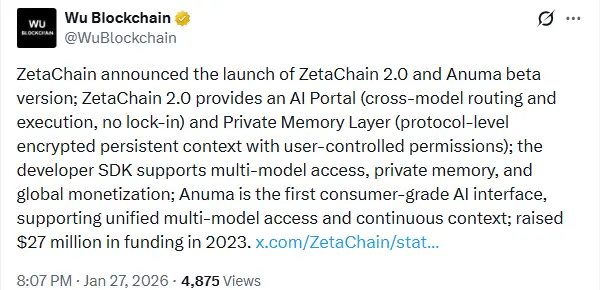
ZetaChain 2.0 Debuts With AI Portal and Private Memory Layer (Source: X)
The announcement follows ZetaChain’s expansion in 2025, when the network reached 11.5 million users and processed more than 225 million transactions. The company stated that ZetaChain 2.0 extends this scale from blockchains into the realm of artificial intelligence.
From Web3 Unification to AI Interoperability
ZetaChain was originally built as a universal layer to reduce fragmentation in Web3. The network allows developers to build universal applications that access assets like Bitcoin and execute across multiple blockchains from one platform.
On X, the company said it built ZetaChain so developers could “build once and reach every chain.” It added that in 2025, the network secured operations with support from major technology companies. The company stated that ZetaChain 2.0 applies the same approach to AI.
ZetaChain 2.0: The Universal Layer for AI and Web3 (Source: X)
The company said AI now acts as a new application layer, yet remains fragmented across models, tools, and integrations. The company explained that most AI systems do not share state. As a result, applications fail to reliably carry context, and developers repeatedly rebuild routing, memory, and billing systems.
Market Adoption Meets Structural Limits
AI adoption continues to grow fast globally. McKinsey reported that ChatGPT reached 100 million users within two months of launch. OpenAI later reported 800 million users who accessed their platform every week by the end of 2025.
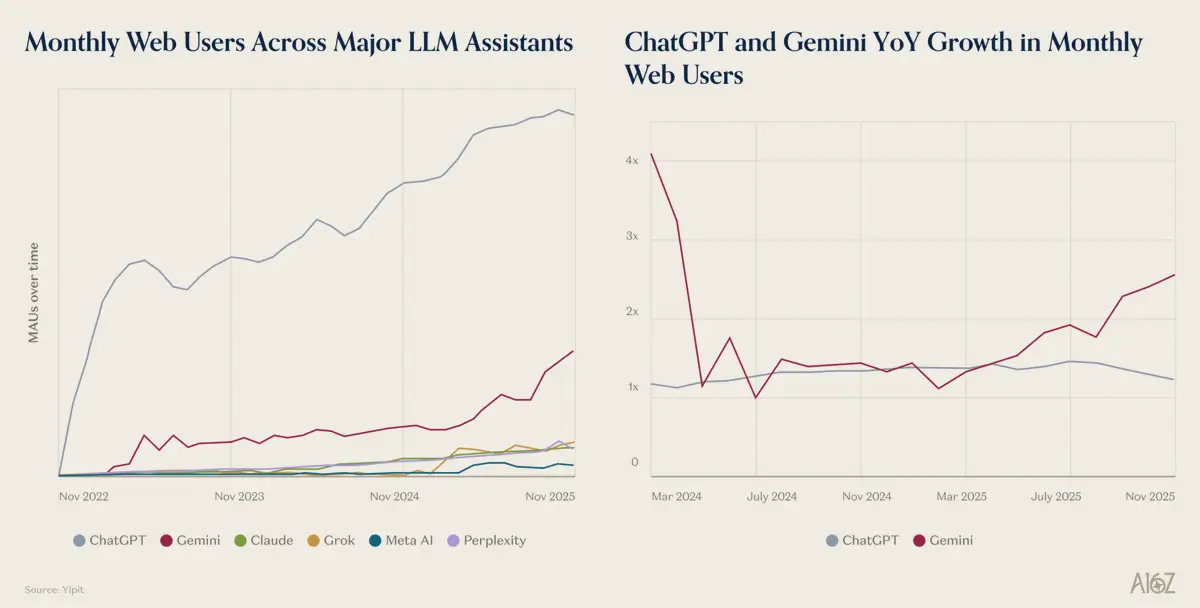
ChatGPT sustained 800–900M MAUs; Gemini is growing MAUs at nearly 3X (Source: Andreessen Horowitz)
Despite this growth, the ecosystem remains divided. The firm cited data showing that only 9% of consumers pay for more than one AI subscription across major assistants. This structure creates lock-in at the model level.
ZetaChain 2.0 Unifies Routing Private Memory Monetization
ZetaChain 2.0 consists of two core components. The AI Portal provides unified routing and execution across multiple AI model providers without lock-in, while optimizing availability, fallback, and cost performance. On the other hand, the Private Memory Layer introduces protocol-level encrypted memory.
It allows persistent user context across sessions while giving users direct control over which applications and agents can access that data. Alongside these components, the organization released a developer SDK.
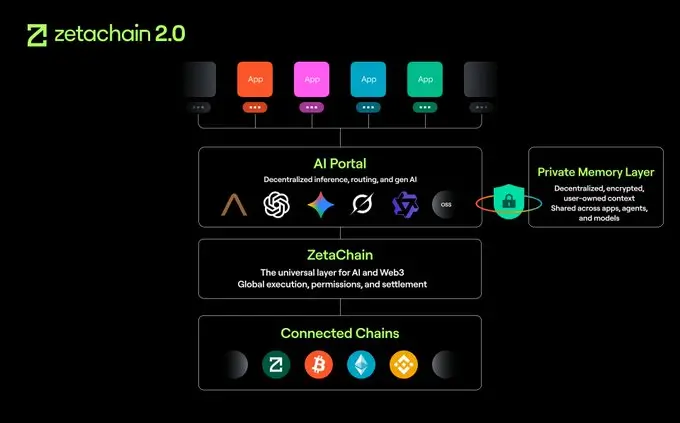
ZetaChain 2.0 General Purpose Layer-1 Designed Application (Source: X)
The toolkit packages private memory, cross-model access, and monetization features into a single platform. The SDK supports global monetization rails, including on-chain settlement and traditional payment processors. The team said developers can generate revenue without building custom backend systems.
Anuma Brings Privacy-First Multi-Model AI to Users
Anuma serves as the first consumer interface built on ZetaChain 2.0. The product offers access to multiple AI models through a single interface and enables users to switch models without losing context. The firm said Anuma keeps memory private and user-controlled by default.
Users can now request early access through the public waitlist. Ankur Nandwani, a core contributor to the company and co-creator of Basic Attention Token, compared Anuma’s approach to Brave’s privacy-first browsing model.
Brave now supports more than 100 million monthly active users. Nandwani said Brave demonstrated that privacy-first defaults can succeed at consumer scale. He added that ZetaChain 2.0 extends this approach to AI across models and chains.
In 2023, the firm raised $27 million in funding. Participants included Blockchain.com, Human Capital, VY Capital, Sky9 Capital, Jane Street Capital, VistaLabs, CMT Digital, Foundation Capital, Lingfeng Capital, and GSR.