
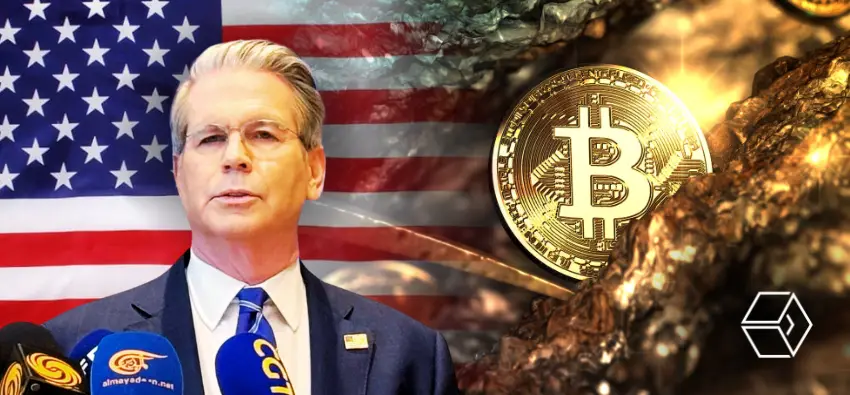
- Scott Bessent told Congress the U.S. Treasury cannot support Bitcoin or force banks to buy it
- The U.S. Treasury will only hold seized Bitcoin and cannot buy BTC during market downturns
- Trump’s Bitcoin reserve allows growth only through seizures or budget-neutral asset swaps
The U.S. Treasury has no legal authority to intervene in Bitcoin markets or orchestrate a bailout during periods of stress, Treasury Secretary Scott Bessent told lawmakers this week. Testifying before Congress on Wednesday, Bessent made clear that while the United States will retain Bitcoin obtained through criminal asset seizures, it will not direct private banks to buy the digital asset or step in to stabilize prices during a downturn.
Bessent’s remarks came amid renewed debate over the federal government’s role in digital assets following President Donald Trump’s executive order establishing a Bitcoin strategic reserve in March 2025. The policy has drawn sharp reactions across the political spectrum, with critics warning of financial risk and some Bitcoin advocates arguing the approach falls short of creating meaningful demand.
Congress Presses on Bitcoin Bailouts
During the hearing, California Congressman Brad Sherman, a long-time critic of cryptocurrencies, asked whether the U.S. Treasury or the Federal Open Market Committee could legally bail out Bitcoin. Sherman also pressed Bessent on whether he planned to adjust bank reserve rules to encourage purchases of Bitcoin or so-called “Trump Coin,” referring to memecoins linked to President Donald Trump.
However, Bessent rejected the premise outright. He told lawmakers that he does not have the authority to direct banks to buy Bitcoin and that, even in his role as chair of the Financial Stability Oversight Council, such powers do not exist. His testimony underscored that the U.S. Treasury has no mandate to support crypto markets in the way it might backstop banks or other systemically important institutions during a crisis.
Bessent also disclosed new figures on seized digital assets. According to his testimony, roughly $500 million in Bitcoin obtained through forfeiture cases appreciated to more than $15 billion while held in government custody, highlighting the scale of exposure created by law-enforcement seizures rather than by active market purchases.
U.S. Treasury: Bitcoin Reserve Rules and Limits
The Bitcoin strategic reserve established by Trump’s executive order restricts how the U.S. Treasury can expand its holdings. The order allows additional Bitcoin acquisitions only through asset forfeiture or so-called budget-neutral strategies that do not add new spending lines to the federal budget.
Those methods include converting existing reserve assets, such as petroleum stocks or precious metals, into Bitcoin. The framework explicitly rules out open-market purchases, disappointing parts of the Bitcoin community that had hoped for direct government buying to boost demand and prices.
Some Republican lawmakers continue to explore alternative paths. One such senator, Cynthia Lummis, has suggested using U.S. gold reserves to acquire Bitcoin, arguing such a move could fit within existing executive authority. She further added that she raised the idea with Bessent and would support further action if legally permissible.
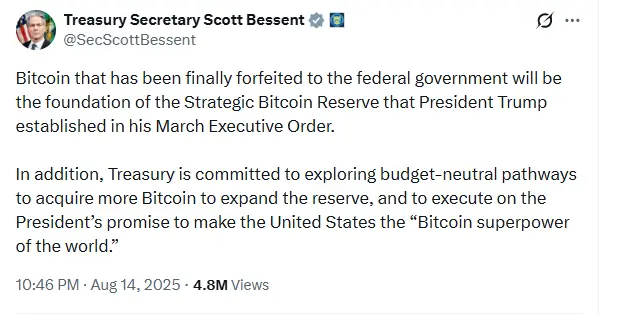
U.S. Treasury’s Scott Bessent’s View on budget-neutral methods to acquire Bitcoin (Source: X)
In August 2025, Bessent added nuance to the debate by saying the U.S. Treasury was exploring budget-neutral methods to acquire Bitcoin, a statement that appeared to soften earlier resistance while still staying within the limits of the executive order.
CBDC Questions and Market Critics
Lawmakers also questioned Bessent about central bank digital currencies. However, he said he was unaware of any active effort by the Federal Reserve or the federal government to develop a U.S. CBDC. The Fed has studied the concept, publishing a report in 2024, but Chair Jerome Powell has repeatedly said no CBDC would be issued without congressional approval.
Critics seized on the hearing to reiterate opposition to Bitcoin. Economist Peter Schiff argued on X that prioritizing crypto diverts capital from productive investment. Schiff contrasted U.S. crypto policy with China’s focus on manufacturing and gold accumulation and reiterated his view that Bitcoin will never serve as a global reserve currency.
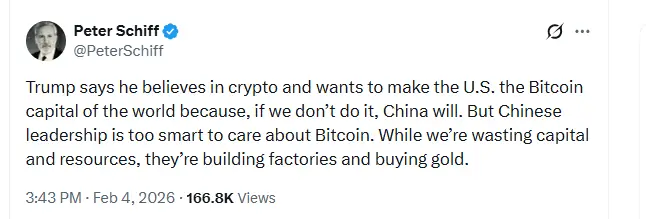
Economist Peter Schiff Compares U.S.-China Bitcoin Accumulation (Source: X)
On the other hand, Bitcoin advocates counter that even limited government exposure matters. Samson Mow has argued that any expansion of U.S. holdings could send a powerful signal to other countries. For now, Bessent’s testimony draws a firm line: the U.S. Treasury will hold seized Bitcoin, but it will not bail it out.