
- The Senate Agriculture Committee advanced the Crypto Bill on a 12–11 party-line vote
- The measure gives the CFTC authority over digital commodities and spot crypto markets
- Democrats opposed the bill, citing ethics risks and a lack of limits on public officials
The Senate Agriculture Committee moved a long-debated cryptocurrency market structure proposal forward on Thursday, sending a clear signal that Congress is edging closer to defining how digital asset markets are regulated in the United States. The vote, split cleanly along party lines, advanced legislation that would place much of the crypto spot market under the supervision of the Commodity Futures Trading Commission.
By a margin of 12 Republicans in favor and 11 Democrats opposed, the committee approved the Digital Commodity Intermediaries Act. While narrow, the result was historic, as no prior crypto market structure bill had ever cleared a Senate committee. The development gives fresh momentum to an effort that has stalled repeatedly amid jurisdictional disputes, industry pressure, and growing political mistrust around digital assets.
A First-of-Its-Kind Senate Breakthrough
The Agriculture Committee’s action does not send the measure directly to the Senate floor. The Senate Banking Committee must first pass its own version before lawmakers can reconcile the two texts into a single bill. Only then can the legislation be considered by the full chamber.
Even so, the vote matters. The committee oversees commodities markets, making it the natural home for proposals that expand the authority of the Commodity Futures Trading Commission. Supporters framed Thursday’s move as a necessary step to keep market structure negotiations alive after months of delay.
Chairman John Boozman proceeded with the markup despite the collapse of earlier bipartisan talks. A prior draft, negotiated with Democratic Senator Cory Booker last year, unraveled after disagreements over ethics and enforcement scope. Booker formally withdrew support before Thursday’s vote, leaving Republicans to advance the measure on their own.
What the Crypto Bill Covers
The legislation approved by the committee focuses on clarifying regulatory authority rather than rewriting the entire digital asset rulebook. It defines what constitutes a digital commodity, establishes registration requirements for trading platforms, and sets expectations for coordination between the CFTC and the Securities and Exchange Commission.
Consumer protections are also central to the text. The bill requires segregation of customer funds, addresses conflicts of interest, and outlines baseline conduct standards for intermediaries operating in spot crypto markets. Supporters argue these provisions mirror safeguards long applied in traditional commodity trading.
Committee aides and industry analysts say clearer jurisdiction could reduce uncertainty that has pushed U.S. trading activity offshore. They also note that overlapping enforcement claims by federal agencies have raised compliance costs without delivering consistent protections for retail participants.
Democratic Objections and Unresolved Ethics Questions
On the other hand, Democrats on the committee opposed the measure, citing both structural and ethical concerns. Booker argued during the markup that advancing a crypto framework without stronger guardrails for public officials risks undermining public trust. He criticized what he described as extensive personal involvement by President Donald Trump and his family in the digital asset sector.
As a result, Democratic members proposed amendments to bar senior public officials from participating in the crypto industry and to address exposure to digital commodities linked to foreign adversaries. However, none of those proposals was adopted. Boozman ruled that such matters fall outside the Agriculture Committee’s jurisdiction, a decision that preserved the bill’s narrow focus but sharpened partisan tensions.
Industry Response and the Path Forward
Crypto industry leaders welcomed the committee’s action. Coinbase chief executive Brian Armstrong called the vote an important step toward comprehensive federal rules, thanking committee leadership and emphasizing the need for a unified framework.
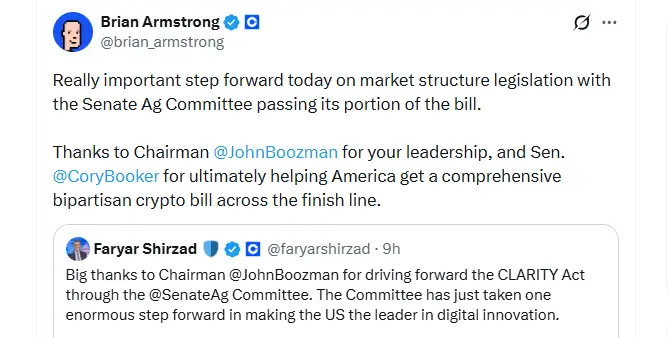
Coinbase CEO on Senate’s Crypto Bill Advance (Source: X)
Still, the road ahead remains uncertain. The Senate Banking Committee postponed consideration of its companion bill earlier this month after industry pushback, and no new markup date has been set. Boozman said he expects further coordination between committees, including discussions around crypto-related scams and consumer risks.
For the bill to pass the Senate, Republicans will need at least seven Democratic votes. Whether that support materializes will depend on negotiations still to come. What Thursday’s vote establishes, at minimum, is that the Senate Crypto Bill is no longer theoretical. It has cleared its first real hurdle, and the debate over how the U.S. regulates digital assets has entered a more consequential phase.