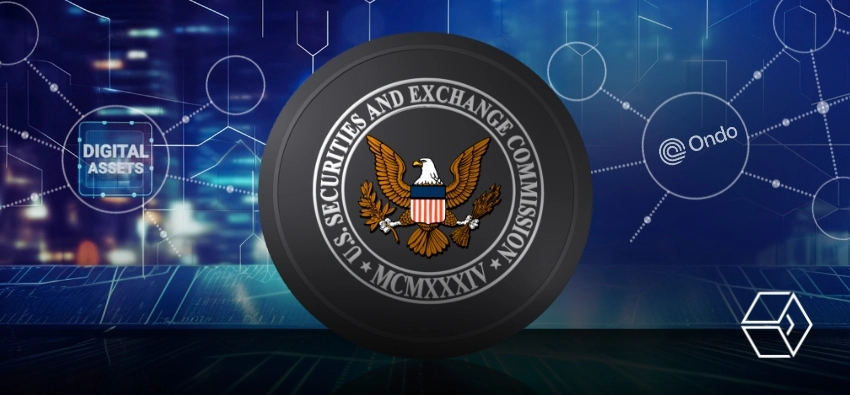
- Ondo urges the SEC to allow all tokenization models to support fair growth in U.S. markets.
- The firm says tokenized Treasuries can operate safely today under existing U.S. rules.
- Analysts project RWAs to exceed $5T by 2030, underscoring the need for a clear U.S. policy.
Ondo Finance has intensified the U.S. debate over digital asset regulation after submitting a detailed “Roadmap for Tokenized Securities” to the Securities and Exchange Commission (SEC). The filing, delivered on December 4, urges regulators to embrace multiple tokenization models rather than forcing a single architecture to dominate the future of blockchain-based securities. The firm argues that unclear frameworks are restricting innovation at a moment when global markets are rapidly moving real-world assets (RWAs) on-chain.
A Call to End the ‘False Debate’ Slowing U.S. Progress
In the report, Ondo Finance told the SEC that U.S. tokenization efforts are being slowed by an unnecessary dispute: whether direct registration, beneficial ownership, or wrapped and linked securities should prevail as the “correct” on-chain structure. According to the firm, this debate misunderstands how traditional markets already work.
All three models operate today in U.S. finance, serving different needs across equity, fixed income, and custodial systems. The Depository Trust Company (DTC), which processes more than $2 quadrillion in annual securities transactions, already supports multiple ownership pathways. Ondo argues that blockchain should mirror this flexibility rather than forcing premature standardization.
The firm highlighted the growing urgency by pointing to global accelerations. BlackRock’s public blockchain tokenized funds and Franklin Templeton’s on-chain U.S. Government Money Fund, now holding more than $380 million, show surging institutional interest, supported by major regulators abroad. Global bodies such as the BIS and IMF have also warned that excluding permissionless systems risks fragmenting markets and hindering adoption.
Four Regulatory Actions Ondo Wants the SEC to Take
The roadmap outlines four specific actions the SEC can implement without overhauling U.S. market infrastructure:
- Support direct and intermediated ownership models: Ondo argues this mirrors existing structures, allowing institutions to tokenize securities without redesigning compliance, custody, or broker-dealer processes.
- Recognize permissioned, permissionless, and hybrid blockchains: This aligns with BIS and MAS findings that public networks offer unmatched liquidity and composability, while permissioned systems support institutional control.
- Modernize transfer-agent rules for tokenization: The SEC already oversees transfer agents, but updated guidance is needed to formally recognize blockchain-based recordkeeping and issuance.
- Enable tokenization of securities held in DTC: Allowing tokens to link directly to existing DTC entitlements would create scalable, compliant pathways for retail and institutional adoption.
Ondo’s recommendations mirror ongoing discussions on Capitol Hill. Congressional committees have held multiple hearings since 2023, arguing for tokenized securities to fit within, rather than replace, current regulatory infrastructure.
Focus on Treasury Tokenization and Retail Access
Notably, a major portion of the filing highlights tokenized U.S. Treasuries, one of the fastest-growing asset categories on public blockchains. Ondo reiterated that these instruments can operate safely under existing securities law when properly structured.
The company urged the SEC to allow retail access to tokenized securities backed by assets already custodized in DTC, a shift that could broaden participation and strengthen market inclusivity.
At present, regulatory ambiguity has confined tokenized Treasuries mainly to accredited investors and overseas jurisdictions. Ondo stated that targeted clarity would support safer market growth while ensuring investor protections remain intact.
Implications for the RWA Tokenization Market
Industry research from Citi and BCG estimates that tokenized real-world assets could exceed $4–5 trillion by 2030. Ondo’s filing suggests that U.S. regulatory decisions made today will determine how much of that market develops domestically. Jurisdictions including Singapore, Hong Kong, and the EU have already established legal frameworks for multiple tokenization models, creating competitive pressure for the U.S. to act.
The firm warns that rigid U.S. rules could push innovation offshore, while supportive guidance, especially around DTC-linked products, could place the U.S. at the center of global digital-asset markets. Ondo frames the moment as an inflection point: one where regulatory leadership can either accelerate responsible innovation or leave the country trailing more agile jurisdictions.
Ondo concluded its submission by offering continued collaboration with the SEC and emphasizing that “all assets are moving on-chain.” The firm asserts that the U.S. is well-positioned to lead, but only if policy recognizes the diversity of models already built into modern finance.