- OKX rebuilds XLayer on OP Stack to boost scale and improve system control.
- OP Stack powers most Ethereum L2 activity and attracts more enterprise users.
- The migration signals rising exchange adoption of shared rollup frameworks.
OKX has moved its XLayer network to the OP Stack, marking a decisive shift in how the exchange intends to run its Layer-2 operations. The change moves XLayer away from Polygon CDK and places it inside an ecosystem that has become a common choice for enterprises needing dependable blockchain infrastructure.
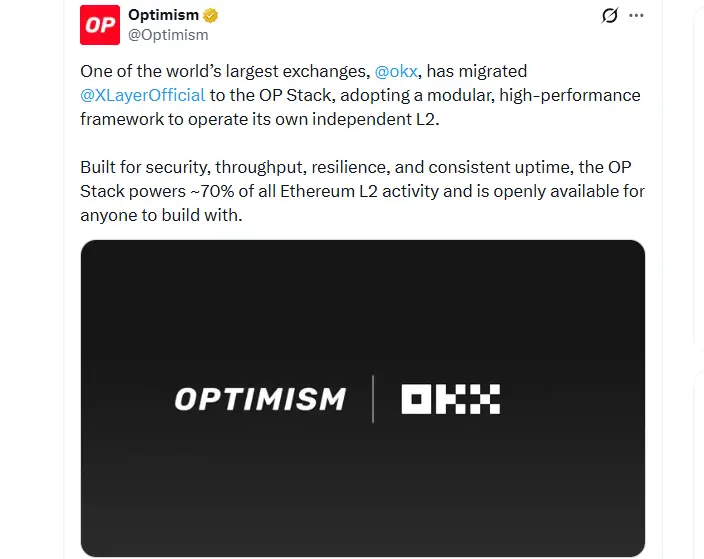
OKX Shifts XLayer to OP Stack (Source: X)
The exchange’s decision lands at a moment when global firms are reassessing how they build and maintain systems that handle large volumes of digital-asset activity.
OP Stack Emerges as the Enterprise Standard
The OP Stack has grown into one of the most widely used Ethereum scaling frameworks. It currently supports most Layer-2 traffic on the network and remains a core part of the broader Optimism ecosystem. Its design allows different operators to run their own chains while drawing from the same pool of tools, improvements, and shared engineering work.
For OKX, the appeal is straightforward: it gains direct control over XLayer’s behavior while avoiding the burden of maintaining a completely isolated system. The need for reliable uptime and predictable performance has pushed many enterprises toward open, production-ready frameworks instead of bespoke solutions.
Studies tracking corporate adoption show that a large share of Fortune 500 companies are exploring blockchain, with long-term projections placing the enterprise market in the hundreds of billions of dollars.
Why the Migration Matters for OKX and Its Users
With XLayer rebuilt on OP Stack, OKX can tune its network more closely to the needs of its platform. The exchange already handles billions in daily trading volume, and the move aims to create smoother handling of deposits, withdrawals, and on-chain movement.
Transactions may settle faster, and fees could drop once the system runs at full stability. The OP Stack is fully compatible with Ethereum’s smart-contract environment. That allows XLayer to support decentralized applications and tools without requiring major redevelopment.
It also places the network inside Optimism’s “Superchain” layout, where multiple L2s interconnect and share communication standards. Kraken recently confirmed that its upcoming L2, Ink, will join the same structure, showing how exchanges are beginning to adopt similar architectures.
A Turning Point in Exchange-Led L2 Adoption
OKX’s migration adds momentum to a trend in which major exchanges operate their own Layer-2 systems instead of relying exclusively on public networks. Modular rollups give these firms the ability to tailor performance and reliability without investing years in internal infrastructure.
This shift places OP-Stack chains in the ring with other scaling models, including zk-rollups and hybrid approaches. Each framework answers different needs around speed, security, and complexity. As more institutions adopt rollup standards, the broader Ethereum ecosystem gains from stronger interoperability and more consistent routing for liquidity.
What stands out in this transition is the way shared engineering work benefits every participant. Improvements pushed by one operator spread across the entire set of chains, reducing fragmentation and shortening development cycles for later adopters.
What to Watch Next
Attention now turns to the features OKX plans to introduce with its upgraded environment. Faster bridging, specialized settlement paths, or new tools for institutional clients may appear as the exchange expands XLayer’s capabilities.
Developers watching the Superchain expect deeper liquidity connections and more uniform tooling as additional chains go live. The broader L2 sector is moving into a phase defined by enterprise participation.
This may accelerate progress in areas such as privacy features, cross-chain communication, and new approaches to mitigating MEV. With OKX’s migration in place, exchanges are signaling that custom L2s are no longer experimental; they are becoming operational foundations for large platforms.