
- NEAR clears 1M TPS in a live sharded test using real code and fully open benchmark data.
- The test used 70 shards on consumer hardware to prove horizontal scaling under heavy load.
- New optimizations across execution, consensus, and storage raised throughput stability.
NEAR Protocol has recorded a new performance landmark after pushing its network past one million transactions per second in its first publicly verifiable sharded benchmark. The figure places NEAR at the top of current throughput demonstrations, offering one of the strongest data points yet for the viability of a fully sharded Layer-1 design.

NEAR Hits 1M TPS in Public Sharded Benchmark Trial (Source: X)
NEAR Protocol: A Test Built to Reflect Real Network Conditions
The benchmark relied on NEAR’s actual core code rather than experimental branches or isolated prototypes. According to the report, engineers spread activity across 70 shards and used traffic distributions that resemble what large networks display under heavy load.
The setup used Google Cloud’s C4D virtual machines, relatively affordable instances powered by the newest generation of AMD EPYC processors. Each machine costs roughly $900 per month, an amount within reach for validators rather than specialized operators. However, to focus purely on throughput, the test excluded contract calls and fed transactions straight into the mempool.
Block gas limits were also removed, and account activity followed Zipf patterns, which tend to emerge naturally when many users interact in parallel. The team reported that the C4D machines delivered a performance jump of around 45 percent compared with the hardware used in earlier internal trials.
Sharding’s Scaling Argument Demonstrated at Full Load
The milestone arrives more than a year after NEAR introduced Nightshade 2.0, a major sharding upgrade that brought stateless validation and reduced the overhead required for block production. On mainnet, these changes allowed the network to expand to nine shards, shorten block times to roughly 600 milliseconds, and reach finality in around 1.2 seconds.
During the benchmark, throughput climbed steadily as shards were added, an expected outcome for a sharded network but one rarely demonstrated at this scale. Most Layer-1 chains still run on monolithic designs, forcing all execution through a single pipeline. However, NEAR’s structure spreads execution, storage, and state across independent shards, giving the chain room to expand capacity without steep increases in cost or validator requirements.
Several technical adjustments contributed to the final result. These included signature-verification improvements, rewrites to trie and database layers, refinements to stateless-witness handling, adjustments to consensus flow, and new tools for analyzing timing inside each block.
These details were shared openly to allow researchers to scrutinize the conditions and replicate the outcome.
Transparency Through Full Public Reproducibility
NEAR published its benchmark scripts, the commit hash used during the run, and a public Grafana dashboard containing the full performance trace. The dashboard shows the network clearing the one-million TPS threshold while maintaining stable block production.
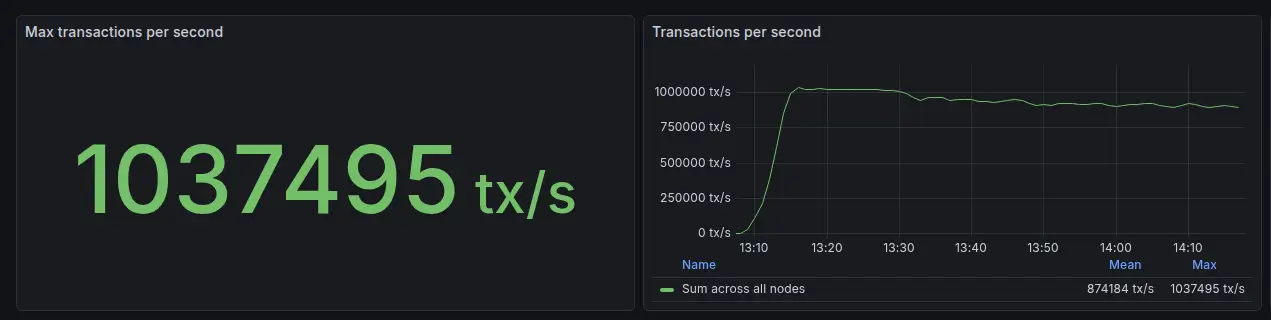
Near Protocol 1 Million TPS (Source: NEAR Protocol)
The team stated that many validators operate on bare-metal servers, which often outperform the cloud machines used for this test, suggesting headroom beyond the recorded number. This emphasis on transparency stands out in a sector where high TPS claims frequently rely on closed systems or test rigs detached from any real deployment.
Broader Context for NEAR’s Ecosystem and Market Position
When compared with other high-throughput networks, NEAR now sits at the top of theoretical benchmarks. Chainspect data published on December 8 places Sonic, ICP, and Aptos next in line at roughly 400,000 TPS, 210,000 TPS, and 160,000 TPS. Live throughput on major chains remains far lower, with Solana leading real-time activity at roughly 1,238 TPS during the same period.
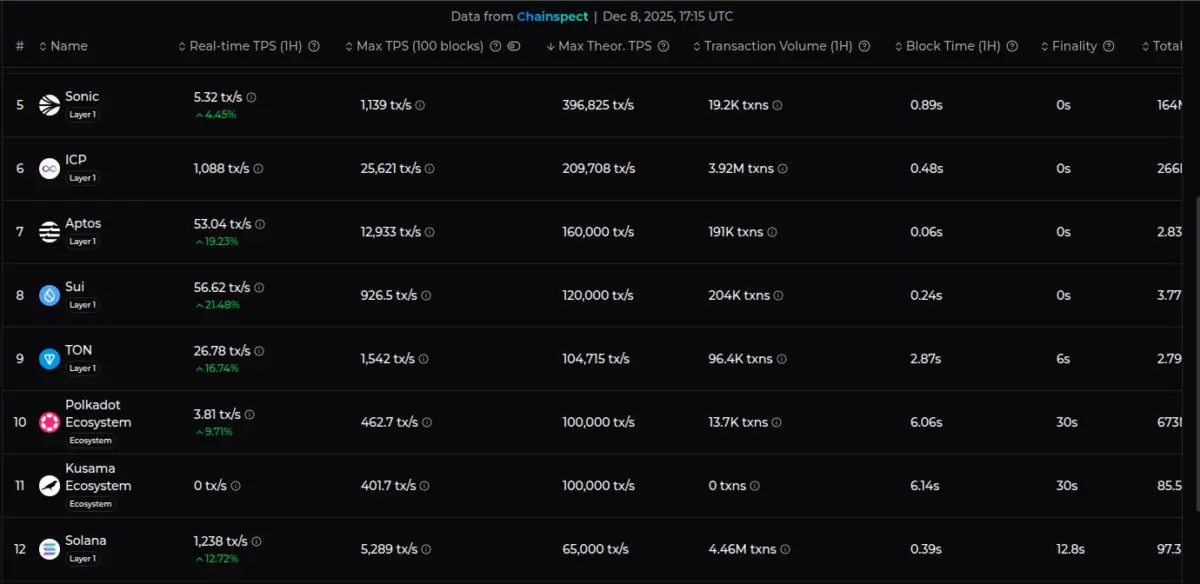
Fastest Blockchains by Transactions Per Second (TPS) (Source: Chainspect)
The timing aligns with a series of new ecosystem developments. TravAI, built with ADI Chain, allows on-chain agents to complete full travel-booking flows. NEAR AI Cloud and Private Chat gained early integrations, including adoption by Brave Browser. Meanwhile, NEAR Intents passed $7 billion in all-time chain-abstracted swap volume.
The team’s next areas of focus include dynamic resharding, sharded smart-contract execution, deeper execution tuning, and the separation of consensus and execution layers to reduce latency. Most of the code used for the benchmark is already live on mainnet, with the remainder slated for release in version 2.12.
Overall, the one-million-TPS result signals that NEAR’s architecture is capable of supporting high-load decentralized systems, cross-chain routing, and the emerging wave of AI-driven on-chain activity—without relying on specialized hardware or centralized sequencing layers.