

- Multiliquid brings real-time swaps between tokenized RWAs and major stablecoins.
- Institutions gain instant liquidity as legacy redemption delays fall away.
- GENIUS Act shifts create demand for compliant yield and 24/7 settlement rails.
Multiliquid has transitioned from development to full production, providing institutions with a settlement rail for tokenized real-world assets that behaves far more closely to the always-on nature of digital markets. Uniform Labs, the team behind the protocol and staffed by former executives from Standard Chartered, UniCredit, and digital banking, framed the launch as a necessary correction for a tokenized market that has grown quickly yet remains hampered by sluggish liquidity. The RWA sector has passed the $35 billion mark, but its infrastructure still resembles an older financial era.
A Purpose-Built Liquidity Layer for a $35B Tokenized Market
The protocol went live on Ethereum Mainnet after months of audits and controlled testing. Its purpose is straightforward: convert the slow churn of redemptions and off-chain windows into a single atomic transaction that can settle at any hour.
Per reports, Multiliquid supports stablecoins such as USDC and USDT at launch, pairing them with a lineup of tokenized Treasury assets and institutional-grade money market funds. However, Uniform Labs emphasized that Multiliquid is not another yield product.
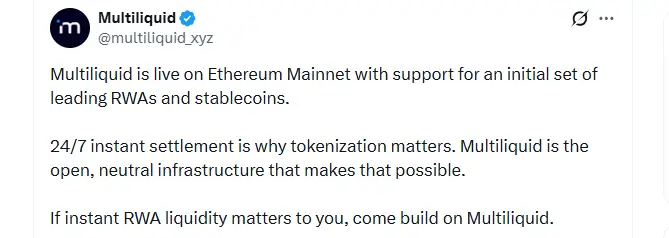
Multiliquid Goes Live, Settling Tokenized RWAs on Ethereum (Source: X)
Instead, it is a settlement lane designed to function without favoring any specific fund or issuer. Tokenized private credit, private equity, real estate, and other RWAs are also supported. Notably, a Solana deployment is planned, but no timeline was attached to the announcement.
The live system also allows institutions to rotate between regulated funds and stablecoins without the usual wait. That design is central to its pitch: liquidity becomes a constant, not a scheduled event.
Instant RWA–Stablecoin Settlement and Institutional Workflows
For treasurers and trading desks that operate on thin margins and faster clocks, redemption delays have been a recurring frustration. Even prominent tokenized funds, BlackRock’s BUIDL among them, still depend on processes rooted in legacy settlement cycles. On-chain wrappers have improved transparency but have not erased friction.
Nonetheless, Multiliquid attempts to narrow that gap. According to reports, institutions can run automated stablecoin sweeps, handle instantaneous RWA redemptions, conduct on-chain repos, or rebalance collateral for platforms seeking yield on idle balances.
Liquidity, in this setup, is not tied to daily cutoffs or issuer windows. It is instead something users can reach whenever market stress or internal workflow demands it. Uniform Labs described the protocol as open and neutral, avoiding any positioning as a counterparty.
It acts more like infrastructure, the type of plumbing that sits beneath financial products and disappears into the background once adopted.
A Regulatory Turning Point After the GENIUS Act Reshapes Stablecoins
The timing of the launch underscores broader shifts in U.S. regulatory policy. The GENIUS Act, now in force, bars stablecoin issuers from offering direct yield. The move effectively separated the payment function of stablecoins from their role in income-producing strategies.
As a result, banking trade groups raised concerns that the rules, if misapplied, could weaken deposit bases or create uncertain channels for retail flows. With hundreds of billions of dollars now locked into non-yielding stablecoins, institutions have been searching for a compliant method to link liquid payment assets with regulated yield sources.
Multiliquid was built to sit precisely at that junction. The yield remains with tokenized money market funds and other regulated RWAs, while stablecoins remain payment instruments. The protocol simply connects the two without crossing regulatory boundaries.
Addressing Structural Illiquidity in Tokenization
Despite the enthusiasm surrounding tokenized assets, the market’s structural weakness has been persistent. An IOSCO report pointed out this year that tokenization often reintroduces legacy limitations because many products still depend on off-chain settlement.
Similarly, the Bank for International Settlements echoed the concern, warning that liquidity mismatches could intensify stress if on-chain expectations collide with traditional fund mechanics.
By offering a settlement path that behaves like a digital market rather than an imitation of an off-chain cycle, Multiliquid aims to remove one of the core barriers to wider institutional adoption. The team maintains that access to liquidity “anytime” is not a feature but a requirement for tokenization to meet its own narrative.