
- Laser Digital applied for a US trust bank charter to support regulated spot crypto trading
- The OCC charter would let Laser Digital operate nationwide without separate state licenses
- The move shows crypto firms seeking clarity as US legislation remains unresolved
Nomura-backed Laser Digital has moved to anchor its U.S. ambitions inside the federal banking system, filing for a national trust charter as it prepares to expand spot crypto trading. The application, first reported by the Financial Times, underscores a broader recalibration among digital-asset firms as Washington’s regulatory posture shows signs of easing.
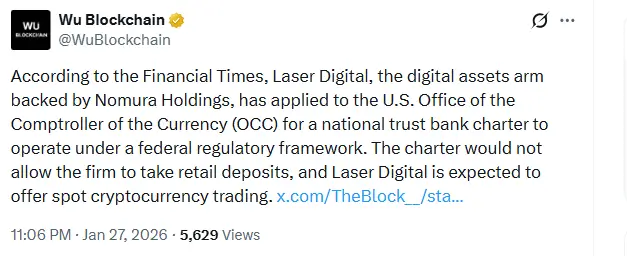
Nomura’s Laser Digital Seeks US Bank Charter for Crypto Push (Source: X)
People familiar with the filing said the application was submitted to the Office of the Comptroller of the Currency, which oversees national banks. The charter would allow nationwide operation without the need for separate state custody licenses. The firm does not plan to accept customer deposits, according to the report, instead focusing on trading and related market services under a federal framework.
A Federal Route for Crypto Operations
The OCC’s national trust charter has become a practical route for crypto firms seeking scale without reinventing themselves as full-service banks. Trust banks can provide custody, settlement, and trading infrastructure while remaining outside the deposit-taking system that defines traditional banking.
Approval, however, is measured. The OCC typically grants conditional clearance first, followed by final authorization once capital, governance, and compliance standards are met. That process can stretch close to a year. For regulators, the extended timeline provides room to pressure-test controls.
For applicants, it offers a clear, if demanding, roadmap. The institutional pedigree also matters. Laser Digital sits within Nomura Holdings, Japan’s largest investment bank by assets. According to reports, Nomura reported roughly $430 billion in assets under management in its most recent disclosures.
That scale does not guarantee approval, but it places the application on firmer footing at a moment when regulators are scrutinizing balance sheets and risk culture across the sector.
Building on a Global Regulatory Footprint
Founded in 2022, Laser Digital is headquartered in Switzerland and has accumulated licenses in multiple jurisdictions, including Switzerland and Dubai. Those approvals allowed it to build trading and asset-management operations in established regulatory centers while the U.S. framework remained unsettled.
However, the OCC filing signals a shift. As policy clarity inches forward, firms are increasingly bringing operations onshore. The trust charter offers a single federal rulebook, replacing the patchwork of state regimes that have long complicated U.S. crypto expansion.
Other firms have already moved down the same path. The OCC has issued conditional approvals to Circle, Ripple, BitGo, Fidelity Digital Assets, and Paxos. Earlier this month, World Liberty Financial also said it is pursuing a charter to support the issuance and redemption of its USD1 stablecoin under federal oversight.
Industry Pushback and Policy Tensions
Regardless, the charter wave doesn’t go without resistance. The American Bankers Association warned last July that granting bank licenses to digital-asset firms raises policy and process concerns. Industry groups argue that trust charters could blur long-standing safeguards that separate banking from higher-risk market activity.
Yet, those tensions play out alongside unresolved legislation. The Senate Banking Committee, for instance, recently delayed markup of the CLARITY Act after Coinbase withdrew support, citing limits on tokenized equities, expanded DeFi surveillance, and the removal of stablecoin reward programs.
Traditional banks have also cautioned that yield-bearing stablecoins could pull deposits from the banking system and constrain lending. Nonetheless, for Laser Digital, the charter application reflects a pragmatic response to that uncertainty. Rather than waiting on Congress, the firm is seeking clarity through supervision.
If approved, the trust charter would place its U.S. spot trading plans inside a defined regulatory perimeter, marking another step in crypto’s steady migration from the margins toward the core of the financial system.