- Hong Kong sets rules that let licensed firms offer regulated crypto perpetual trades
- Brokers gain approval to issue credit backed by Bitcoin and Ether for strong clients
- New steps fit Hong Kong’s push to build a controlled and trusted digital asset hub
Hong Kong’s market watchdog is preparing to widen the scope of its digital-asset regime, setting the stage for regulated platforms to offer perpetual crypto contracts for the first time. The shift, outlined by Securities and Futures Commission CEO Julia Leung during a keynote session at Consensus Hong Kong, adds fresh momentum to the city’s digital-asset roadmap and signals a firmer push toward institutional participation.
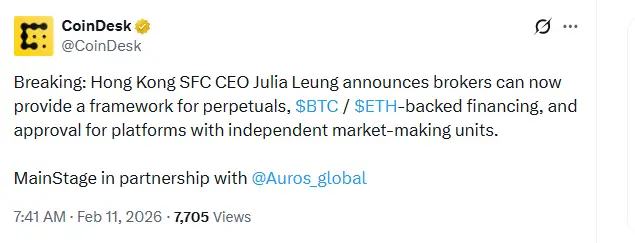
Hong Kong SFC Backs Crypto Perpetuals and BTC-Backed Loans (Source: X)
Leung also confirmed that licensed brokers will be allowed to provide financing backed by bitcoin and ether, a move that folds the two largest crypto assets into the city’s collateral framework. While the regulator kept the finer details under wraps, the direction was clear: broaden access, but only inside a controlled perimeter.
A High-Level Framework for Perpetuals
The SFC plans to release a framework that would let licensed platforms list perpetual futures, a dominant product in global crypto markets but still largely fenced off in many regulated jurisdictions. The decision stops well short of opening the door to retail users.
For now, however, institutional investors will be the only audience. Risk controls will be central. At the Consensus Hong Kong session, Leung stressed that firms must prove they can handle leverage, pricing integrity, and volatility before any approval is granted.
The SFC wants operators to demonstrate that they can run these markets without compromising fairness or market stability and without repeating the failures that have haunted offshore venues over the past several years. The announcement follows the SFC’s earlier consultation conclusions on custody and asset segregation. These set the groundwork for the broader regime now taking shape.
Bitcoin and Ether Move Into Collateral Rules
The second plank of the policy shift concerns financing. Per reports, Hong Kong brokers will soon be able to extend credit to eligible clients using traditional securities and digital assets as collateral. Nevertheless, only Bitcoin and Ether qualify at the start.
Leung noted that volatility remains a major constraint, so the new channel will be limited to clients with strong credit profiles. The intention is to move gradually. By incorporating only the most liquid crypto assets, the regulator hopes to test the structure without introducing unnecessary risk into the system.
For institutional participants, this opens a fresh liquidity avenue. It also signals that digital assets are being folded more deliberately into the city’s financial architecture, not as a parallel system, but as an extension of existing market practice.
Independent Market-Making Units
In addition, Leung confirmed that the SFC will allow trading platforms to run independent market-making operations. These units, she acknowledged, will need to sit apart from other business lines to reduce conflicts of interest and maintain transparent pricing.
Market-making is essential for liquidity, particularly in instruments like perpetual futures. By setting clearer boundaries and operational expectations, Hong Kong aims to boost depth in licensed venues while guarding against abusive practices. Further guidance is expected soon as the regulator finalizes the operational and supervisory conditions.
A Regional Outlier With a Structured Plan
Meanwhile, the global regulatory picture remains fractured. The United States splits oversight between agencies, and Europe’s MiCA framework prioritizes spot markets over leveraged products. Against that patchwork, Hong Kong’s measured push into supervised perpetuals stands out.
The city has already launched spot Bitcoin and Ether ETFs and has been vocal about integrating Web3 development into its financial strategy. At the same time, it continues to pursue unlicensed operators, maintaining a dual-track approach that rewards compliance and punishes evasion.
With perpetuals, collateral financing, and market-making rules now advancing, Hong Kong is laying out a more coherent digital-asset structure. The direction suggests neither retreat nor frenzy, but a steady attempt to modernize its markets while keeping close guard on the risks that come with them.