
- LUIXX shifts to short T-bills to meet new federal stablecoin reserve standards
- DIGXX adds a digital share class to enable blockchain-based fund ownership
- Institutions accelerate use of tokenized cash as major firms upgrade fund rails
Franklin Templeton has taken another step toward blending traditional cash instruments with emerging blockchain rails, updating two of its institutional money market funds to operate more cleanly inside regulated stablecoin and tokenized finance frameworks. The shift does not reinvent the products themselves, but it does move them closer to the way large institutions increasingly want to use short-term dollar assets.
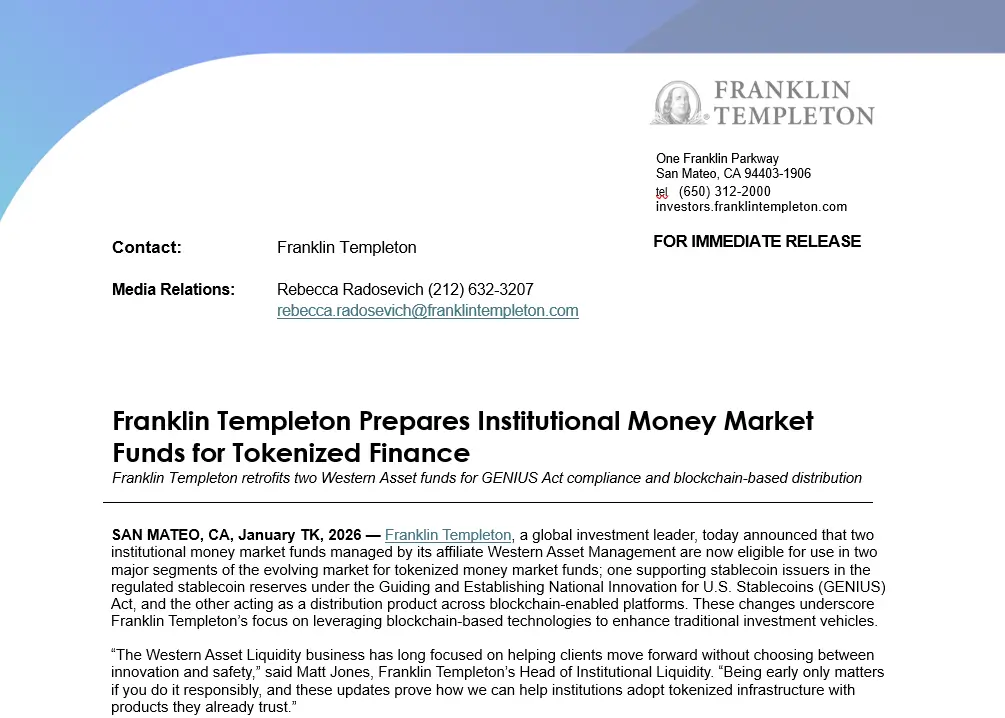
Franklin Templeton Prepares Money Market Fund Tokenization (Source: Franklin Templeton)
According to reports, the funds are managed by Western Asset Management, a Franklin Templeton affiliate known for its conservative fixed-income mandates. This time, the adjustments center on eligibility, settlement mechanics, and the ability to slot directly into digital finance systems, areas that have grown more important as on-chain settlement gains traction across major financial firms.
Funds Shift to Meet Stablecoin Reserve Standards
One of the funds, the Western Asset Institutional Treasury Obligations Fund (LUIXX), was tightened to fit the rules laid out in the GENIUS Act, the U.S. law passed last July that defines what can back regulated stablecoins. The language in that statute puts a heavy emphasis on short-dated Treasuries, which meant LUIXX needed a narrower set of holdings.
Per the official reports, it now holds only Treasury bills with maturities of 93 days or less. This puts the vehicle in the category that stablecoin issuers can use for reserve backing, a role that is becoming increasingly competitive. Still, the change does not alter the fund’s risk profile so much as sharpen it to meet the federal criteria. For institutional investors already using Treasury-heavy cash products, the shift simply opens another avenue of deployment.
Digital Share Class Broadens Access
The second vehicle, the Western Asset Institutional Treasury Reserves Fund (DIGXX), added a digital institutional share class, an operational change rather than an investment one. The new class lets approved intermediaries record ownership and transfer shares over blockchain rails while the underlying fund remains a standard money market product.
The goal is to smooth operational frictions, not to push investors into a crypto-native environment. Faster settlement cycles, continuous transfer windows, and easier integration with digital collateral systems are the real draws for institutions managing intraday liquidity. Franklin Templeton framed it as a way for clients to use tools they already trust in settings that increasingly demand real-time movement of capital.
Roger Bayston, who oversees digital asset strategy at the firm, said the priority is interoperability. His point was that traditional funds are already moving toward on-chain environments, and the firm wants to meet that shift with familiar products rather than experimental ones.
Part of a Broader Institutional Trend
The updates fit into a larger pattern that has unfolded over the past two years. In 2025, Franklin Templeton partnered with DBS Group and Ripple to bring tokenized money market products and a stablecoin-linked liquidity model to accredited and institutional investors in Asia.
The joint effort included plans to list a tokenized fund, sgBENJI, alongside Ripple’s RLUSD stablecoin on the DBS Digital Exchange. It marked one of the earliest attempts to link regulated cash vehicles directly with a digital-only trading venue.
The firm also widened its global footprint in November 2025 by rolling out the Franklin OnChain U.S. Government Money Fund in Luxembourg for distribution to institutional and professional investors in Hong Kong. That vehicle used blockchain record-keeping to trim processing steps in the investment workflow.
Franklin Templeton Competitors Move in the Same Direction
Other asset managers are making similar adjustments. JPMorgan, for instance, launched a tokenized money-market fund on Ethereum last month, and BlackRock disclosed plans in late 2025 to modify a Treasury fund for potential use as a reserve asset for U.S. stablecoin issuers. BlackRock already manages a dedicated government money market fund tied to USDC reserves.
All told, the updates underscore how a growing share of traditional finance now views regulated cash funds as critical infrastructure for tokenized markets, an area Franklin Templeton expects to expand as on-chain settlement continues to scale.