- SEC grants DTCC narrow relief to test tokenized entitlements on approved blockchains.
- Pilot applies to Russell 1000 stocks, major ETFs, and key U.S. Treasury instruments.
- Success may ease settlement friction and support broader adoption across markets.
The Depository Trust & Clearing Corporation is preparing to roll out a regulated tokenization service after securing a rare nod from the Securities and Exchange Commission. The green light arrived in the form of a No-Action Letter, giving DTCC clearance to begin limited operations in the second half of 2026. It is a cautious but meaningful move, reflecting how far U.S. regulators have come in letting blockchain technology into the core of financial plumbing.
SEC Authorizes a Controlled Three-Year Pilot
The relief applies to The Depository Trust Company, DTCC’s central securities depository. Instead of a sweeping authorization, the SEC opted for a narrow pilot that runs for three years. The agency’s Division of Trading and Markets signaled it would not pursue enforcement if the service operates as described, an approach that stops short of rewriting rules but still allows genuine experimentation inside one of the world’s most important settlement networks.
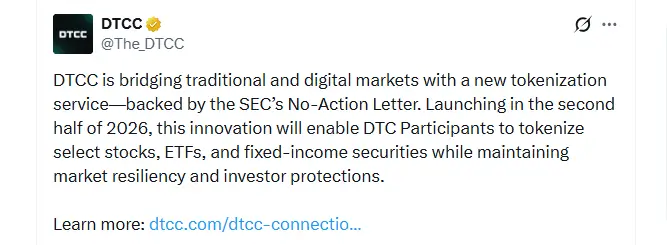
DTCC Prepares SEC-Backed Tokenization Platform for 2026 (Source: X)
The pilot gives DTC participants a choice: continue using the traditional ledger, or elect to record security entitlements on pre-approved blockchain networks. However, only a specific slice of the market qualifies at the start. Eligible instruments include securities from the Russell 1000 index, several high-volume ETFs, and a range of U.S. Treasury products.
These tokenized entitlements will carry the same legal protections and ownership rights as the conventional entries already residing inside DTC systems. Although DTCC faces recurring oversight under the deal.
It must file quarterly notices, maintain strict access controls for participating networks, and demonstrate that its operational safeguards can handle a hybrid setup. None of this is flashy, but the regulated framework is exactly what many institutions have been waiting for.
DTCC: Tokenization With Full Investor Protections
The design may matter even more than the approval itself. Instead of creating a new category of digital instruments, the service preserves existing entitlements and simply mirrors them on a distributed infrastructure. That alignment removes the ambiguity that has long slowed institutional adoption.
However, rights and investor protections do not shift. Only the underlying recordkeeping mechanism changes. Market analysts have pointed out that such a structure could ease the long-running bottlenecks in reconciliation and post-trade processing.
Those frictions are costly and mostly invisible to the public, yet they shape the speed and efficiency of everyday markets. Nevertheless, digitizing entitlements does not solve every issue, but it does give institutions a less cumbersome way to track, transfer, and verify positions.
Industry Frameworks Address Blockchain Risk Management Gaps
The SEC’s decision arrives as the financial industry is working to sharpen its understanding of blockchain-specific risks. The Global Blockchain Business Council and Oliver Wyman recently outlined a framework aimed at helping institutions manage non-financial risks tied to public blockchains.
Their work brings together banks, market infrastructures, development institutions, and protocol teams that have grappled with the operational realities of decentralization. Their findings are straightforward. Public blockchains introduce new governance dynamics and require different approaches to resilience.
Yet, institutions may need to run or rely on third-party nodes, contribute to open-source maintenance, and stress-test systems in ways that are uncommon in traditional markets. Security tokens offer efficiencies but demand clearer interoperability rules and updated custody models.
In short, the industry needs tooling that matches the pace of new infrastructure without losing its grounding in established risk practices.
A Narrow Scope With Potential for Broader Transformation
The SEC has deliberately limited the scope of this first phase. Highly liquid equities, widely traded ETFs, and U.S. government securities form the boundary lines, which help contain operational risk as the system integrates with existing infrastructure. But even within this narrow frame, the potential implications are large.
If the pilot proves stable, it could influence how a broader set of assets settle and move across markets. For now, though, DTCC’s controlled rollout marks the most substantive step the United States has taken toward embedding tokenization directly inside its financial backbone.