
- Coinbase launches stock trading and prediction markets inside its unified retail platform.
- Kalshi partnership brings regulated event contracts to the exchange’s expanding ecosystem.
- Custom stablecoins and payments APIs anchor the firm’s broader push into financial services.
Coinbase has begun the most sweeping expansion in its history, moving beyond cryptocurrency trading to offer U.S. equities, prediction markets, and custom stablecoin infrastructure as part of an ambitious plan to build what executives call an “everything exchange.”
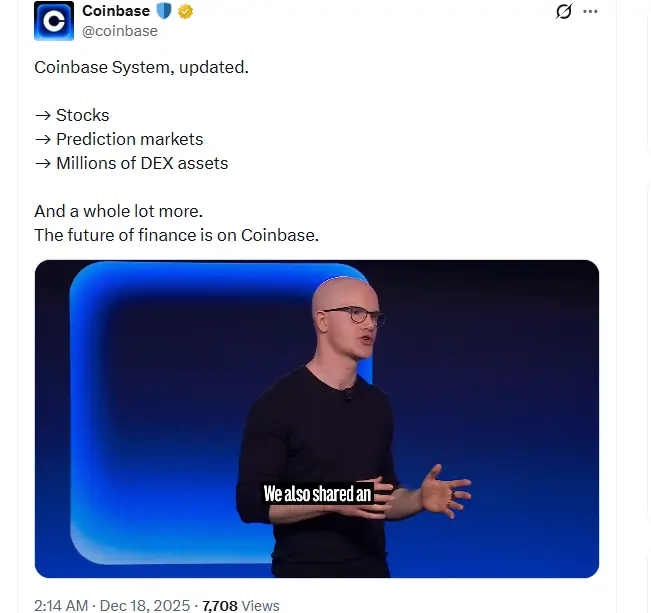
Coinbase Revamps Platform to Build the ‘Everything Exchange’ (Source: X)
The update follows a social post from the company highlighting a unified system capable of hosting stocks, event contracts, and millions of decentralized finance assets in one interface.
Stocks Enter the Coinbase App
The largest U.S.-listed digital-asset platform officially rolled out stock trading today, allowing customers to buy, sell, and manage equities and exchange-traded funds directly within its retail app. The integration places conventional financial instruments beside crypto portfolios and supports settlement in both U.S. dollars and USDC.
According to Max Branzburg, the company’s head of consumer and business products, hundreds of top-ranked stocks will be available at launch, with thousands of equities and ETFs scheduled to follow. The offering includes zero-commission trading and near-continuous market access, running 24 hours a day, five days a week. Early in 2026, the platform plans to extend access to perpetual futures tied to non-U.S. equities for customers outside the United States.

Stock Trading on Coinbase (Source: Coinbase)
The expansion is powered by Coinbase Tokenize, a new institutional platform designed to support the tokenization of real-world assets and provide future retail access to tokenized stocks. Branzburg said the technical and regulatory mechanics for these assets are still being finalized but emphasized that the firm’s compliance standards position it to lead as rules evolve.
Prediction Markets Arrive Through a Regulated Partner
A key addition to the revamped platform is a regulated prediction-market product created in partnership with Kalshi, a U.S. Commodity Futures Trading Commission-supervised event-contracts marketplace.
Through the integration, users can trade contracts tied to outcomes such as elections, economic figures, and sporting events in the same interface used for equities and digital assets. Industry data shows a jump in activity across prediction markets, with monthly volumes climbing from under $100 million in early 2024 to more than $13 billion by late 2025.

Prediction Markets on Coinbase (Source: Coinbase)
The surge has attracted major fintech entrants, including Robinhood, Crypto.com, and Gemini, and has intensified policy scrutiny. Working with a CFTC-regulated partner allows the exchange to operate within established financial-markets oversight rather than gambling frameworks.
Stablecoin Infrastructure Broadens Through Customizable Models
The company also announced a new product called Custom Stablecoins, enabling firms to issue their own branded digital dollars collateralized by USDC and other regulated USD-backed assets. Early participants exploring the model include Flipcash, Solflare, and R2.
The initiative places the platform into more direct competition with established stablecoin issuers such as Paxos and Anchorage. At the same time, the exchange is expanding its developer suite with APIs that support custody, payments, trading, and stablecoins. Companies including Deel, Papaya, Routable, and dLocal are already using its payment infrastructure.
In parallel, the firm highlighted x402, an emerging payments standard that attaches stablecoin transfers to web requests. The protocol has processed more than $200 million in annualized volume over the past 30 days and is now being advanced through a new foundation involving Cloudflare and additional partners.
“Finally, we recently launched x402, an open internet standard that makes it easy to attach a stablecoin payment to any web request – it enables AI agents to pay for content and execute transactions using stablecoins,” the Coinbase blog wrote.
Industry Positioning and Market Response
The broadening of the platform immediately prompted comparisons with competitors that combine multiple asset classes. Robinhood, for instance, which already offers equity and crypto trading, has expanded its event-contract products and has invested in AI-driven analytics to retain users.
Market reaction to the announcement was measured. Shares of Coinbase traded unevenly during the session, dipping earlier in the day before inching higher after hours as investors assessed the scale of the shift.
Regulators are also expected to track the expanded business closely, especially as event-contract markets grow and as tokenized equities move toward mainstream adoption. For now, working with Kalshi and pursuing an OCC National Trust charter provides defined regulatory paths for the company’s next stages.