

- CFTC unifies U.S. person rules and ends years of fragmented cross-border interpretations.
- New clarity cuts compliance strain and helps global dealers restore structured market activity.
- Reform aligns swaps oversight with SEC goals and supports digital-asset collateral adoption.
The Commodity Futures Trading Commission has taken a major step toward resolving long-standing confusion in the cross-border swaps market. On December 9, 2025, the agency issued a no-action letter that unifies the meaning of “U.S. person,” a term that has shaped compliance decisions for global firms since the early years of the Dodd-Frank era. Acting Chairman Caroline D. Pham described the measure as a necessary fix to restore consistency in an area that has lacked stability for nearly 15 years.
A Unified Definition to End 15 Years of Confusion
The relief brings together three separate interpretations that previously guided how market participants determined whether a counterparty fell under U.S. jurisdiction. These distinctions, while intended to offer clarity, often produced the opposite effect.
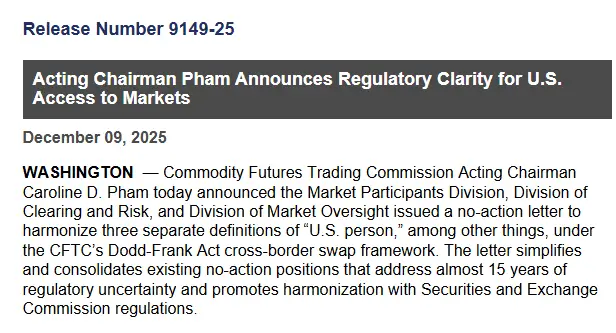
CFTC Issues No-Action Letter Clarifying U.S. Person Definition (Source: CFTC)
On most occasions, firms operating across borders regularly faced conflicting directives from different CFTC divisions, which led many to adopt conservative internal policies or over-register entities to avoid enforcement surprises. However, under the new approach, firms may rely on a single, harmonized definition without fear that older staff letters or informal guidance will generate conflicts.
For many participants, the clarification provides a practical, workable baseline after more than a decade of uncertainty. The agency also emphasized that its action aligns its framework more closely with the Securities and Exchange Commission, reducing a regulatory gap that had complicated compliance for institutions supervised by both regulators.
Modernization Efforts Extend Beyond Swaps
The no-action letter is one piece of a wider effort to update outdated requirements and streamline market operations. Over recent months, the CFTC has adopted several measures that reshape collateral management, digital-asset treatment, and internal oversight.
In November, the agency issued an interpretation allowing futures commission merchants to use customer-owned securities as foreign collateral under Part 30. This decision freed an estimated US$22 billion that had been effectively idle.
Soon after, the CFTC launched a pilot program permitting certain tokenized assets to be posted as collateral under defined safeguards. The pilot covers stablecoins and major cryptocurrencies and is designed to test how digital assets function within traditional derivatives frameworks.
The agency also carried out an internal reorganization that redistributed enforcement priorities, simplified compliance processes, and reduced reliance on old interpretive paths that added cost without improving oversight.
At the 2025 SIFMA Annual Meeting, Pham said her goal is to modernize the rulebook, strengthen coordination with the SEC on market structure, and support responsible innovation without weakening market integrity.
How the Change Could Reshape Global Markets
With a single definition governing cross-border activity, firms may begin updating internal classifications, reviewing affiliate relationships, and restoring services that were previously scaled back. Market analysts expect that some international dealers, having avoided U.S. exposure due to unclear jurisdictional triggers, may revisit the possibility of returning flow to U.S. markets.
A clearer framework also reduces operational friction for non-U.S. entities interacting with U.S. clients. The new standard could also support deeper alignment between the CFTC and the SEC. A shared understanding of counterparty classification removes a major obstacle that had complicated joint oversight across different products and venues.
As a result, the supervisory application will determine how well the new approach holds. The guidance reduces uncertainty, but examination teams will need to apply the standard consistently for its benefits to be fully realized.
Significance for Digital-Asset and Derivatives Firms
The clarification arrives at a moment when digital-asset firms are seeking more predictable regulatory treatment. Many of them operate across borders and have faced the same jurisdictional questions that traditional derivatives dealers have managed for years.
With the CFTC now offering a clearer rule set, exchanges, stablecoin issuers, and dealers may encounter fewer structural barriers when engaging with U.S. clients or intermediaries. Taken together, the recent reforms suggest an agency reshaping its posture toward modern markets.
By removing a major source of regulatory friction, the CFTC has created space for improved liquidity, stronger market participation, and more confident integration of tokenized collateral into mainstream clearing systems. The clarification may also strengthen the United States’ position in the global derivatives landscape as firms adjust to a more coherent cross-border framework.