

- Quantum timelines are overstated, pushing teams toward risky early migrations.
- Encryption needs fast upgrades, but blockchain signatures follow a slower risk cycle.
- Implementation flaws pose more serious near-term threats than any quantum hardware.
a16z has issued a detailed warning that much of the public conversation about quantum computing and its threat to blockchains is being shaped by misplaced urgency. The firm argues that timelines toward a machine capable of breaking modern cryptographic systems are often exaggerated, creating pressure to adopt new protections before they are ready and potentially exposing systems to new weaknesses long before quantum hardware becomes disruptive.
a16z: Misjudged Timelines Are Driving False Alarms
The firm states that a cryptographically relevant quantum computer remains far beyond current capabilities. Although several research groups showcase steady progress in trapped-ion, neutral-atom, and superconducting systems, none demonstrate the scale or fidelity required for Shor’s algorithm to threaten RSA-2048 or secp256k1.
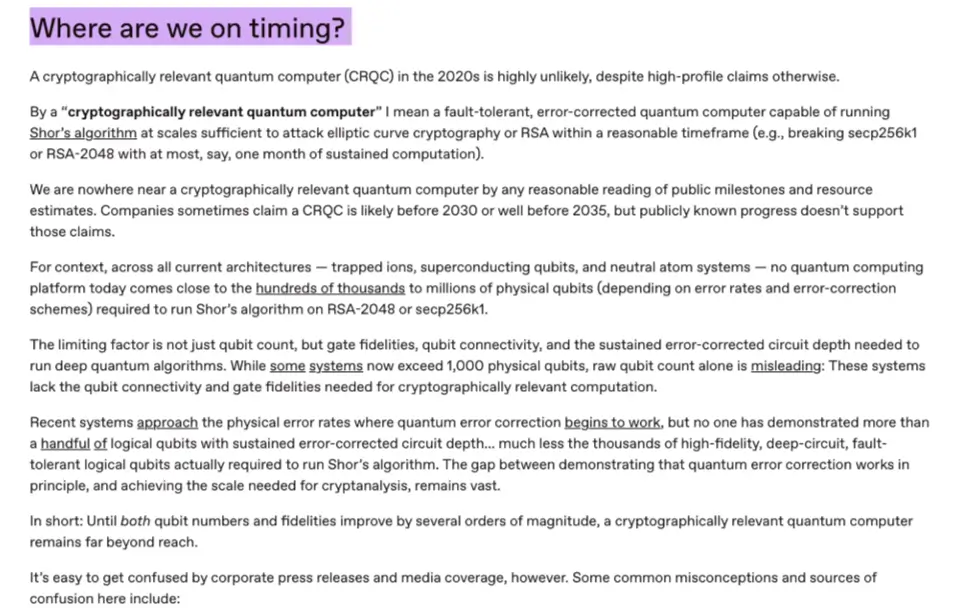
a16z Sounds Alarm on Quantum Risks for Blockchains (Source: X)
Some announcements highlight large physical qubit counts or “quantum advantage” over classical machines, but these milestones often involve narrow, contrived tasks that do not reflect real cryptanalytic potential. Others describe “logical qubits” built from only a handful of physical qubits, even though error-corrected logical qubits for cryptanalysis require hundreds or thousands of stable physical qubits each.
Even optimistic academic voices who mention the possibility of near-term fault-tolerant demonstrations clarify that such experiments may involve factoring trivial numbers like 15, symbolic milestones, rather than evidence of a system capable of breaking modern public-key cryptography. a16z concludes that any forecast suggesting a functional cryptanalysis-grade machine before 2030 has no grounding in publicly verifiable data.
Encryption Needs Swift Action, but Signatures Follow a Different Clock
The firm draws a sharp distinction between encryption, which hides information, and signature systems, which authenticate messages. Encryption faces an immediate threat from “harvest-now, decrypt-later” activity, in which state-level actors store sensitive data for future decryption.
Because encrypted material remains valuable for decades, many reliance points across the internet have already moved to hybrid post-quantum schemes. These approaches combine new mathematics with existing methods to guard against both quantum and classical weaknesses.
Signatures, however, do not face this retroactive exposure. A signature created before the arrival of a quantum machine cannot be forged after the fact, which removes the urgency for abrupt migration. For blockchains like Bitcoin and Ethereum, this distinction is critical: most activity depends on signature verification, not confidentiality.
However, the real quantum threat arises only when a machine is capable of extracting private keys from public ones. Privacy-oriented blockchains sit in a separate category. Their encrypted transaction details could be exposed retroactively, making their migration timeline far shorter.
Why Blockchains Should Avoid Rushing Migration
a16z cautions that pushing ahead with immature post-quantum signature systems carries significant risk. Many promising lattice-based schemes introduce bulky signatures, intricate arithmetic, and demanding implementation requirements that can fail under side-channel or fault-injection attacks.
Several once-high-profile contenders in the post-quantum race were broken by researchers using ordinary computers, not quantum ones, demonstrating how delicate these systems can be. Blockchains also depend on signature aggregation to maintain throughput. Efficient post-quantum aggregation is still in early research, meaning a hasty migration could trap networks with heavy, costly, and brittle systems that later need to be replaced.
Bitcoin faces a special challenge. Early pay-to-public-key outputs and reused addresses expose millions of coins to future attacks once a quantum machine appears. Since Bitcoin changes slowly and requires broad consensus for upgrades, a16z argues that planning must begin early, not because quantum threats are imminent but because the social and technical process will take many years.
Implementation Flaws Pose the Real Near-Term Danger
Across both blockchain systems and broader cryptographic tools, the most immediate risk comes from software bugs, faulty implementations, and side-channel failures. This is especially true for zero-knowledge systems and post-quantum algorithms, which involve complex logic and long chains of sensitive intermediate values. According to a16z, these weaknesses far outweigh any practical quantum threat in the coming years.
The firm outlines several recommendations: deploy hybrid encryption where long-term confidentiality matters, adopt hash-based signatures in size-tolerant environments, plan blockchain migration paths early, transition privacy chains sooner, invest heavily in implementation security, support quantum research at the national level, and treat quantum-related announcements with sober scrutiny.
a16z’s core message is that quantum threats deserve attention, but action must match reality rather than hype. Far more damage can arise from flawed migrations and overlooked software weaknesses than from quantum computers that remain distant on the horizon.